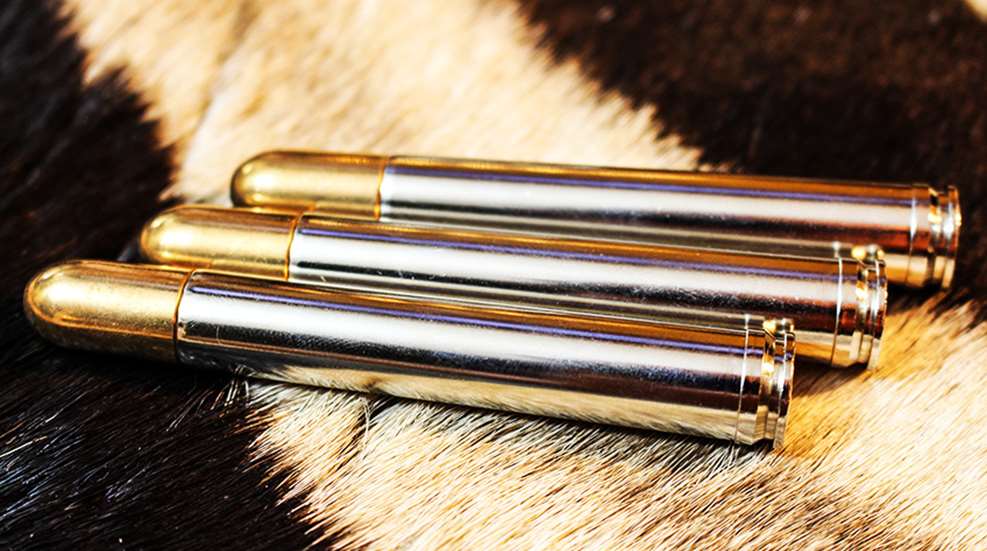
John Rigby & Company’s .450 3¼-inch Nitro Express set the bar for dangerous-game cartridges at the end of the 19th century; released in 1898, the cartridge wasn't as powerful as the various iterations of the .577 Express, but it proved to be effective for all game animals. Driving a 480-grain bullet of .458-inch diameter at 2150 fps for just over 4,900 ft.-lbs. of energy at the muzzle, it became the industry standard across east Africa and India.
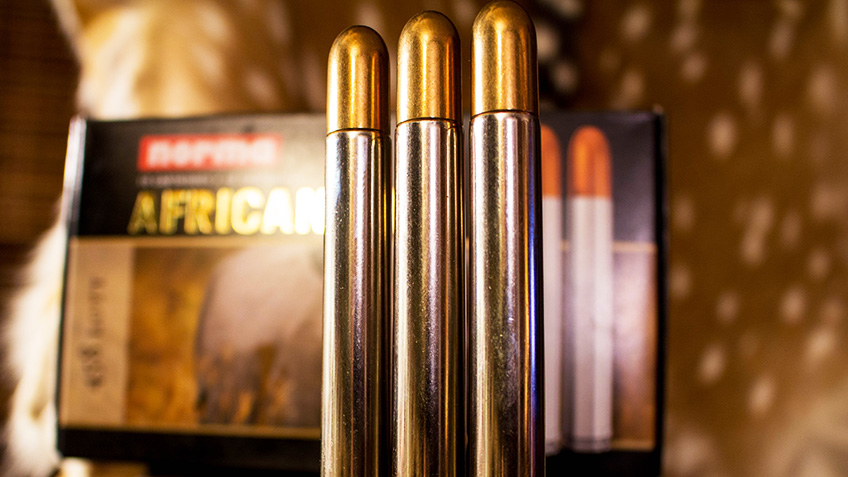
After the end of WWII, when ammunition for the British cartridges began to dry up, Winchester saw fit to release a series of belted magnums based on the .375 H&H case, shortened to 2.50 inches, with an overall length suitable for use in a .30-06-length action. The .458 Winchester Magnum was the first in the series, designed to roughly duplicate the .450 Nitro Express, but using a 510-grain bullet. Where the .450 NE attained its velocity from a 28-inch barrel, the .458 Winchester reported its 2,150 fps from a 26-inch barrel. But, as time would tell, that was not the case.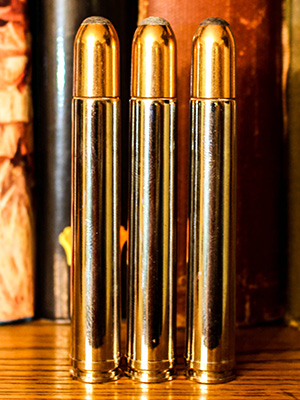
Though the Model 70 African rifles used a 25-inch barrel, the muzzle velocities of the early .458 Winchester Magnum ammo never came close to the advertised velocity, and that created some problems. Field reports rolled in of poor penetration, poorer terminal performance and dissatisfaction from more than a few professional hunters and clients. The blame was laid at the feet of the ball powder used—as a result of limited case capacity—to fuel the cartridge. In the hands of one Jacques Lott, known to his friends as Jack, the .458 Winchester Magnum failed to put down a Cape buffalo bull, and Jack found himself airborne and bleeding as a result of the encounter. He (and he was not alone in the sentiment) felt the cartridge needed more case capacity, and set out to revise the design; this is the point in time when all the .458 Winchester fans collectively groan.
Jack Lott drew—on a paper diner napkin of all things—his plan, which would maintain many of the features of the Winchester design, but solve the case capacity issue by simply extending the length of the case from 2.500 inches to 2.850 inches. During the course of experimentation (fire-forming .375 H&H brass) the case ended up at 2.800 inches, and stayed at that dimension, even when Col. Arthur Alphin’s A-Square firm was granted SAAMI approval for the cartridge in 1989. With the additional case capacity, the .458 Lott (as the cartridge was dubbed) would drive the 500-grain bullets to a muzzle velocity of 2300 fps, for 5,870 ft.-lbs. of energy. And, as an additional bonus, the .458 Lott chamber will accept and safely shoot .458 Winchester Magnum ammunition in a pinch. As a note, there is a 2.850-inch-length cartridge called the .450 Watts, which will accept its own ammunition, as well as the .458 Lott and .458 Winchester Magnum ammunition, much along the lines of the .45-110, .45-90 and .45-70 cartridges.
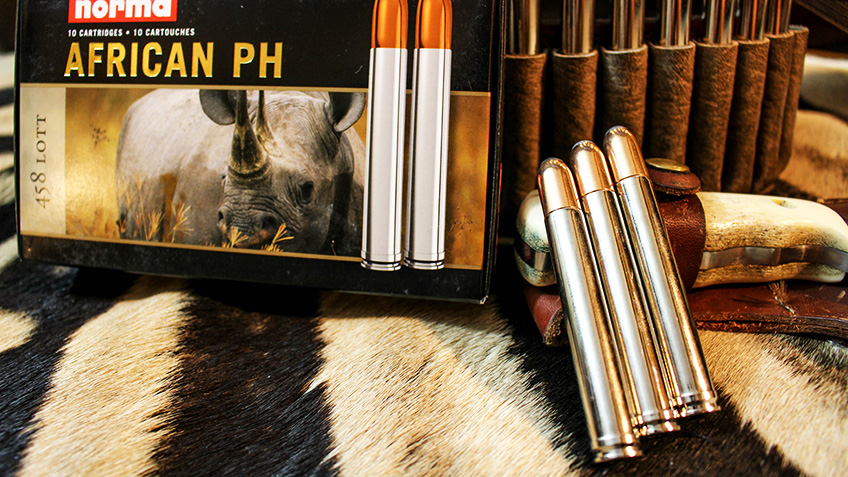
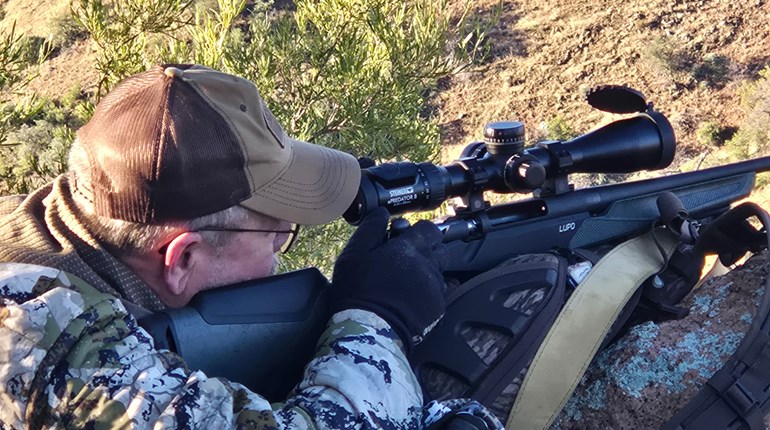
The .458 Lott factory ammunition offers bullet weights from 350 grains (DoubleTap’s TSX load) and 550 grains (in Norma’s African PH line) with the 500-grain selections being the most popular by far. Most ammo will push that bullet to the 2300 fps mark, and that formula will cleanly take the largest brown bear, bull elephant or Cape buffalo that the Lord ever made. This cartridge is at home in Africa—it is probably best suited for the heavyweights like hippo, buffalo and elephant—but is effective on bison and bears here in North America. A 500-grain bullet at 2300 fps will generate a respectable amount of recoil, and it’s one of those cartridges which can be a beast off the bench, especially if the stock doesn’t fit the shooter well. But, with a well-fitting stock, the .458 Lott can be tamed and has proven to be an accurate cartridge.
For the handloaders, it is much more flexible than the .458 Winchester Magnum, as the additional case capacity allows for a wider variety of powders without running into the compressed load issues of the Winchester case. A large rifle magnum primer and a healthy roll crimp to keep bullets in place will have you on your way, and if you prefer to adhere to the .450 NE/.458 Win. Mag. velocity of 2150 fps, you will find the Lott case to be an excellent platform, as the recoil will drop off significantly at this speed.
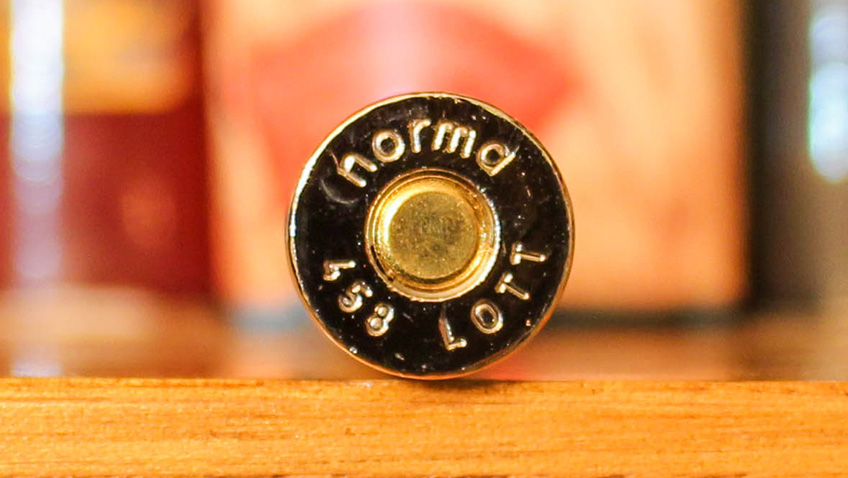
Most of the velocity issues of the .458 Winchester Magnum have been resolved, but I still see the wisdom of a rifle chambered for the Lott cartridge; the added flexibility just makes good sense, and the slightly longer bolt throw has never bothered me. If you are attracted to the .45-caliber cartridges for your dangerous game hunting, the .458 Lott is a serious contender for the top of the heap.
Looking for previous installments of our "Behind the Bullet" series? We've got you covered.
• .264 Winchester Magnum
• .348 Winchester
• .33 Nosler
• .260 Remington
• .30-30 Winchester
• .416 Rigby
• .358 Norma Magnum
• .22 LR
• 7mm-08 Remington
• 8mm Remington Magnum
• .338 Federal
• .224 Valkyrie
• .338-06 A-Square
• 9.3x62mm Mauser
• .257 Weatherby Magnum
• .45-70 Government
• .300 H&H Magnum
• .25-06 Remington
• .30-06 Springfield
• 6.5 Creedmoor
• .300 Remington Ultra Magnum
• 7mm Remington Magnum
• .470 Nitro Express
• .280 Remington
• .300 Winchester Magnum
• .270 Winchester
• .222 Remington
• .45 ACP
• .404 Jeffery
• .44 Remington Magnum
• .41 Remington Magnum
• .243 Winchester
• .338 Winchester Magnum
• .357 S&W Magnum
• 6.5-284 Norma
• 8x57 Mauser
• .38 Smith & Wesson Special
• 7x57mm Mauser
• 9 mm Luger
• .35 Whelen
• .454 Casull
• .375 H&H Magnum
• .45 Colt
• .22-250 Remington
• 10mm Auto
• .308 Winchester