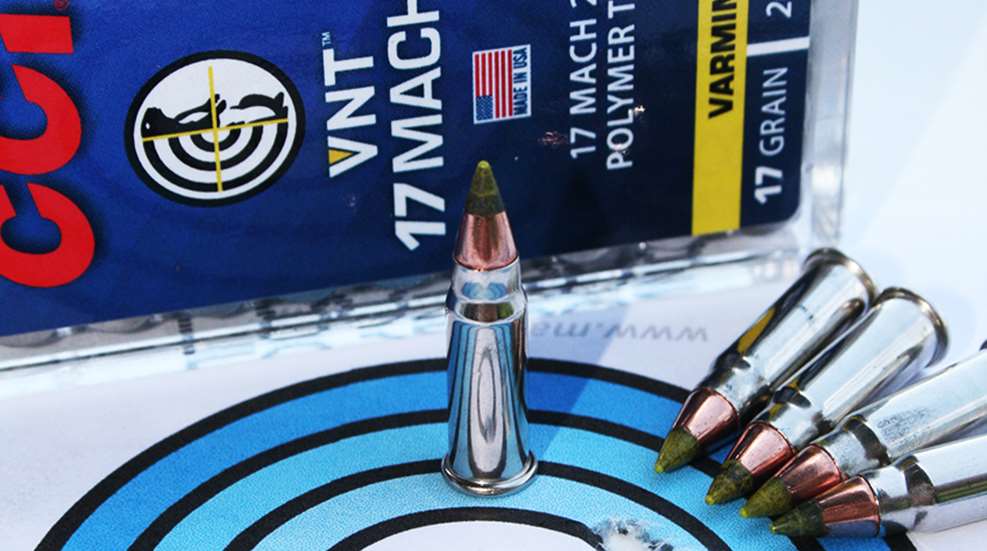
Since the late 1990s, there have been more new cartridge introductions than during any other period in history. It’s through that two-decade span that now-stalwart cartridges, such as the Winchester Super Magnum (WSM), Nosler, and Remington Ultra Magnum (RUM) series, .260 Remington, 6.5 Creedmoor, 6.5 Grendel and .17 Hornady Magnum Rimfire (HMR), among numerous others, were unveiled in rapid succession.
Although jubilation generally accompanies the debut of any newfangled round, ultimately, success is measured in staying power—and for one reason or another, not all cartridges retain their initial shimmer. Included among those that lost most of their initial support were the Winchester Super Short Magnum (WSSM) lineup and the subject of this article, the .17 Mach 2, which debuted in 2004.
A joint venture between Hornady and CCI, the .17 Mach 2 is little more than a CCI Stinger case, which measures 0.100-inch longer than a standard .22 LR case, necked down to accept a 17-grain, 0.172-inch diameter bullet. The resulting 2100 fps muzzle velocity is double that of some .22 LR ammunition—its closest competition—thereby enabling hits at distance with minimal compensation for drop. Moreover, the jacketed, polymer-tipped bullets common among various loadings delivered pinpoint accuracy in most rifles, as well as sufficient fragmentation upon impact for rapid expiration of smallish species and minimal risk of ricochet. Recoil was nil, too. With all it had going for it, you’d think that the .17 Mach 2 would be lasting top seller, but it wasn’t. There are several reasons why.
On paper and in the field, the .17 Mach 2 is an all-star performer; however, that alone wasn’t enough to overcome other influencers that decreased interest in the petite .17. For instance, many rifle and cartridge aficionados place the blame of its failing squarely on the shoulders of the .17 Hornady Magnum Rimfire (HMR), which was introduced two years earlier and had already established a firm foothold. It was hotter than Hades when it was announced. What’s more, with a muzzle velocity of 2550 fps, the .17 HMR offered hunters an increased effective range, less wind deflection and more on-target energy than the .17 Mach 2. Why buy the latter, right? Strike one.
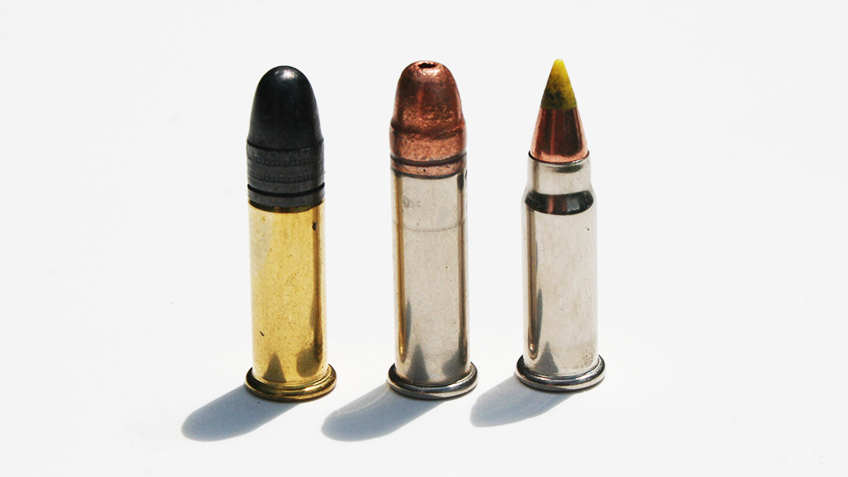
Beyond the cannibalization of sales by a fellow Hornady brainchild, the .17 Mach 2 ammunition was comparably expensive to purchase—especially in relation to the cost of high-volume .22 LRs. Fact is, most consumers of .22s plink with the least-costly, round-nose-lead “promo” loads, and they simply balked at the price of .17 Mach 2. When some .22s could be had for $1 per 50-round box, the .17s cost six to eight times that; that’s too expensive for casual practice. No matter that the .17 Mach 2 offered vastly superior external ballistics over the .22 LR, or that high-quality (premium) .22s cost much more than the .17 Mach 2s. It simply didn’t matter. Strike two.
If there were a proverbial “nail in the coffin” for the .17 Mach 2, it was the lengthy and widespread ammunition shortage experienced during the Obama presidency. Why? Production of ammunition in chamberings low in demand was halted as companies struggled to fill orders for the high-demand cartridges. The .17 Mach 2 was among the former. Honestly, why would you produce .17 Mach 2 ammunition that may (or may not) sell when every .22 LR, .22 WMR (then experiencing a renaissance), and .17 HMR is flying off the shelf, right? You wouldn’t. If you cannot purchase ammunition for a gun, it’s a paperweight, and therefore, there was no interest in the round. Strike three.
Fortunately, the seemingly unending thirst for ammunition has been quenched (at least temporarily), so manufacturers have resumed production of .17 Mach 2, and there’s a new option to boot. This bodes well for the fans that stood beside the cartridge through the lean times, as well as for those who would benefit from its use.
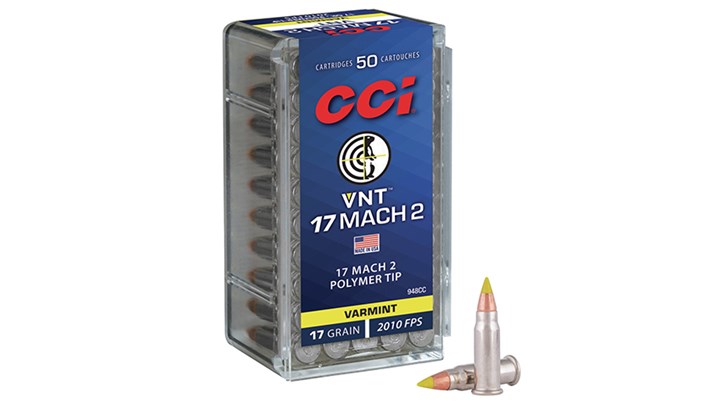
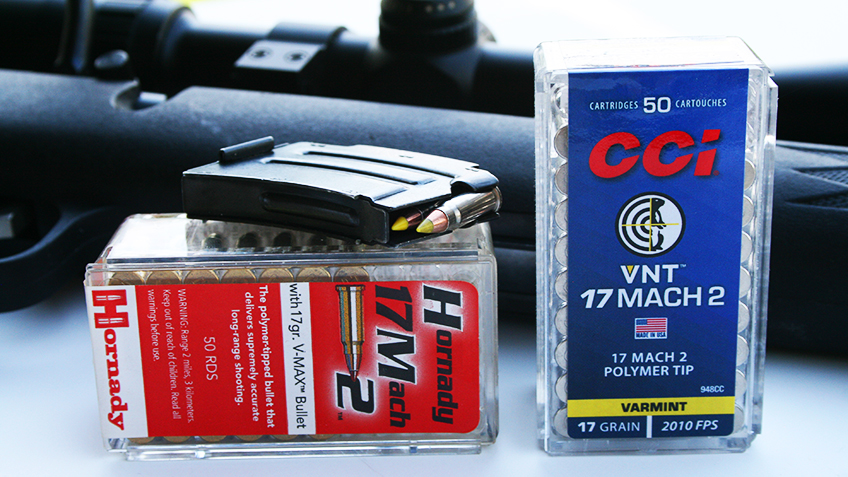
Fresh from CCI is VNT 17 Mach 2, which has a 17-grain Speer tipped lead-core bullet with an especially thin jacket propelled to 2010 fps for rapid expansion and maximum damage. The latter will endear it to pest eliminators and small-game hunters who accurately place their shots. It’s housed in a nickel-plated case. CCI also loads Hornady’s 17-grain V-Max bullet, as well. Retail pricing for the VNT load is $10.95 for a 50-round pack. CCI’s V-Max load is available at MidwayUSA for $7.99 per 50-round box.
Hornady manufactures two .17 Mach 2 loads. First, there’s the traditional 17-grain V-Max bullet at 2100 fps, which, when zeroed at 100 yards, drops 14 inches at 200. For areas requiring lead-free ammunition, the company also loads a 15.5-grain NTX bullet at a slightly slower 2050 fps. With the same zero, it’ll drop 15.6 inches at 200 yards. The Hornady ammunition runs $9.99 per 50-round box at MidwayUSA. I’ve also found .17 Mach 2 ammunition on ammoseek.com for as low as $5.79 per 50-round box. That’s it for .17 Mach 2 ammunition choices.

As for rifles, factory-new options are relegated to those from Savage Arms; that isn’t necessarily bad, as the company builds accurate, economically priced models. The newest to market is the 5.55-pound, semi-automatic A17 HM2, which has a 20-inch carbon steel barrel and is fed by a rotary-style 10-round magazine. The user-adjustable AccuTrigger and Weaver-style bases are also standard. It has an MSRP of $379.
There are also the bolt-action Mark II F and FV models. The former has a 21-inch sporter-profile carbon steel barrel with adjustable open sights and a 10-round, detachable-box magazine, while the latter has a sightless, 21-inch carbon steel heavy profile barrel and is fed by a five-round, detachable-box magazine. MSRPs are $319 and $355, respectively.
On the used market there’s a better assortment of rifles, though often at a significant premium. I was able to quickly locate models from Ruger, Marlin, Volquarten, Magnum Research and Remington on various auction sites. For plinking or hunting, I’d just opt for one of the abovementioned Savage Arms rifles.
Since the newest .17 Mach 2 ammunition to market is the CCI VNT 17-grain polymer tip load, I opted to evaluate it in my older, pre-AccuTrigger Mark II FV from Savage. For comparison sake, I also accuracy tested and chronographed Hornady’s V-Max offering. Topped with a Bushnell Elite 3200 5X-15X-40 mm scope, I fired five consecutive, five-shot groups at 50 yards with each ammunition type from a sandbag rest. Velocities were recorded using a Competition Electronics ProChrono Digital chronograph.
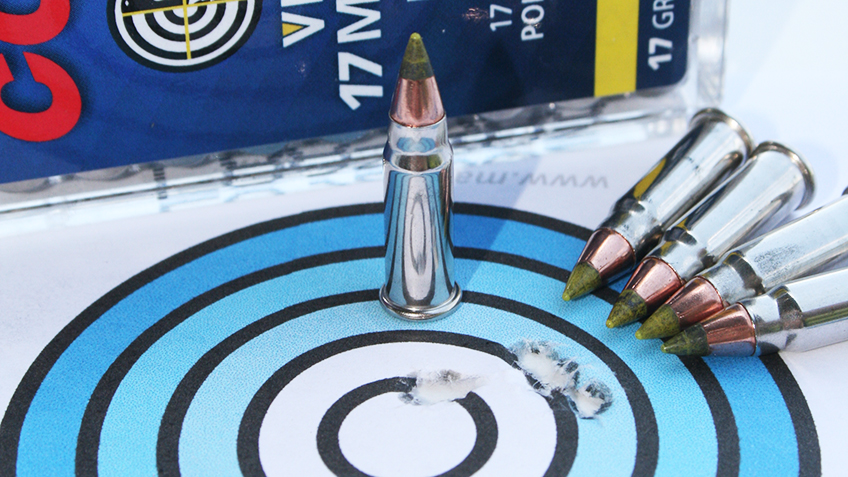
Despite the 4-pound, 9.5-ounce, creep-filled pull of the AccuTrigger’s predecessor, when using the CCI VNT I averaged a very respectable 0.553-inch group for the 25 shots. At 2105 fps, the average velocity for five shots was slightly higher than factory published data. Consistent with previous findings, my particular Savage rifle doesn’t perform nearly as well with Hornady’s V-Max load (though it does with other no-longer-made loads featuring the same bullet); the average for five, five-shot groups was 0.841-inch. The average velocity was 2060 fps.
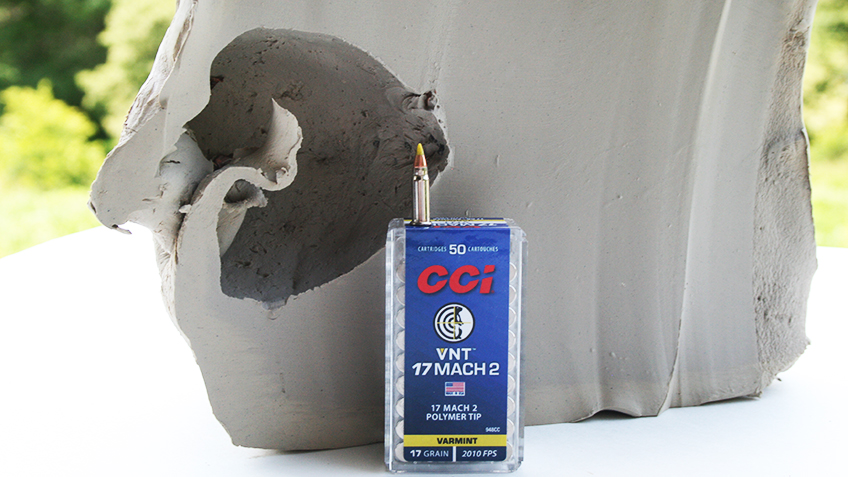
With “formal” testing completed, I next wanted to examine the terminal performance of the new VNT round. As such, I fired a single projectile into a 25-pound block of modeling clay from 50 yards and then sectioned it. What I found was convincing; the fragile, 17-grain tipped bullets created a shallow, yet cavernous cavity that would prove devastating on vermin and small predators alike. Choice shots would need to be taken to prevent excessive meat loss on small game. Given its accuracy, velocity and terminal performance, CCI has a winner with the VNT round.
For many, the .17 Mach 2 is seen as a bust—another to be relegated to the heap of cartridge failures. But for those who have used the cartridge and understand the niche it fills, it’ll always be near and dear to our hearts. I’ve used it to rid the field of ground hogs, halt foxes and hunt gray squirrels, and never have I been left wanting.
It’s a phenomenal cartridge that was introduced with unfortunate timing, and it suffered because of it. Give it a try and you, too, might find it to be the ideal cartridge for your small-game hunting and pest control needs.