By Larry Leistritz, Fargo, N.D.
How often it all comes down to one shot.
As I eased into position behind a screening Sitka spruce, I could see the brown bear quartering away from me. There was a gap in the foliage and a branch that would make a convenient rest for my rifle.
Lucas, the young guide, whispered, “It’s about 180 yards.” Then, as I started to squeeze the trigger, he asked, “Are you sure?” Whatever else he meant to say was lost in the roar of my Winchester Model 70 in .375 H&H.
My brown bear hunt in May of 2018 actually began a bit more than a year earlier, when Keith Atcheson (of Jack Atcheson and Sons of Butte, Mont.) put me in touch with Paul Johnson of Gull Cove Lodge on Chichagof Island, Alaska. His hunts consist of spotting and stalking from skiffs operating along the north shore of the island.
The trip to Chichagof Island began with flights from Fargo, n.d., to Minneapolis to Seattle to Juneau, Alaska. After overnighting at a hotel near the airport, I caught a flight operated by Alaska Seaplanes to Gustavus, a small community located at the mouth of Glacier Bay and just across the Icy Strait from Chichagof Island. At the Gustavus harbor, we boarded Paul’s boat, the Yakobi, for the trip to the island. Near Point Adolphus, my guide, Lucas Mullen, and I cast off in an 18-foot aluminum skiff powered by a 30 hp outboard to hunt southwest along the coast to Gull Cove, a distance of about 15 miles.
We hunted primarily by cruising slowly and scanning the beaches and the grassy meadows that bordered some of the inlets. If we saw a bear, we might land the skiff and try to stalk closer for a better look. Lucas and I saw seven brown bears that first evening.
Our hunting days settled into a routine. After breakfast at the lodge, we would take our lunches and equipment and board our skiff between 9 and 10 a.m. We could hunt either northeast toward Point Adolphus or south along the Idaho Inlet and Trail River. We generally planned on hunting until the end of shooting light (about 9:30 p.m.) and returning to the lodge after dark. The schedule for dinner was flexible, depending on when we returned from hunting.
I saw brown bears on all but one of the 10 days I hunted. The number of bears we saw per day varied from one to 12, and the total number we saw across the 10 days was 50. Each bear sighted was evaluated first with binoculars and then with a spotting scope. If initial glassing indicated an animal might be interesting, we would attempt to approach or intercept. Often animals we sighted were dismissed as being too small, too badly rubbed or almost certainly sows. Others that seemed to have potential just did not offer the opportunity for a shot.
Events like this led someone to comment, “I guess that’s why we call it hunting and not killing.”
On the evening of our 10th day, we were hunting on the Trail River at the head of Idaho Inlet when Lucas spotted a bear just at the edge of the timber along a grassy meadow. Through the glasses and then the spotting scope, the bear looked good. We would need to stalk at least half a mile across the meadow, and we didn’t have any daylight to waste. Because the other Gull Cove hunter had taken his bear and already departed for the Lower 48, his guide, Mike, was also hunting with us. The three of us moved across the meadow slowly, with frequent stops to check on the bear. As Lucas and I eased into position behind the spruce tree, he checked with his rangefinder and said the distance was 180 yards.
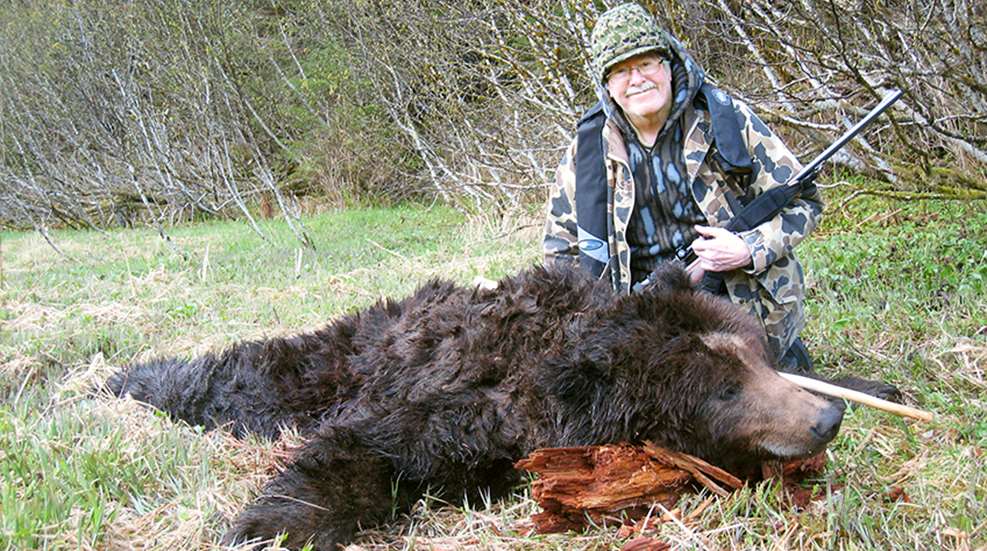
After the shot, I quickly cycled the action, but the bear took two jumps and was out of sight before I could possibly shoot again. As the light was fading, Lucas and Mike decided to walk to where the bear was standing when I shot to see if they could find any blood. When they reached that point, they could see the bear. It had fallen just inside the timber. The pelt squared 8 feet 7 inches, which is a very nice bear for the area, and Lucas said it was easily the largest bear we had any possibility of shooting over the 10 days of our hunt.
Do you have an exciting, unusual or humorous hunting experience to share?
Send your story (800 words or less) to [email protected] or to American Hunter, Dept. MH, 11250 Waples Mill Road, Fairfax, VA. 22030-9400. Please include your NRA ID number. Good quality photos are welcome. Make sure you have permission to use the material. Authors will not be paid, and manuscripts and photos will not be returned. All material becomes the property of NRA.