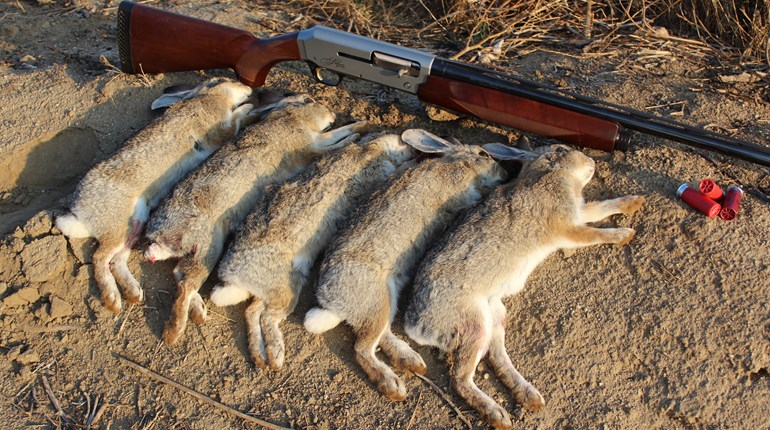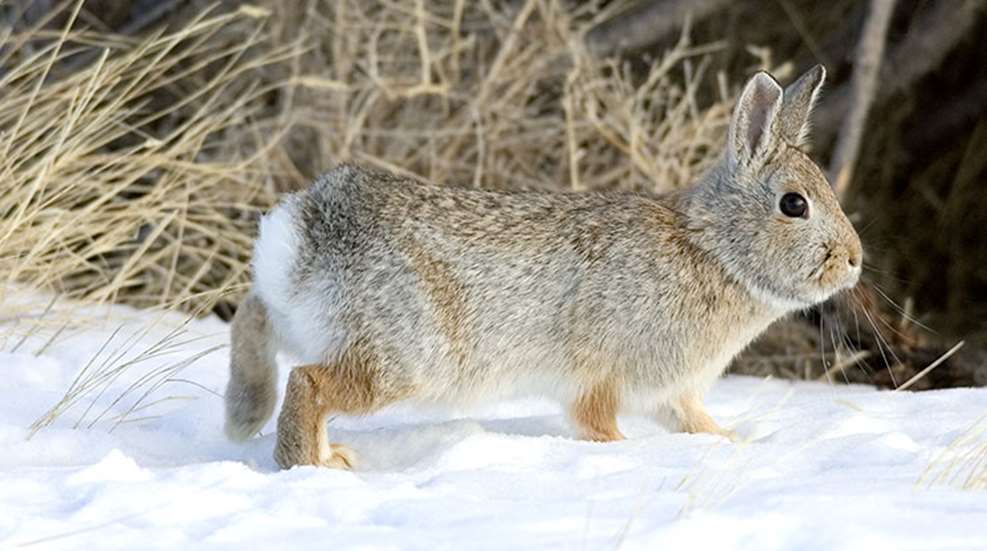
Hunting rabbits usually means either busting brush and shooting a hightailing cottontail before it disappears into the tangles, or letting a beagle chase a bunny through the brambles and under your gun barrel. Both techniques are productive, but when there is snow on the ground you have other options that can be even more rewarding. Try still-hunting, and even tracking, rabbits this winter for a challenge that will both sharpen your stalking skills and produce the ingredients for a hearty meal on a bone-chilling night.
While you can still-hunt rabbits anytime during the season, snow—especially fresh snow—is a boon to success. Mainly, it makes rabbits and their travels more visible. But it also helps quiet your progress through their haunts, and you’ll need the near-silent stealth of a bobcat to slip up on a bunny.
To find rabbits after a snow, focus on places where cover meets food sources. In winter, rabbits feed mainly on buds, twig tips, stems and bark of brush and saplings. Look for stands of birch, maple, sumac or willow, along with thickets of blackberry or raspberry. In farm country, bunnies may also root through the snow to get winter wheat. Good winter cover includes patches of multiflora rose, autumn olive and bush honeysuckle, as well as deadfalls, treetops left behind from logging, stands of conifers with low-hanging branches and old homesteads.
Nasty cover like blackberry and multiflora rose is noisy to hunt, so concentrate on edges. On calm mornings rabbits will often move to the outskirts of thick cover to warm in the sun. Still-hunt tight to these ragged edges, just far enough from the vegetation to prevent getting your sleeves hung up in the briars. A logging road running through a two- to five-year-old clearcut provides the ideal route for a still-hunt. If you can find a fencerow or windbreak adjacent to a field of winter wheat or another crop rabbits have been feeding on, use the cover to disguise your stalk while watching for rabbits along its edge. Also look for cover in the form of old stone fences, abandoned outbuildings, leftover hay bales and large tree trunks, and plan your route to take advantage of these obstructions.
Just as with big game, the key to still-hunting rabbits is moving into or across the wind at a tortoise’s pace, and closely inspecting every piece of cover. You want to see a bunny before it sees you, and keep in mind your quarry has excellent eyesight. In states where blaze orange is not mandatory, don head-to-toe snow camo. A binocular is a must, as is an accurate rimfire. While rabbits are typically within shotgun range when driving them from the brush or chasing them with beagles, shots during a still-hunt may stretch beyond 50 yards. It’s wise to take the first good shot you get, as attempting to sneak closer will almost always result in the rabbit seeing you. It may freeze for a few seconds to assess its escape and give you an opportunity, but it won’t hold for long.
If you encounter fresh rabbit tracks in the snow, try following them to get a shot at their maker. First, of course, you need to determine the rabbit’s direction of travel. Rabbit tracks form a rough T shape. The hind feet land forward of the front, bracketing the top of the T and pointing the way. Use a bino to study the tracks in front of you to assess the speed of the rabbit. The tracks of a bounding bunny may have 3 feet of untouched snow between them. When a foot of space or less separates each set of tracks, slow down and start looking for the rabbit. Getting a shot at a bunny this way will be almost as satisfying as tracking down a buck.