Designing a line of long-range hunting ammunition involves many engineering considerations. The main focus is hitting the target, so the ammo will have precision-made bullets with high ballistic coefficients. An equally important, but sometimes ignored, aspect is terminal ballistics—what happens after the bullet hits the critter. Not only at long range, but also up close and at all distances in between, the bullet must expand, stay together and penetrate. That’s a difficult problem, and it’s the key difference between hunting and match loads. Federal Premium might have cracked the code with its new Edge TLR (Terminal Long Range) ammo.
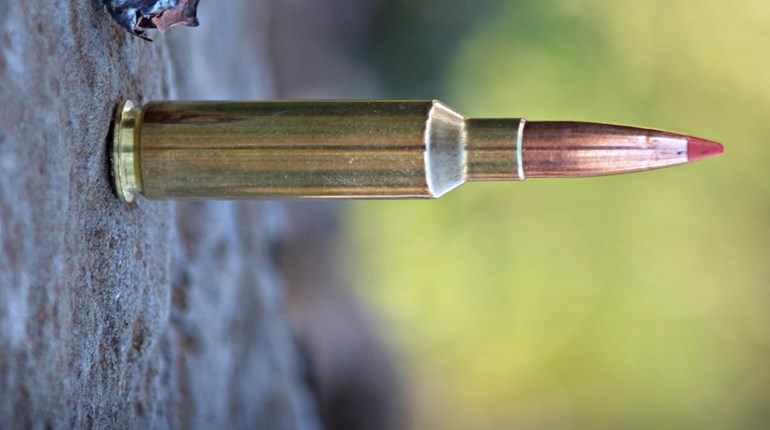
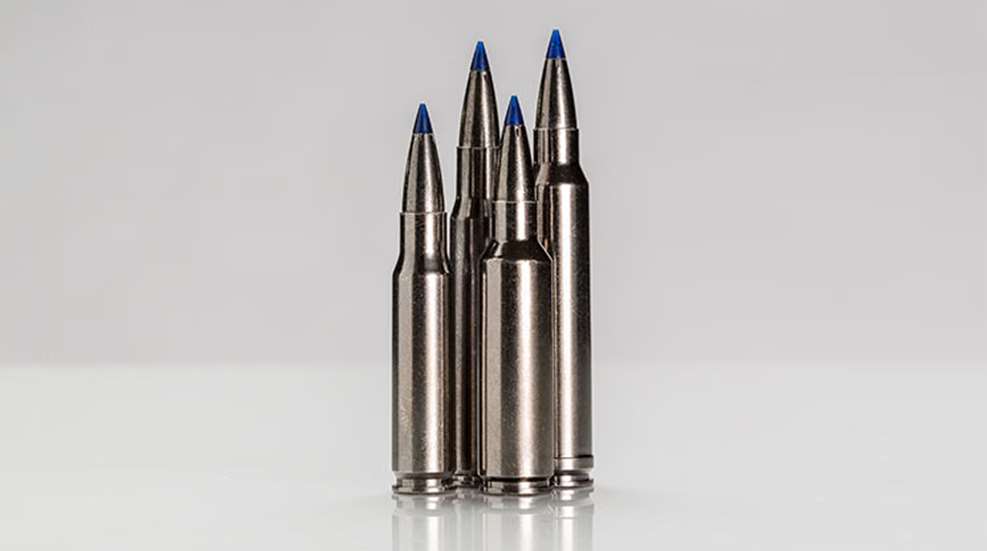
This is very “tactical”-looking ammo: the cases and bullets are both plated with black nickel, and the plastic tips are a deep blue color. The heavy-for-caliber bullets have secant ogives and long boattails, which result in high ballistic coefficients. For example, the G1 ballistic coefficient (BC) of the 200-grain Edge TLR bullet used in the .300 Win. Mag. load is .625, nearly twice as high as many common hunting bullets.
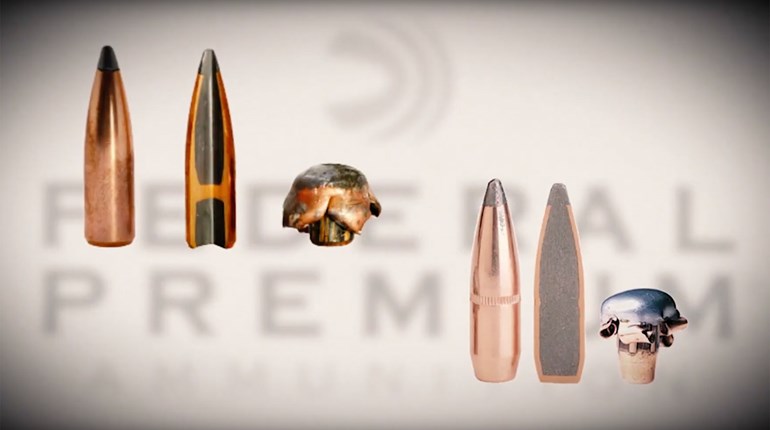
The Edge TLR bullet is a modified version of Federal’s Trophy Bonded Tip bullet. It’s a copper bullet with a bonded lead core in the front and a long, solid shank. The nose is skived to aid and control expansion. The last tenth of an inch or so consists of jacket material that forms a hollow point, not unlike a match bullet design.
A new heat-resistant plastic tip—Federal calls it the Slipstream tip—fits inside the hollow point and caps the nose. The tip has a solid front but is hollow through the rest of its length to weaken the stem so that the tip breaks away on impact. This, of course, is contrary to what we have been told for years about plastic tips helping to initiate long-range expansion by pushing back into the bullet on impact. But as Federal engineer Justin Carbone explained, ballisticians discovered that by designing the plastic tip to break away and expose the hollow point, they could lower the threshold of impact velocity required for expansion.
The accepted way to judge expansion at any given distance is by using ballistic gelatin under controlled conditions. Carbone said in his tests the bullet expanded at impact velocities as low as 1350 fps. He defined “expansion” as the nose opening up to the diameter of the shank. I don’t call that “hunting-worthy” expansion. So, to allow a little tolerance, let’s say the impact velocity needed for more adequate expansion is 1500 fps. The .308 Win. Edge TLR load drops below that 1500 fps threshold at 800 yards. The .300 Win. Mag. load drops to 1500 fps just past 1,000 yards. In my never humble opinion, both are much farther than you should be shooting at big game with those cartridges, so I think it’s safe to say this bullet will expand on game at any ethical hunting distance.
Carbone noted that because of its bonded core, the Edge TLR bullet will also stay intact and work well with close-range, high-velocity impacts. I have quite a bit of experience with Trophy Bonded Tip bullets on a variety of game. They use the same bonded-core technology, and it’s always performed well across a wide range of impact velocities on moose, mountain goat, deer and other big game. I believe his claim that the Edge TLR works up close as well as at long range.
In the early years, solid-shank bullets were a problem child in achieving accuracy. That issue was solved years ago when Barnes put a series of grooves on its bullets and everybody else copied the design. The problem for long-range shooting, though, is the grooves add drag and cut the BC pretty drastically. Carbone told me engineers experimented with a single groove and solved the accuracy side of the equation while minimizing the effect on BC by sloping the groove’s rear wall. I had serious doubts about Federal’s so-called AccuChannel, as I have used a lot of other monolithic and solid-shank bullets with a single groove and have not found their accuracy to be consistent across multiple rifles. So I set out to prove Carbone wrong.
The initial Edge TLR loads all have .30-caliber bullets, and I decided to test two popular cartridges at opposite ends of the spectrum: the .308 Win. and .300 Win. Mag. I shot both loads in a long-range, heavy-barrel rifle and a lightweight hunting rifle. As a bonus I also had my buddy Mike Brookman shoot the .308 Win. load in his heavy-barrel varmint Remington Model 700 to see how it would do with the 1:12-inch twist rate in that rifle. The groups started to open up a bit in this normally accurate rifle, which leads me to believe that a 1:10-inch twist rate is much better for the long Edge TLR .308 Win. bullet. In fact, you will probably get better results with a 1:10-inch or faster twist when shooting any of the .30-caliber Edge TLR ammo.
The loads were amazingly accurate in all of the other rifles, putting to rest my fears that a single groove in the shank might not work well. Three out of the four rifles I used to test the ammo achieved a sub-MOA, three-group average at 100 yards. Groups from the fourth rifle averaged sub-1.25 MOA. Several groups dipped below or approached .5-MOA, and rivaled the performance of the best match ammo in these rifles. The accuracy held up farther downrange, too, as we proved with a five-shot group fired from a custom .308 Win. rifle that measured 1.5 inches at 400 yards. Using a .300 Win. Mag. rifle that I built, Mike shot another five-shot group at 400 yards and put four shots into 2.2 inches. We called the last shot a “flyer,” which opened the group to 3.9 inches. That’s still sub-MOA accuracy.
I shot several hundred rounds of Edge TLR ammo over multiple range sessions. Accuracy was consistently match-grade, and I was able to make long-range hits with predictability. I know my shooting range well. It runs just a bit uphill, and I have found I need to adjust my dial-up numbers slightly for the longer shots. The Edge TLR ammo matched that pattern exactly. Using my knowledge of the range and the BC provided on the ammo box, I repeatedly made hits out to 500 yards, which is the limit of my range. I am talking about hitting the 6-inch-by-6-inch head area on a steel IPSC target, at 200-500 yards.
While I have seen such performance with match-grade factory ammo and select handloads, very few factory hunting loads have exhibited this level of accuracy and long-range predictability. I have not had an opportunity to shoot it at game yet, but based on the range results and the technology I have little doubt Federal Premium Edge TLR will be an outstanding line of hunting ammo at any range.
Technical Specifications:
• Caliber: .308 Win. (tested), .30-06 Sprg., .300 Win. Mag. (tested), .300 WSM
• Bullet: 175-gr. Edge TLR (.308 Win.), 200-gr. Edge TLR (.300 Win. Mag.); solid copper shank w/bonded lead core, polymer tip
• Ballistic Coefficient: .536 (.308 Win.), .625 (.300 Win. Mag.)
• Muzzle Velocity (advertised fps): 2600 (.308 Win.), 2810 (.300 Win. Mag.)
• Muzzle Energy (advertised ft.-lbs.): 2,627 (.308 Win.), 3,506 (.300 Win. Mag.)
• MSRP: $47.95 (.308 Win.), $59.95 (.300 Win. Mag.) per 20-rnd. box