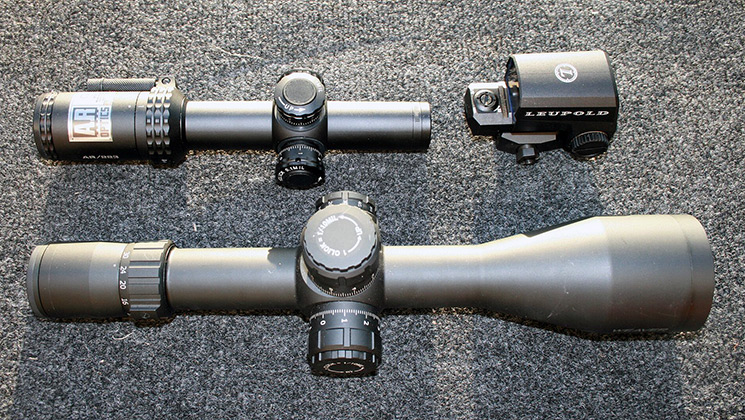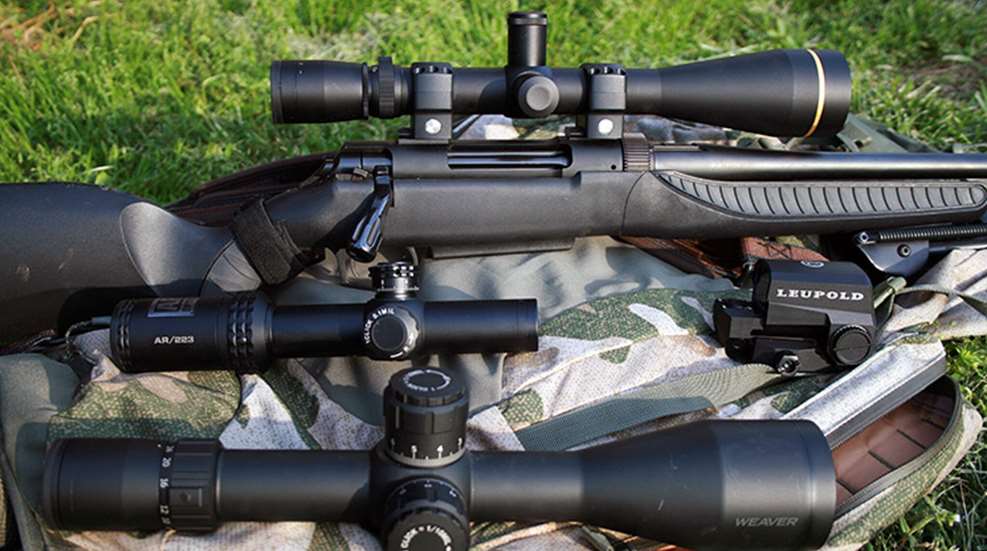
Unless you’re relegated—by choice or regulation—to using open sights, chances are that you’ll need to select an optic to top your long gun. But, with an ever-increasing array of options from which to choose, narrowing the field to the “right” one can be a daunting task. Below is some “food for thought” when beginning that journey.
Main Tube and Objective Lens
A riflescope’s main tube generally measures 1”, 30 mm or 34 mm in diameter. Large-diameter main tubes increase the range of adjustment, which is important for long-distance targeting, and they enhance durability, too. But, the additional material used in their construction increases weight, and rings—especially in 34 mm—used to mount them can be pricier and more limited in selection when compared those for 1” main tubes. For example, many 34-mm rings cost in excess of $200. Honestly, a high-quality 1” riflescope is all that is needed for the majority of hunting worldwide. For those wanting or needing something different, though, a “happy median” is an optic with a 30-mm main tube; it’ll offer all the adjustment range that you’ll ever need for hunting, costs less than comparable 34-mm scopes, and rings are widely available and their cost isn’t ridiculous (like those for 34-mm scopes).
It should go without saying that you want the optic to be nitrogen or argon purged to displace water vapor and thus eliminate internal fogging. The riflescope needs to be waterproof and shock proof as well.
Objective lens sizes run the gamut; everything from 20 mm to 72 mm is available, though 40-mm and 50-mm sizes dominate the marketplace. Increasing the objective lens size slightly boosts an optic’s light-gathering ability (and thus resolution), which can be beneficial in low-light conditions. There can be too much of a good thing, too. Riflescopes with a 50-mm objective lens or larger require that the optic be mounted higher than normal so that there’s clearance between the scope’s bell and the rifle barrel; however, doing so can impact scope-to-eye alignment and consistency of cheek weld, which is required for accuracy. This is especially problematic on AR-style rifles. Moreover, scopes with large objective lenses are naturally bulkier and heavier, making them cumbersome to carry. Truthfully, an objective lens measuring 40 mm to 44 mm is all that is needed. Don’t compensate for low-quality glass and/or insufficient lens coatings by selecting a larger objective lens.
 Glass
Glass
When it comes to glass, you get what you pay for; don’t expect amazing feats from inexpensive materials. It’s preferable to select an optic featuring extra-low-dispersion glass (or similar premium-quality material), as it minimizes chromatic aberration (i.e. color fringing), thereby enhancing image sharpness, contrast, and color fidelity. Also, ensure that the lenses are fully multi-coated for maximum brightness and light transmission, and they should have a hydrophobic lens coating, such as Bushnell’s RainGuard HD or Zeiss’ Lotu Tec, to hasten removal of moisture from the exterior lens surfaces as well.
Reticle and Focal Plane
There are myriad reticles from which to choose, and the optimal one depends on your firearm, quarry, and location. Unless a trajectory compensating reticle, such as Leupold’s Boone & Crockett Big Game or Nikon’s BDC, is desired, a standard “Duplex” is sufficient for most hunting arms, ranges and conditions. If you’re hunting in thickets, a German No. 4 or Heavy Duplex is a good option, while long-range varminting demands a finer crosshair. For long-range hunting, the go-to reticle is mil-dot, though some hunters prefer those by Horus, Huskemaw and others.
Where should the reticle be positioned? When the reticle is located in the first focal plane, its scale in proportion to the image is unchanged through the entire magnification range. This consistent subtension permits accurate ranging, holdovers, and windage corrections at all magnification settings. That’s why marksmen prefer it. On the other hand, when the reticle is in the second focal plane the image increases and decreases with changes in magnification while the reticle stays the same size. Therefore, the subtension is constantly changing, so if a trajectory-compensating reticle is used, a specific magnification setting must be used for accurate ranging and holdover. By far, the most prevalent and least costly riflescopes have the reticle in the second focal plane.
Lastly, where legal an illuminated reticle can help improve sighting in low-light conditions. This isn’t necessarily relegated to dusk and dawn, either, but also in dense vegetation, beneath cloud cover, and in inclement weather.
Turrets and Adjustments
Rapid-adjusting, “tactical”-style turrets are all the rage today—especially among long-range shooters—as they hasten elevation- and windage-adjustments. Learning to rapidly dial-in dope isn’t difficult, but it takes time and practice to master. Once you do, the guesswork of long-distance shooting is eliminated.
If you choose tactical-style turrets, be sure that they’re absolutely consistent (not likely to be found on inexpensive scopes) and there’s a true return-to-zero feature. Additionally, frequently check the turrets (especially before a shot is taken) to ensure that the turret wasn’t accidentally rotated—especially if the rifle was removed from a scabbard or case. If it did and you don’t catch it, it’ll result in a miss or worse, a cripple. Whereas 0.1-mil. “clicks” are most often found on “tactical”-style scopes, most non-tactical models have adjustments in inches—be it 1/4” or 1/8”. Once shooters learn the mil-dot system it’s preferred to all others, but it takes dedication. For those unwilling to dedicate the time to learning them, opt for standard turrets with clicks valued at 1/4”.
Magnification
Proper magnification is highly subjective; opinions vary greatly on the subject. As a rule of thumb for me, I prefer an increase of 3X per 100 yds. For example, at 200 yards it’d be 6X and at 300 yards I like 9X. Although I’ve engaged papers targets at 1,000 yards using 15X, at that distance I preferred 25X. That being said, I’ve connected at longish ranges using far less magnification. For example, I shot my biggest mule deer to-date beyond 350 yards on 7X (though the scope adjusted to 12X), and several animals have been taken beyond 500 yards on 9X. Magnification is wholly a personal choice.
In the past, the 3:1 zoom ratio resulted in the utilitarian 3-9X becoming deemed the “all-around” scope. This makes since because it’d handle close-up shots as well as extended ones. It still reigns supreme in the minds of most shooters. For many years, my favorite was 4-12X. Now, with 5:1, 6:1, and even 8:1 zoom ratios, you don’t have to compromise; a single scope can readily handle the nearest and farthest shots. For example, in Swaroski’s Z8 line there’s a 1-8X, 1.7-13.3X, 2-16X, and 2.3-18X, while Bushnell’s Elite 6500 series has 2.5-16 and 4.5-30X models. Talk about versatility! Still, low-magnification models (such as 1-4X) are perfectly capable for hunting where shot distances are short, and mid-range models, such as those in the 2.5-10X or 3-9X range, afford all the magnification you’ll need for even longish shots. For my Dall sheep hunt I used a utilitarian Trijicon AccuPoint 3-9X 40 mm to take my ram at 375 yards. It left me wanting nothing.
For ranges within 200 yards, don’t overlook dot- and reflect-style sights. Although they lack magnification, they’re great choices for close range (especially in dense cover and on moving game). Additionally, the reticle is easily seen in all lighting conditions (either via self-adjustment or manually turning the rheostat). As a word of caution, beware of cheap imitations of popular models; they’ll cost you in the field.
As you can see, there’s a lot to consider when selecting an optic for your long gun. Make a good choice and it’ll help you connect when the moment of truth arrives.