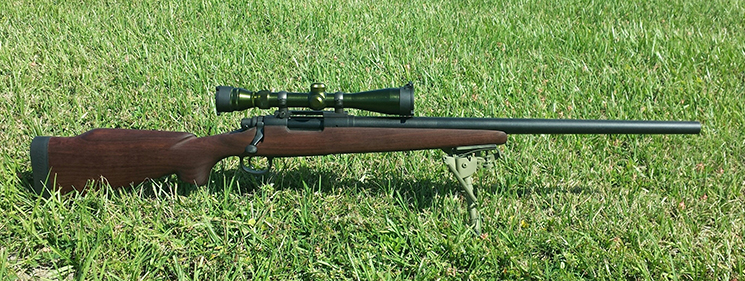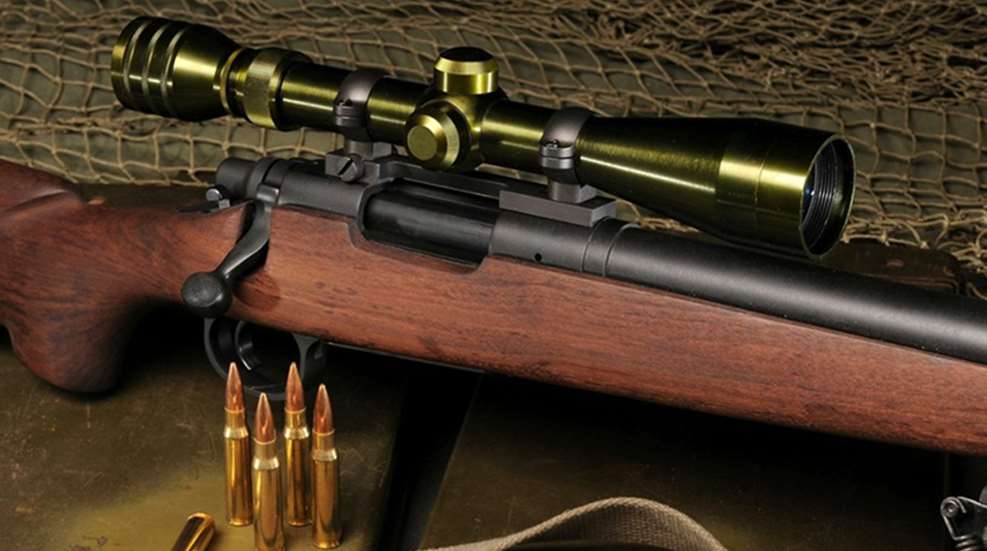
When the U.S. entered Vietnam, the military found itself in desperate need of trained snipers and appropriate rifles—it essentially began the conflict with neither. After making due with various off-the-shelf hunting rifles, such as the Winchester Model 70 .30-06 fielded by Carlos Hathcock, the Marine Corps developed a standardized sniper rifle called the M40. The rifle was a modified Remington 40X target rifle chambered in 7.62x51mm NATO. Introduced in 1966 and fielded until the 1970s, when they were replaced by the synthetic-stocked M40A, the M40 stands as one of this nation’s iconic rifles. To honor the service of the M40 and the men who carried them, these rifles are being replicated as the M40-66 and made available in limited quantities.
1. It's built to match the original M40 specs, with a few tweaks thrown-in.
Each M40-66 starts as a standard Remington 700 and is trued on the lathe so that it provides a square and concentric platform for a match-grade barrel. 1-10” twist stainless steel cut-rifled Krieger barrels are installed one at a time using manual machinery and finished at 24”. The chamber is cut using a match .308 Winchester chamber, rather than a 7.62 NATO, in order to accommodate the wide variety of match and hunting ammunition on the market. The factory recoil lug is replaced with a precision-ground stainless unit and the bottom metal is also made from stainless. All of the metal is coated matte black with a moly-based coating to simulate the matte blue of the original while providing additional corrosion resistance. Triggers are set to 2¾ pounds and are adjustable.
2. It features an American Black Walnut stock.
The market is awash with sniper-style rifles built using synthetic stocks but few, if any, are seen wearing walnut. Like the original, the M40-66 uses an American Black Walnut stock that should make the rifle more attractive to the many hunters and shooters who can’t grow to love fiberglass. The stocks are oil finished by hand and pillar-bedded with Marine-Tex epoxy. The action and bottom metal bedded into the stock to provide the rigid fit that is necessary for great accuracy and consistency, and the barrel channel is coated with epoxy to waterproof and stiffen the forend. Despite the bedding material in the forend, the barrel is free-floated. The M40-66 captures the nostalgia of one of our nation’s last wood-stocked military arms and adds some modern touches.
3. It comes with a ½-MOA accuracy guarantee.
The company guarantees 3-shot groups of under ½” at 100 yards with match ammo. Sample guns from this lot have shot as well as ¼” MOA with Federal Gold Metal Match ammo, so expect excellent accuracy out of the box. Great accuracy is no big secret—you start with quality components and assemble them using best practices. This doesn’t come cheap, though.
4. It's suited for targets as well as game.
At 8.7 pounds, this rifle fits comfortably in the overlap between a precision target rifle and a hunting arm. I killed my first whitetail buck with a very similar rifle and maintain a varmint weight .308 for shooting steel and stand hunting. Snipers choose rifles on the heavy side because they are easier to shoot with precision from field positions—hunters often have the same needs.
5. It's available for immediate delivery.
I love custom rifles, but I hate waiting for them. You write the check and you wait, and you wait—often for years. Because these rifles are identical, the parts can be ordered ahead of time, which is often the holdup when it comes to hand-built rifles. The M40-66 rifles are being produced in batches and the first run is complete and ready to ship. MSRP on the M40-66 is $3695.