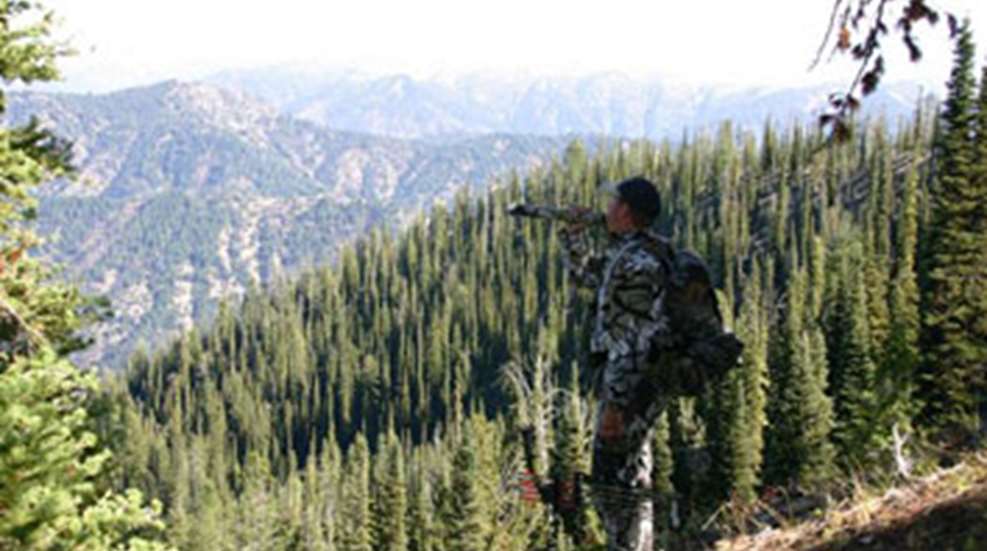
The basis for mountain hunting is a strong enough body to be able to keep steadily going at a reasonable pace for several days at a time. For hunters age 40 years or more who live as sedentarily as most do, a “reasonable pace” is not the equivalent of the pace of a 30-year old that has been guiding in the mountains since he started shaving and does it for months at a time.
That said, you need to become as aerobically fit as possible before your hunt. This is not something that occurs overnight. I liken aerobic training to the economic principle known as the “power of compounding,” which states that the longer your money is invested and earning interest, the faster it will grow. Similarly, the longer you engage in a regular exercise program, the more fit you will become, but when you stop, you go downhill again. Your commitment to prepare for your upcoming hunt means you’ll have to dedicate anywhere from two to six months to the task, depending on your body and the hunt in question.
The goal is not to become a marathon runner, just someone who won’t tap out when the going gets a little tough. Let’s assume you have not been exercising regularly, but have seen your doctor and gotten the go-ahead to get started. Let’s also assume in these tough times you can’t spend the kid’s lunch money on a personal trainer or gym membership. What you need to invest in is a quality pair of well-padded running shoes and a pair of wicking socks, and make a commitment to exercise every day.
Aerobic is a word that means involving or improving oxygen consumption by the body. You do this by increasing your heart rate via exercise for a sustained period of time. This includes jogging, running, riding a bicycle (both stationary and standard), roller blading, swimming or even a brisk walk. Because the thigh and calf muscles will be used hard when climbing, I like to supplement my jogging/running routine by climbing hills or the steps at the local football stadium. I also use the elliptical trainers and stair machines as well as a wonderful tool, the Schwinn Airdyne bicycle at my local gym.
But going to the gym isn’t necessary. Simply get out and walk. After a while, start walking with your pack on, gradually adding some weight. How much weight? You might start out with 5 pounds and gradually increase it to 20 pounds. Need cheap weights? Bags of flour work well, just make sure to wrap them in plastic bags to avoid spillage. In the last couple of weeks before a hunt, I carry a 40-pound pack up and down the hills near home on walks lasting at least an hour. Classic Rock from my iPod keeps me cruising along at a brisk pace.
A hunter must not only prepare to walk farther than day-to-day life demands, but—and this is important—he or she must prepare to walk up and down steep hills for long periods. Trust me, if you have not done the hill work at a brisk enough pace to get your heart rate into the training zone—more on that in a second—your calves and thighs get will get unbelievably sore very fast on the hunt. They need to be specifically trained so they can handle the demands of driving hard uphill and braking on a steep downhill. The weighted daypack will also strengthen the lower back and shoulders.
The aforementioned “training zone” refers to the heart rate required to give you a tangible aerobic training benefit. Basically, everyone needs to exercise at the correct heart rate to get the maximum cardiovascular benefit while staying safe. This is called the training zone. During exercise, most experts agree that you should exercise with a heart rate between 55 and 85 percent of your maximum heart rate. You can find lots of information about this online, but basically, if you are a 40-year-old man, subtract your age from 220. Take that number and multiply it by .55, then multiply the same number by .85. In this case, 220 - 40 = 180 x .55 = 99, and 180 x .85 = 157. This means that during exercise the heart rate needs to be above 99 beats per minute to provide any tangible aerobic benefit, but not over 157 beats per minute, which is 85 percent of the maximum heart rate. In my own training program, I try to get my heart beating at between 75 and 85 percent of my maximum. You must also keep your heart rate in the training zone for a minimum of 20 minutes, but the longer you are “in the zone”, the faster your fitness level will improve, with the exception of interval training, in which you go all-out until you can go no more, then walk until the heart rate goes below the 55 percent of maximum level and, then repeat a few more times.