The surest way to start a passionate debate in any hunting club in America is to say, “The greatest deer cartridge ever invented is,” and name your favorite. Backs will stiffen, voices will raise and pretty soon it’ll get personal. The next best way is to look at a guy’s knife and say the Crocodile Dundee line, “That’s not a knife; this is a knife,” as you pull your blade. Hunters feel strongly about their knives; in fact, this particular debate has probably been going on since two Cro-Magnon men first compared their flint knives. Nevertheless, the answer to what makes the perfect deer knife isn’t purely testosterone meets steel. Knife makers have come up with some answers. Here’s what a few have to say about picking the ultimate deer knife.
Tang
A good deer knife needs to be strong. You don’t want the blade to break off when you use it to split the pelvis on an elk. This is why a full-tang blade is important. The tang of a knife is the portion of the blade that extends down into the handle. A “full-tang” knife means that the metal in the knife’s blade extends in a single piece all the way to the base of the handle. (Obviously this isn’t possible with folding knives. With these knives, you’re looking for a solid locking mechanism that won’t fail in the field.)
Handle
A bone-handled knife can look as impressive as a walnut stock can on a high-end shotgun. Most bone-handled knives today use cow bone that is purposely burned slightly, but some use elk and other big-game bones. Bone is elegant, but it is also a trade-off—looks for utility. Wood handles also can be slippery. Hard-rubber and other polymer-handled knives, however, are easier to grip when they’re bloody, making them safer.
Any knife that has a hollow handle for “storing things” doesn’t garner the ultimate-deer-knife label. Though as manly as axes, these knives have serious drawbacks: Their scary-looking serrations were originally intended to allow air crewmen to cut through the metal skin of crashed aircraft—and no, they don’t function as bone saws. Those hollow handles weaken the knives structurally. I once broke one while opening a can of soup—yeah, I forgot the can opener.
Other than that, the size and shape of a grip is a personal decision, as it needs to fit in your hand like an extension of your pointer finger.
Metal
Some carbon-steel knives seem like they’ll rust up if you breath on them, but you can sharpen them with a few clean passes on a stone. The trouble with high-carbon steel is that if you’re going on an extended hunt you really have to carry a sharpener. For these reasons most knife makers use stainless steel. Mike Dolmage, the director of product development for Buck Knives, says the best compromise with steel is to get a blade around 58-60 on the Rockwell scale. This is hard enough to hold an edge, but soft enough to sharpen in a few minutes.
Blade Type
As you can see, every part of a knife is a compromise. The blade of a deer knife is designed for cutting rather than stabbing, as we need to control the point when field-dressing, skinning and butchering. For this reason it should also have a single sharpened edge. As a trade-off between being a good skinner and a meat cutter, the blade should be slightly curved. Some hunting knives have a blade that has a curved portion for skinning and a straight portion for slicing meat. Buck Knives’ PakLite Large Skinner and Browning Knives’ Backcountry Hunting Knife are two good examples of blades with the right compromises to be an ultimate deer knife.
Blade Point
A drop-point knife fits the ultimate deer knife category best. It allows you to skin an animal using the entire edge of the knife, rather than just the point. This permits quick skinning and causes little damage to meat. It’s also good for field-dressing and boning big game.
Blade Length
This is where the “that’s not a knife; this is a knife” line will ruin you. The ultimate deer knife needs to balance in your hand. You shouldn’t feel like Jim Bowie when you pick up your knife. You must be able to move it surgically as you reach into a chest cavity for the heart or cape a buck. The size will depend on your hand size, but generally an ultimate deer knife should have a blade in the 3- to 5-inch range. Buck’s Alpha Hunter fits my hand best.
Blade Thickness
Generally, the blade of a deer knife should be about .12-.14 of an inch thick, says Dolmage. You want a knife that is strong enough to be used to separate joints, but you don’t want the knife to be too heavy to carry. If the blade bends, the knife doesn’t qualify.
Guthook or No Guthook?
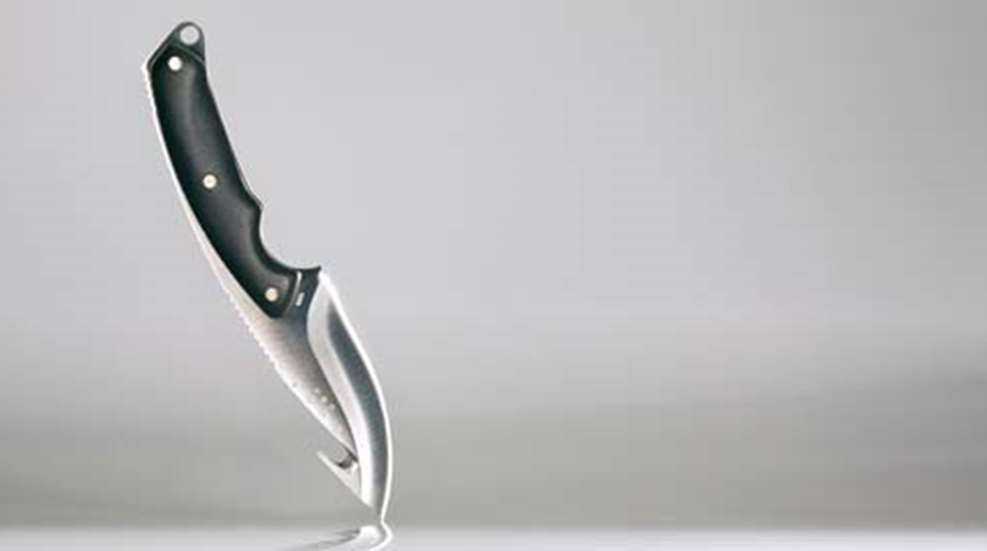
C.J. Buck prefers the Vanguard 692, a traditional deer knife that has a 41/8-inch blade unencumbered by a guthook. I like having a guthook. It can be used to unzip a deer’s abdomen while preventing an errant knick from puncturing internal organs and possibly affecting meat quality. However, guthooks are hard to keep sharp and are really unnecessary, as an experienced hunter soon learns how to make a small incision and then use two fingers to pull the skin up as the blade cuts down from the breast bone. Also, you can’t sharpen a guthook with a regular flat stone, so you will need to purchase a round file. (Unlike the main blade, the guthook is only sharpened on one side, not two.)
Straight Blade or Folding Knife?
Popularity of sheath knives seems to have faded over the last few decades. Buck Knives actually started this trend in 1963 with its Model 110 folding hunting knife. Buck popularized it to such a degree that the term “buck knife” has become a catch-all. Whether your ultimate deer knife is a folding design or a full-tang sheath knife is your call, but realize each has trade-offs.
Sheath
SOG—known for its survival knives—has thought about its sheaths. Many of SOG’s knives come with sheaths that have straps, belt loops and lanyards. The handle strap should be ergonomic—you should be able to open it without thinking. The belt loop should keep it snug to your belt or pack. A lanyard might be necessary, especially if you choose a larger knife. The sheath will affect how you carry and draw your knife, so before purchasing one, try it.
Sheath materials vary from traditional leather to plastic. Leather can be hard to clean blood from and needs to be treated after each season. I prefer the retro look of leather, but realize a nylon sheath wears better on backcountry adventures.