The Myth
The .223 is too light for deer.
The Facts
I read somewhere that today’s premium bullets represent the greatest advance in big game hunting technology since the widespread use of the optical sight, and I agree 100 percent. Many of the myths that we face today are the product of outdated truth—what your grandfather or Elmer Keith said 50 years ago may not be true today. The fact is that today’s premium bullets penetrate deeper, expand more reliably and stay together better than ever before. This has been a game-changer for small calibers (note the resurgence in the .243 Winchester). It’s not that the laws of physics or reason no longer apply, but the fact is that bullet technology has readjusted the scale of which calibers are appropriate for what game. Thanks to these advances, .224 caliber bullets are no longer designed with either varmints or Soviet infantry in-mind. Let’s take a look at factory ammo.
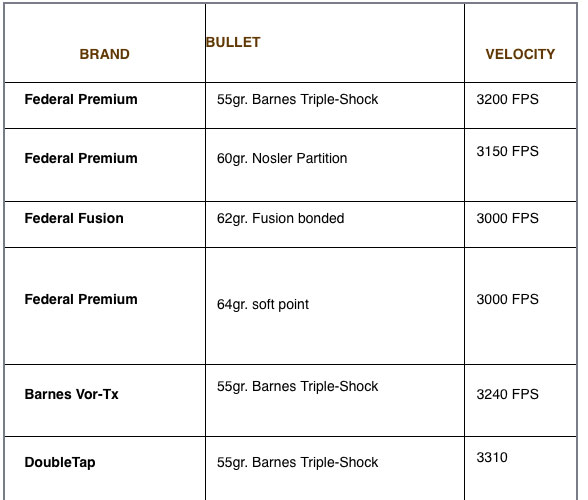
Federal Premium alone lists four factory loads appropriate for deer-sized game, I’m not talking FMJ behind the ear appropriate either—these are legitimate, put-it-on-the-shoulder big game bullets. All of these bullets should shoot well without the need of the fast-twist barrels necessary for the longer, heavier (and excellent) .224 bullets on the market. I’ve personally used three of these bullets in various loads on management whitetails and a truckload of feral hogs—none of them lived to tell about it.
I asked around for some opinions based on more than anecdotal experience. As always, I found a public relations professional willing to answer some questions.
“We would agree that there are adequate loads/bullets for humanely taking deer with the .223,” said Tim Brandt, Federal Premium Public Relations Manager. “We have several .223 loads featuring a couple different bullet options that are designed especially for hunting. Our Fusion line is great example. We see excellent weight retention, expansion and penetration from this bullet in the .223 platform. Hunters that live in areas where it’s legal to use this caliber should have no problem finding an effective load to take into the deer stand.”
Tim also included the following test data, which shows that the average Fusion bullet penetrated nearly 15 inches of gelatin and expanded to .54 caliber. Most of a bullet’s expansion happens within the first inch or so of penetration which means that the Fusion load effectively sends a .54 caliber ball through the vitals of its intended target. I observed recent tests of the DoubleTap load with similar results.
One of NRA’s contracted experts, Richard Mann, helped develop the Bullet Test tube. (It’s slightly harder material than the gelatin used in Federal’s test.) Mann tested Federal’s loads in it and on deer, and here’s what he found:
“The .223 Remington is a suitable cartridge for hunting deer, within its limitation. This cartridge relies on velocity to drive the lightweight bullets deep. This same velocity contributes to tissue damage. The key to using a .223 Remington on deer is to keep impact velocities high. In other words don't shoot deer much beyond 150 yards. Past that distance, the velocity drops below the level needed for dynamic bullet expansion. When robustly constructed bullets like the Barnes TSX, Nosler Partition and Fusion are used inside 150 yards, penetration with the .223 Remington is on par with cartridges like the .243 and the .30-30 Winchester.”
Ok, so we heard from the nerds in the lab coats, what do the guys that shoot deer for a living think? My friend John Shaw has killed more deer than anyone I know—he’s managed an exotic game farm, worked on a Texas whitetail ranch, passionately hunts whitetail in numerous states using the .224 and .22-250. He has also culled scores of does for meat, depredation, and management purposes. John has this to say:
“I rely on my 22 centerfires more so than any other caliber. Low recoil and the typical pinpoint accuracy found in rifles of .224 caliber allow for careful shot placement. If you treat hunting with your .223 much like bow hunting and wait for the perfect shot, there is no reason that this caliber should not be considered for many applications. However, bullet choice is a major factor. Shots to the central nervous system with any type of bullet will work but I recommend premium, controlled expansion bullets, such as Barnes Triple Shocks, Nosler Partitions, and Trophy Bonded Bear Claws. Typically, I keep shots under 200 yards but animals hit in the shoulder, heart, and lung region with a quality bullet expire quickly."
The Conclusion
I’m not saying the .223 is the perfect whitetail bullet, I wouldn’t pack it on a trophy hunt or where long shots were likely but, with the right bullet, it is a legitimate choice for some big game animals. With big game bullets ranging in weight from 55gr. to 70gr., it’s versatile at a range of velocities.