Bacon is one of the most uncontroversial subjects on the planet. To some misinformed groups, meat eating is controversial, gun ownership is controversial, hunting is controversial, but when you combine those things and produce bacon from a wild hog, you have a situation that many can get behind. I know people who are vegetarians except for bacon. It is a condiment after all, isn't it? They say that bacon has five elements of umami, a Japanese word that loosely translates to "savoriness" in English. It encompasses all of the senses: sight, smell, touch, hearing and taste. A food has umami when it has become all that it can be, when it is at its peak of quality and fulfillment.
In America, we typically prepare bacon from the pig belly, but abroad, it is often made from the leaner cuts of meat, including the side and back cuts of the animal. For example, Canadian bacon is made from the loin.
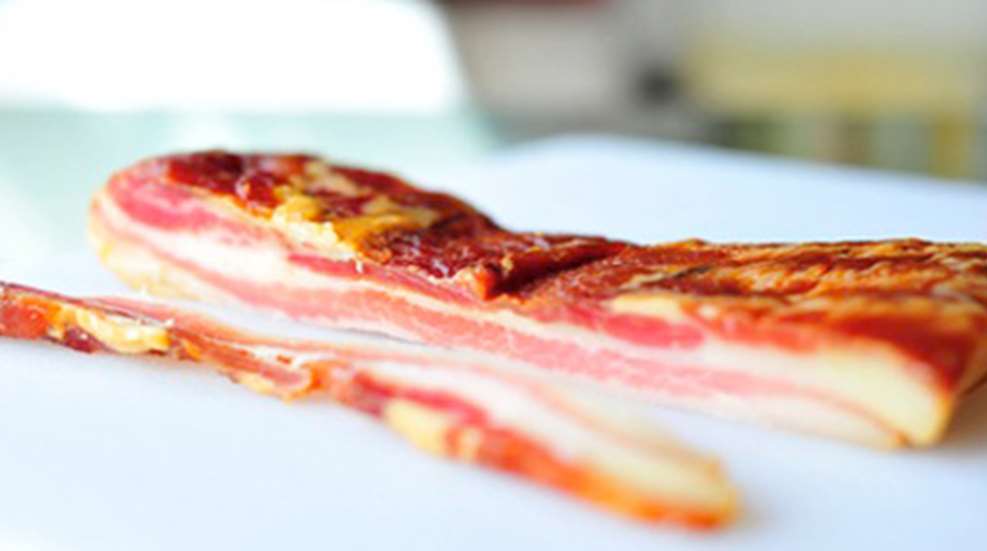
The process of preparing bacon varies as well, but always includes large amounts of salt in either a brine or dry form. Once cured, the result is called fresh bacon, or "green bacon." From there it can be cooked and eaten, or it can be smoked with various kinds of wood depending on what is indigenous to your area-in the South it is pecan wood, in the Southwest it is mesquite, in Washington state it is apple wood, in the Midwest it is hickory. Some people even use corn cobs; the British use peat. This is what gives bacon its unique flavor qualities and makes each batch different, depending on where it was made and who made it.
The choices you make for the bacon cure will also affect flavor. Some people use brown sugar, others use maple sugar and some prefer no underlying sweetness at all. The most essential ingredient regardless of variations is pink salt, also referred to as Prague powder, tinted cure mix or Insta Cure No. 1. It is a mixture of salt and nitrite and is used in many types of cured meat products that are made and then cooked or eaten fairly quickly. The nitrite keeps the meat safe for a short period of time, maintains the meat's red color and gives it that "cured" taste. Its main purpose it to prevent botulism poisoning. Since home curing is experiencing such a renaissance, it can easily be purchased from many places on the Internet.
While home curing offers true versatility in flavor, there are also many ways to use bacon that the supermarket variety doesn't afford. In stores it is most often sold in strips, but when homemade, it can be cut it into batons known to some as "lardons" for classic French dishes, or into thicker cubes for soups, stews and beans, or gently grilled as a whole slab at once and served as a main course. You can also use strips of any size and thickness to lard or bard your other wild game. If you want to achieve a thin slice, freeze the bacon first, then use a long, sharp slicing knife. Bacon from the belly freezes well because of its high fat content, so it is an easy option to always have on hand.
Despite what some might think, bacon can be made from wild hogs just as easily as with domestic pigs. It is just a bit more challenging to find a wild hog with a belly large enough and thick enough to be worthy of bacon. Many wild animals are athletes after all, they don't lounge around all day and get fat. This means you need at least a 300-pound hog, give or take.
My tip for harvesting one of those is to hunt them at night. The largest hogs are the oldest ones, which means they are also the wisest. They know better than to casually roam the woods during the day. But when you do find one of those hogs, it is a rare gem because they provide so many cooking possibilities. There will likely be a thick layer of fat above the backstraps that can be rendered and stored, and the chops will be nice and large and the ribs prime for a good barbecue. With those large loins, you can even dabble in Canadian bacon.
You can make the dry cure for this recipe ahead of time and store it in a plastic container indefinitely to use whenever a large hog crosses your path. One thing to note is that with dry curing, it is best to use weight measurements for all ingredients because it is the most accurate form of measuring. A kitchen scale is a wonderful tool to have, but I've provided approximate volume measurements here, as well.
With this recipe, I challenge you to go and convert a vegetarian. You can offer to be his or her proxy executioner.
"Homemade Bacon"
3-5 pounds (1.5-2.25 kilograms) pork belly, skin on if you plan to smoke it, skin off if you don't
1/4 cup (50 grams) dry cure
Dry Cure
2 cups (450 grams) Kosher salt
1 cup (225 grams) sugar
10 teaspoons (50 grams) pink salt #1
1. Trim the belly of dry meat and glands, trim it for neat edges.
2. Combine the salt, sugar and pink salt. Cover the bellies with the mixture, pressing it in all the cracks and crevices. Do this until all sides are evenly and well coated.
3. Place the belly on a sheet tray in the refrigerator for 5 to 7 days, until the belly feels firm throughout. Flip the belly once a day to make sure it cures evenly.
4. Remove the belly from the refrigerator and rinse. Dry it thoroughly.
5. The belly is ready to use. If you want to smoke your bacon, set your grill or smoker to 200° F and burn out wood chips for at least a half hour. Hot smoke the belly to an internal temperature of 150° F.
6. Remove the skin now with a sharp knife while the fat is still warm. The bacon will keep up to two weeks in the refrigerator, or you can cut it into manageable sizes, wrap it in plastic,and store it in the freezer for several months.
Makes about 2 ½-4 pounds (1.25 - 2 Kilograms) of bacon