Frozen Bolt
First off, shame on you for this one. I have seen firearms freeze up many times when the temperature drops in the neighborhood of zero. If your gun fails to fire in extreme cold, it usually means you should have degreased the bolt before the hunt.
In the field, take the bolt out of the gun and put it under your clothes, such as under your armpit or crotch. For the record, I tried both and I vastly favor the armpit. You will need to keep the bolt under your clothes until it’s warm. Then it will function until it gets cold again.
Back at camp you can use lighter fluid, gasoline or Coleman lantern gas to remove the grease. Soak the bolt overnight and then slosh it around to flush out the grease. Work outside and stay a good distance from any flame. I once had a Coleman lantern ignite the fumes from a 5-gallon gas can from 10 feet away. I was outdoors on a boat dock and I was holding the can and pouring the gas. Trust me, it’s not something you want on your life-experiences list.
A dry bolt will work temporarily, but you should re-lubricate if you can. There are plenty of good lubricants on the market today that maintain viscosity at extreme temperatures such as Break-Free CLP, which is rated to 65 degrees below zero.
Plugged Barrel
This one is common; in fact, just last week I fell off a snowmobile while on a late-season Colorado elk hunt. My rifle barrel was plugged full of snow, which for the record is much better than mud. Either way, it’s a common problem. The best solution is to have a segmented cleaning rod with you. But who thinks that far ahead? Never try to shoot an obstruction out of the barrel—this could wreck your gun or kill you. Also, don’t try to cut a tree branch and jam it down the barrel. That almost always results in a branch stuck in the bore in addition to the snow or mud.
Remove the bolt or open the action on a rifle or shotgun and completely unload the gun. If possible (as with break-open guns or those that allow you to remove the barrel) blow air down the bore from the chamber end. Short, hard, rapid, blasts are better than a constant pressure. This will remove 90 percent of the obstructions. If it does not work, try warming the barrel by rapidly rubbing your hand up and down the outside. Or use a lighter, a truck tailpipe or (carefully) a campfire. You are only trying to melt whatever is in there enough so you can remove it, so don’t let it get too hot.
Once you have the obstruction out of the bore, clean out the mess in the action with the handkerchief. If it’s mud, chances are it is not cold enough to freeze, so carefully pour water from the breech end, letting it run out the muzzle to flush out the dirt and crud. If you have a solid obstruction that cannot be removed this way, like a stuck bullet or compacted mud, then you must use a rod. If that fails, find a gunsmith.
Broken Stock
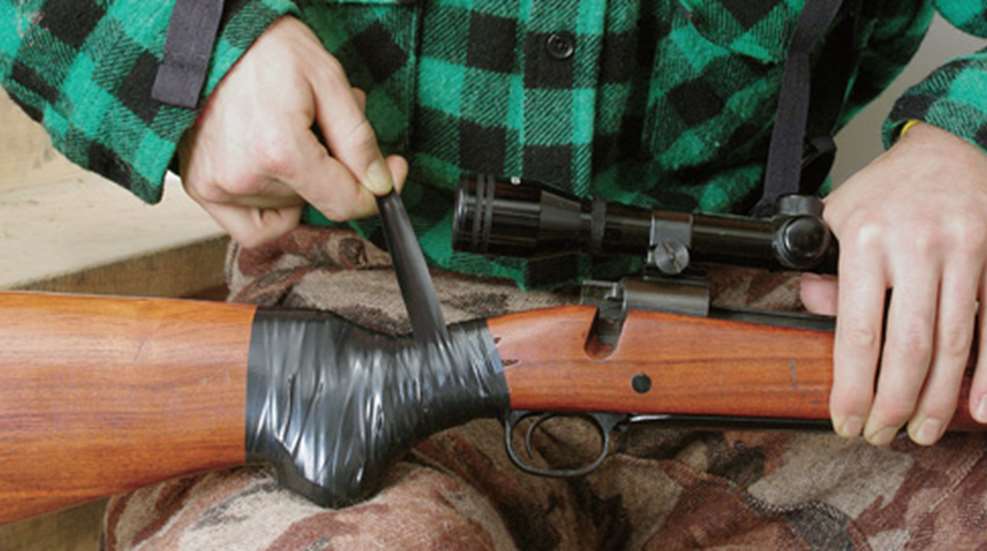
You fell and now your rifle’s stock is broken. This fix is not pretty, but it will help you complete the hunt. Most camps have some sheetrock or wood screws hanging around; find them. You can do this repair with just glue and tape, but some “structural” support, like screws, is far better. Even finish nails will work. It’s best if you can pre-drill the holes to keep the stock from splitting. Coat all the broken areas with epoxy glue, if available. Put the pieces together and gently tighten the screws or tap in the nails. Then wrap it all with lots and lots of electrician’s tape. Start at the center and wrap to one end, overlapping by half. Then come back, past the center to the other end. Go back and forth this way for several passes. Apply enough pressure to stretch the tape to three-quarters of its width. Each wrap of the stretched tape provides more tension and more strength. Make sure that you wrap the tape well past the broken area, at least 2 inches on each side, more if you can. Let the glue dry overnight and be gentle with the gun for the rest of the hunt.
Sling Swivel Pulled Out
If the sling swivel pulls out of the stock it’s probably a coarse “wood screw” thread and the odds are the hole is stripped. First fill the hole with epoxy glue, then jam a couple of wooden matches in to fill it and cut them off flush with the stock. Now screw the swivel back into place. Wipe off the excess glue, let it set at least overnight and it should hold fine for the rest of your hunt.
Of course, the list of potential problems is much longer than this. When they occur on a hunting trip, think like a Marine—improvise, adapt and overcome. Every problem has a solution; you just need to find it.
Build Your Skills: Re-Zero a Beat Up Scope
Your gun took a hard knock and now the scope is whacked out of zero. Your problem is sighting in again with the limited ammo you have with you. Put a big target at exactly 100 yards. Improvise a shooting rest, use a rolled up sleeping bag, a horse saddle … whatever you can find, just support the rifle completely front and rear. You can be prone or you can shoot off a table or bench. The gun must be immobile and the crosshairs must be steady on the target.
Carefully aim at the bullseye as you slowly increase pressure on the trigger. The crosshairs should be on the center of the target when the gun goes off and the shot should surprise you a little.
Measure from the bullet hole horizontally straight across to the center of the target. Then measure up or down to the horizontal center line. Most scopes will move the point of impact ¼ inch per click at 100 yards, so convert your measurement into clicks. Move the scope the number of clicks needed. Take the lead tip of a bullet or the plastic handle of a knife and sharply tap the adjustment knobs on the scope several times. Sometimes the internal adjustments stick, particularly after a hard jolt, and this helps remind them to behave. Now carefully fire one more shot and you should be zeroed.