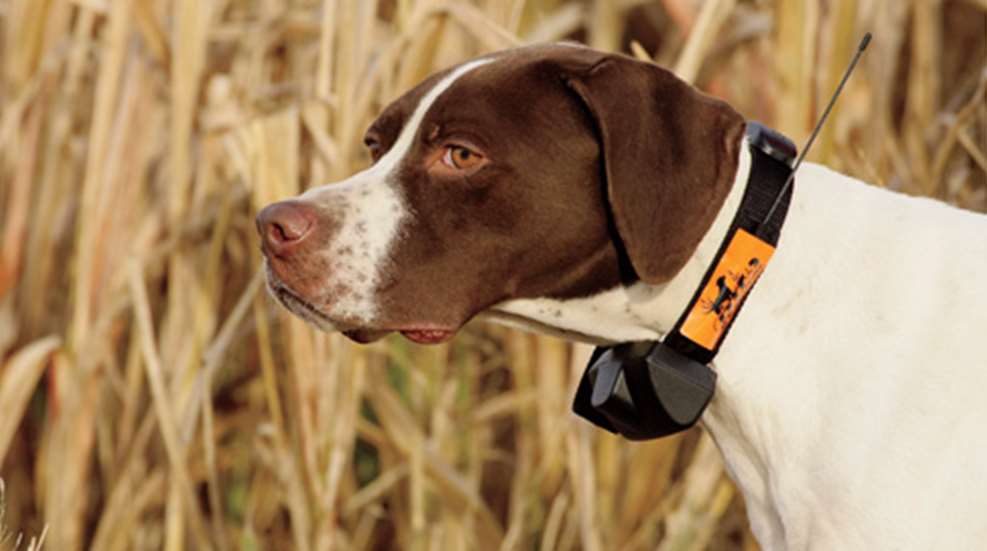
Many dog trainers labor under the misapprehension that an electronic training collar is only for negative reinforcement. “My danged pup won’t come, so I’m gonna get an electric collar and show her who’s boss!”
According to Bryant Kim of D.T. Systems, using the collar in this manner will only confuse your dog.
“Many top pros have found that the right way to use an e-collar is to introduce it gradually and minimally to encourage the pup to do the right thing,” Kim said. “Later it can be used for less-subtle corrections.”
Collar Conditioning
Pro Lab trainer Dan Ihrke of Illinois uses training collars in his program, but not until after he has taught the pup to sit, come and heel using a leash, strap collar and reward treats. At four to six months (depending on how quickly the pup learns), Ihrke transitions the pup to the choke collar for advanced sit/come/heel training. At this point, the pup gets its first taste of negative reinforcement as it learns to avoid pressure (the slight discomfort of the choke collar) by complying with commands.
For instance, say “sit” and put upward pressure on the leash until the dog sits, then release. Say “come” and pull the leash until he comes, then release. Apply pressure when the pup strays from your side during “heel” training and release when he returns. If you’re patient and consistent, before long your dog should have an understanding of the concept of pressure.
“When your dog is responding well to these two formats,” Ihrke said, “we begin collar conditioning.” Ihrke suggests having your dog wear the collar in the off mode for at least two weeks before beginning. Start by establishing the dog’s base stimulation level, the first point at which he can detect the collar’s buzz. For some dogs this is level No. 1, for others it might be No. 3 or higher. The pup will tell you by reacting slightly—a twitch or ducking of the ears. You can now use this low level of stimulation to start applying pressure to your dog in much the same manner as you used the choke collar. If your dog refuses an understood command and ignores the e-collar stimulation, you can increase the stimulation by one level.
Initially Ihrke suggests using the e-collar and choke collar simultaneously to reinforce known commands. When the dog is performing consistently, Ihrke dangles the leash so the only pressure comes from the e-collar. Many dogs will quickly understand that they can eliminate the e-collar pressure the same way they eliminated the leash’s pressure—through compliance. Others will learn more slowly. “If the dog gets confused about the e-collar pressure, I apply pressure with the leash to remind him what he’s done wrong,” Ihrke said. “Eventually the dog will fully transition to off-leash, e-collar training.”
In short, Ihrke uses the e-collar to guide a dog to success, not to punish it. “Stimulation from the collar should be construed by the dog as an indicator it has made the wrong decision,” he says. “That way the dog can think and choose the right response on the next try. And when he gets it right, always reward his success with positive reinforcement.”
The “Notifier” System
A variation on Ihrke’s approach uses the lowest detectable stimulus as a “notifier”—an immediate warning to the dog that it has made the wrong choice after a command. The dog is then quickly given a slightly higher level of stimulation. The neat thing is you only have to dial up two or three levels above the notifier before the dog thinks the sky is falling. It’s the contrast that does the trick. I could barely feel the stimulation from a D.T. Systems H20 1850 collar until it was dialed up to No. 6, yet a retriever pup was responding to it at No. 2 and thought God tapped him on the shoulder at No. 5.
The key is to never use the higher setting until the dog has proven he knows a command. Then, if he ignores it, immediately notify him he has made the wrong choice with a low-level buzz. Follow this in about 2-3 seconds with a quick spurt at the higher setting. The elapsed time gives the dog a chance to contemplate his predicament. He knows what he’s done wrong and he knows the correction is coming.
Pro trainer George Hickox adds two critical points: be consistent and use single commands. When your dog knows the “whoa” or “hup” command, for instance, he doesn’t need to hear it five times. If he ignores it the first time, he’s willfully disobeying and must be notified and corrected. If you aren’t consistent in this and let him get away with an infraction even one time, you’ll be fighting him for weeks because he now knows he can sometimes sneak one past you. If the temptation is worth the risk, according to Hickox, he’ll be willing to try it on for size, just like a child begging at the candy store.
Pressure On/Pressure Off
This technique also uses the e-collar’s lowest detectable stimulation level. You put pressure on, the pup gives you the correct response and you take it off. For example, you could activate the low stimulation, direct the pup into its kennel and immediately turn the stimulation off when it crawls inside. With a few repetitions the pup learns that getting into the kennel will stop the annoying buzz. That’s his reward. Next, overlay the “kennel” command, and the pup quickly learns that obeying “kennel” precludes any irritation. You can similarly teach sit, down and heel. Apply the buzz, help your pup into the correct response, switch off the buzz and then overlay the command. You can apply a slightly higher dose of pressure later if necessary.
This also happens to be one of the most effective ways to force-break retrievers. Apply the buzz, put a dummy in the Lab’s mouth and end the obnoxious tickle. As the dog learns the concept you can overlay the fetch command. It’s easier and less stressful than the old ear-pinch technique and, unlike your arm, high-end e-collars reach out a country mile.
Many good trainers use e-collars as much to guide their dogs to the proper decisions as to punish their disobedience. It’s a kind technique when you think about it. Using a solid training regimen in conjunction with today’s finely tuned e-collars is one of the surest means to a happy dog and trainer alike.
Most Popular