Last year I shot a buck with Hornday's new "expanding solid" bullet. In addition to recharging my freezer, I was granted the opportunity to evaluate the bullet's performance on game. The GMX is non-toxic and California-compatible, but it's also a high-performance bullet for hunting.
One whitetail is not a conclusive test of any bullet, but it does give some indication of what to expect. The path of destruction through the buck was impressive: It started by smashing the near shoulder, passed through at an angle and exited behind the ribs on the far side. Expansion clearly started early and the wound channel grew large, creating massive damage to the lungs, which indicates a large frontal area with good energy transfer. Finally it exited, which I expect from a big-game bullet.
The concept of a monolithic (defined as one homogeneous piece of metal) expanding bullet is hardly new. Barnes developed the idea and introduced its X-Bullet 20 years ago. Legendary terminal performance coupled with emerging social factors that have demonized lead (e.g. the green movement) have created a growing market for this style of
hunting bullet. Hornady has decided to step into the arena.
The new Hornady bullet is called the "Gilding Metal eXpanding" (GMX), which gives a clue to what monolithic metal is used. Gilding metal is the same material most jacketed bullets use to wrap the lead core, an alloy composed of 95 percent copper and 5 percent zinc. Gilding metal has more lubricity than pure copper and has been found to produce less metal fouling and lower bore friction than copper. It is malleable enough to expand without breaking, but tough enough to resist further shape change once expansion is completed. It has been the standard for jacketed bullets for generations and is proving to be a very good choice for monolithic, expanding bullets.
In general these types of projectiles exhibit very high weight retention-they have no core from which to separate, which aids in penetration. They open early, but once the expansion reaches the solid shank below the hollow cavity in the nose, the expansion stops. Plus, because gilding metal is much tougher and far less malleable than lead, the bullet retains its shape during penetration, and this keeps it on a straight course.
The downside of a monolithic bullet is the cost, which is typically much higher than a traditional lead-core bullet; also, because the specific gravity of the material is lower than lead, the bullet will be longer in any given weight. To meet the specified cartridge overall length they must be seated deeper into the case, which robs powder space. This is critical in some cartridges, but not all.
In years past, monolithic bullets had some other problems, but they are fading away as technology evolves. Because the bullets are longer and much harder than lead-core bullets, they caused internal pressures to spike earlier, therefore they had to be loaded with less powder and so produced slightly less velocity. Also, monolithics often had fouling and accuracy issues; however, the new designs have all but eliminated those problems.
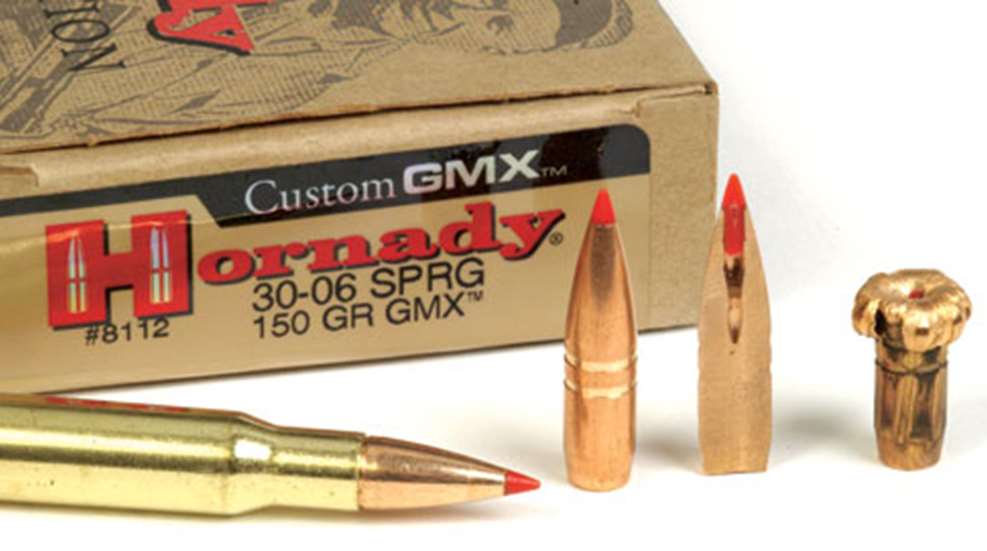
The boattail-style GMX has a polymer tip to raise the ballistic coefficient and to aid in initiating expansion. There are two rings cut into the forward portion of the bearing surface of the shank. These allow the displaced metal to flow when engaging the rifling, which can improve accuracy and reduce metal fouling. The front ring also serves as a crimping groove, or cannelure.
Hornady's Steve Johnson explained that one important goal when designing the bullet was that the load data for all its other bullets of the same caliber and weight must also work with the GMX bullets. Johnson assured me that any data developed for handloading Hornady's other bullets are fine to use with the GMX, provided the caliber and weight are the same. The GMX was also designed to have a similar BC as its lead-core, plastic-tipped, boattail bullets for big game, such as the SST and Interbond.
The GMX is a sleek bullet with a high ballistic coefficient of .415 (for a .30 caliber, 150-grain bullet) and proved to be accurate in my rifles. I shot it in the Knight KP1 and a Remington 700. Accuracy in both rifles was in the upper percentile of factory loads tested in these guns. This accuracy potential, combined with the high BC, make the GMX a good long-range choice with positive expansion at impact velocities as low as 2000 fps. But it's tough enough to withstand high-speed, close-range impacts as fast as 3400 fps. That's a very wide performance window, which is important in a big-game bullet.
Unlike the notable Barnes bullet that expands in a four-petal X shape, the GMX is designed to expand into a mushroom similar to conventional lead core bullets, which increases the frontal area. Like any monolithic expanding bullet, the GMX has excellent weight retention and deep penetration. Hornady claims 1.5-times expansion and 95 percent weight retention, with 30 inches of penetration in ballistic gelatin.
To test that claim, I fired two .30-06, 150-grain GMX bullets point-blank into Perma-gel. The average penetration was 34.25 inches. The average retained weight was 149.35 grains, which, when you account for the missing plastic tip, is 100 percent. The average expanded diameter was .501 inch. To compare, I fired a 180-grain Hornady Interbond .30-06 at the Perma-gel. This bullet is 30 grains heavier and has a reputation for excellent penetration. It penetrated 24.75 inches, weighed 142.8 grains and measured .539 inch. Although the Interbond exhibited larger expansion, the GMX beat it in penetration and weight retention.
Another impressive trait is that it retains a long shank after expanding, which aids in straight penetration. These bullets penetrated so straight in Perma-gel that both still had fragments of their plastic tips captured in the dimple in the center of the bullet.
The GMX is currently available in five bullets and six factory loads, but this line will surely grow. This versatile bullet is a good choice for any big-game hunting from antelope to zebra. It clearly works well on deer and may well be the best bullet for bigger game like elk that Hornady has ever produced. It fills a big hole in the Hornady line as until now it lacked a super-premium bullet. I think the GMX is destined to become one of the most respected hunting bullets on the market.
Bullet Type: expanding monolithic
Point: polymer tip
Material: gilding metal
Base: boattail
B.C.: .415 (150-gr., .30-cal.)
Calibers/Grs.: bullets: . 270/130-gr.; 7mm/139-gr.; .308/150-gr.; .308/165-gr.; .338/225-gr.; loaded ammo: .270 Win./130-gr.; 7mm Rem. Mag./139-gr.; .308 Win./150-gr.; .30-06/150-gr.; .300 Win. Mag./150-gr.; .300 RCM /150-gr.
MSRP per box: bullets (per 50) $38.91-$47.67; loaded ammo (per 20) $47.92-$52.60