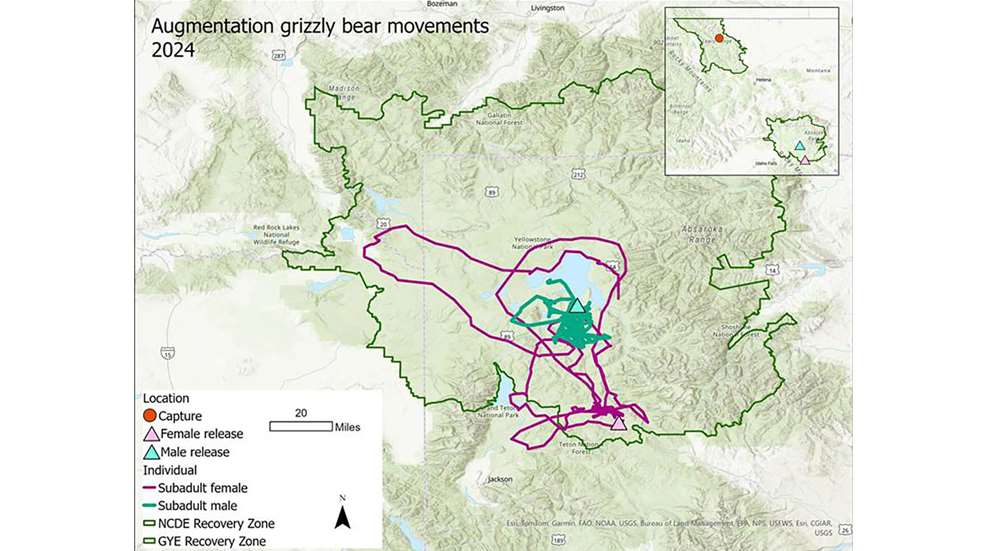
The lines on the map look like the doodling of a toddler, but they reflect the movements of the female (pink) and male (green) grizzly bears relocated from the Northern Continental Divide Ecosystem (NCDE) to the Greater Yellowstone Ecosystem (GYE) this past summer. Both ecosystems have populations of grizzly bears that have surpassed recovery goals.
The translocation effort was designed to help increase the genetic diversity of the GYE population, which has been isolated from nearby populations for years. The effort may be repeated in the future, depending on how close the two populations eventually grow. Ken McDonald, head of Montana Fish, Wildlife & Parks’ Wildlife Division (FWP), said the relocation was a jump start to a process that would likely occur in the future.
The July capturing and collaring of the bears took place southwest of east Glacier, in a remote area of the Middle Fork of the Flathead River drainage. The pair were then driven overnight to the GYE. One was a 3- to 4-year-old female, the other a 4- to 5-year- old male.
“We were looking for the ideal bears,” McDonald said. “It’s actually not that easy to capture two bears that are prime candidates for translocation.”
The bears were subadult, meaning they were older than cubs but not at sexual maturity. They also had no history of conflict and weighed enough to prepare for hibernation. “Bears of this age are often in search of their permanent home range,” according to McDonald, “therefore they are more likely to stay in the relocation than more mature individuals.”
FWP worked with partners from the National Park Service and the Wyoming Game & Fish Department on the translocation destinations. The male bear was hauled by boat to the southern end of Yellowstone Lake. The female was taken to a remote location in the Blackrock Creek drainage west of Dubois, Wyo.
“We are very pleased to see that both bears have remained in the GYE, even staying mostly within remote areas of the Recovery Zone,” said Cecily Costello, FWP grizzly bear researcher. “It’s not always easy for a bear to adjust after being moved like this, but they seem to be settling in. We believe both have recently found a den site for the winter.”
Population recovery levels in the NCDE and GYE were passed several years ago. Montana has petitioned the U.S. Fish and Wildlife Service to delist bears in the NCDE, and Wyoming, with support from Montana and Idaho, has petitioned to delist grizzly bears in the GYE.
In both ecosystems, the states have met the delisting requirements and addressed concerns identified by the public or lined out by federal courts that have overturned previous delisting efforts.