Last year Savage unlocked the code to making the .17 HMR work in a semi-auto rifle with their A17. The same A17 that won the American Hunter Golden Bullseye award for Rifle of the Year. Lost in the brilliance of this rifle was the new A17 ammo that was developed by CCI and introduced with the rifle. Using the latest in technology, this new load elevated the performance of the .17 HMR to yet another level.
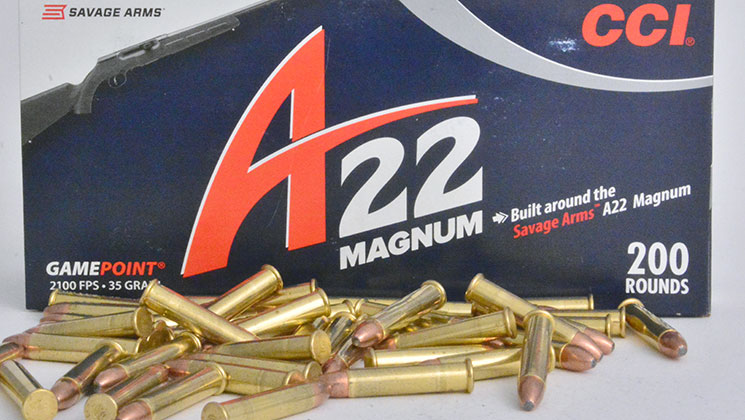
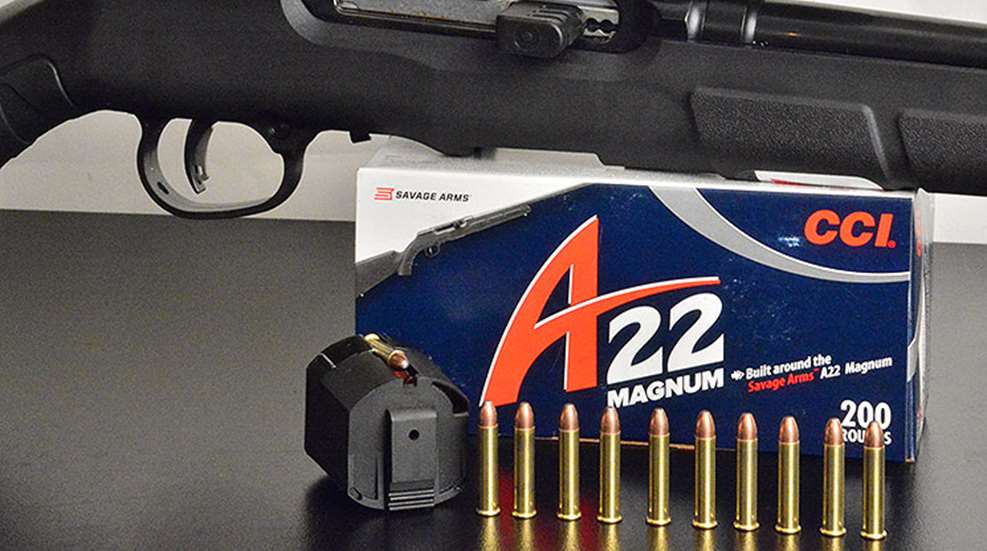
The .17 HMR cartridge is made by necking the .22 Magnum cartridge down to take a 17 caliber bullet, so it makes sense that Savage would look at the .22 Magnum next. This year they introduced the Savage A22 Magnum rifle. It is more or less the same rifle as the A17, but with a slightly bigger hole through the barrel. Following the successful lead from last year, CCI also introduced a new companion load for the gun. (Of course, it works great in existing .22 Magnum rifles as well.)
 The .22 Magnum is a bit of a fire-breather in terms of rimfire cartridges. It’s under appreciated as it rises well above the .22 LR in performance. It’s been around since 1959 and was the only truly successful rimfire cartridge introduction of the 20th century. It’s a great little cartridge for hunting small predators and larger varmints. For foxes or bobcats called in close, it’s perfect, while it anchors tough critters like ground hogs and prairie dogs easily with careful bullet placement. It works well on rabbits, squirrels, raccoons and similar small game. It can take coyotes in a pinch. I have even shot a deer with the .22 Magnum. It’s not a deer cartridge by any stretch, but it was legal to use where I was hunting and it was a target of opportunity. I am simply illustrating that it can be versatile. It’s a surprising little rimfire that bridges the gap to centerfire quiet well.
This new loading for the 57 year old cartridge brings in some of today’s cutting edge technology. CCI used a new progressive burning propellant specifically developed for this class of rimfire cartridges. This propellant results in higher velocity without a pressure spike. The concept behind progressive burning powder is that it flattens the sharp angles on the bell shaped pressure measurement graph. The peak stays the same, but the angles on either side of the pressure curve are more gradual. The pressure is spread more evenly than the old days where it rose quickly to a peak and then dropped off just as quickly. By controlling the burn rate and progressively increasing it, the pressure rises gradually and drops gradually, meaning there is more pressure behind the bullet for a longer period of time. The result is that the average amount of pressure during the “event” (engineer-speak for firing the cartridge) is much higher, so it equates to higher velocity. Not a lot; it’s a small cartridge and only holds a little powder, but it all counts.
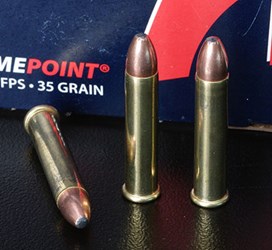
The new 35-grain Game Point bullet also uses new technology. The thin jacket is electronically plated to the lead core, much the same way the chrome is attached to a trailer hitch ball. Then the bullet is skived and is pre-expanded. After that it is formed back into the final shape under high pressure with a forming die. The metal retains memory of that pre-expansion which creates easier and controlled bullet expansion on impact. If this sounds familiar, that’s because it’s the same technology used in the very successful Fusion big game hunting bullets. This is all very high tech for a rimfire cartridge.
My testing, using the Savage A22 magnum rifle, produced higher muzzle velocity than the advertised 2,100 f.p.s. I measured 2,225 f.p.s. average velocity from a 22 shot string. That means the little 35-grain bullet is generating 385 foot-pounds of energy. That’s more than most 9mm handgun rounds. Accuracy was outstanding; one group measured .20-inches and the average for three, 3-shot groups at 50 yards just over half an inch.
The CCI A22 Magnum jumps the .22 Magnum to the next level.
Accuracy Results
Cartridge: CCI A22 35-Grain
Velocity at 15' (fps): 2225
Energy (ft.-lbs.): 385
Smallest Group Size: .2"
Largest Group Size: .9"
Average: .53"
*Testing was conducted with the Savage A22 Magnum Rifle, topped with a Bushnell Trophy 1-4 scope. Range test results are reflection of three, 3-shot groups at 50 yards. Machine front rest with sand bag, toe bag in rear.