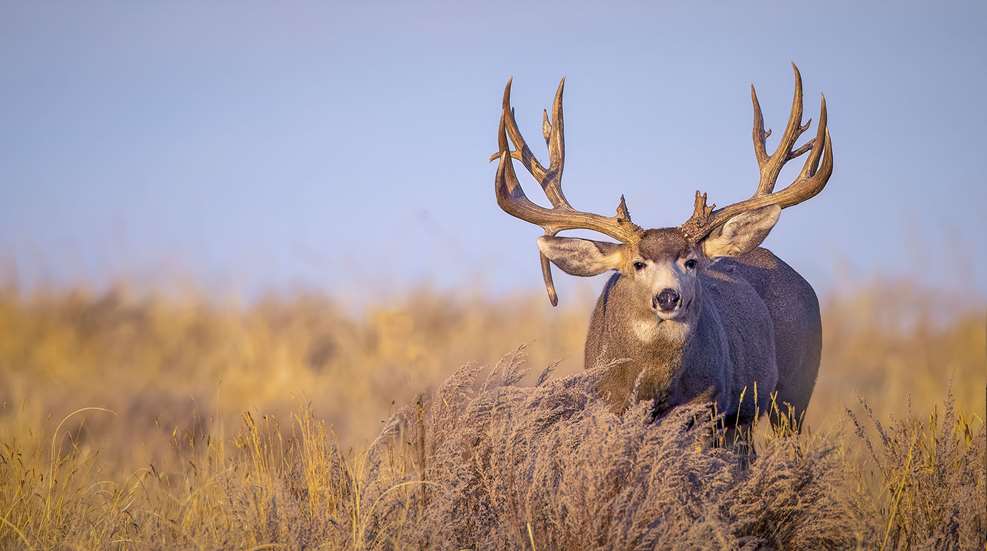
Dawn had already swept a silvery wave across the ragged landscape when I heard the distinctive boom of a distant long rifle. The sound is different than the whip-crack of a high-powered rifle or the heavy thud of a 12-gauge; it’s more of a deep-chested roar. It was a sound I’d been hungering to hear ever since my son and I parted company in the darkness several hours earlier. We were several days into Utah’s muzzleloader mule deer season and my son, hunting on the far side of a canyon, had evidently just gotten a shot. With deep anticipation I waited, listening. Minutes strolled by on lazy feet until finally the message rolled in: “I just shot a big one!”
This harvest was a significant one for my 16-year-old son, Josiah, because he was hunting with a traditional long-barreled muzzleloading rifle built with his own hands. Hours and days had stretched into weeks and months while he labored over the gun, crafting it between work and school. There’s a lot of precision wood and metal work to learn during such a project, and mistakes are to be expected. While hand filing the dovetail for the rear sight, his file ran away with him and the dovetail turned out too big. The sight was loose in its slot and he came to me for advice.
“Make another one,” I said. A day later he showed me a new rear sight, cut and filed from an old railroad spike. I could tell he was proud of it, and rightly so. This one fit snugly into the dovetail, and the rifle was almost completed. After sanding, staining and finishing, Josiah triumphantly carried the rifle out to our range, poured some genuine black powder down the barrel and rammed a patched round ball home atop the powder. When that first shot bellowed smoke downrange his smile spread from ear to ear.
 Across two days in the Utah backcountry, father and son took great bucks and great photos then relived great stories of mule deer bucks taken the hard way.
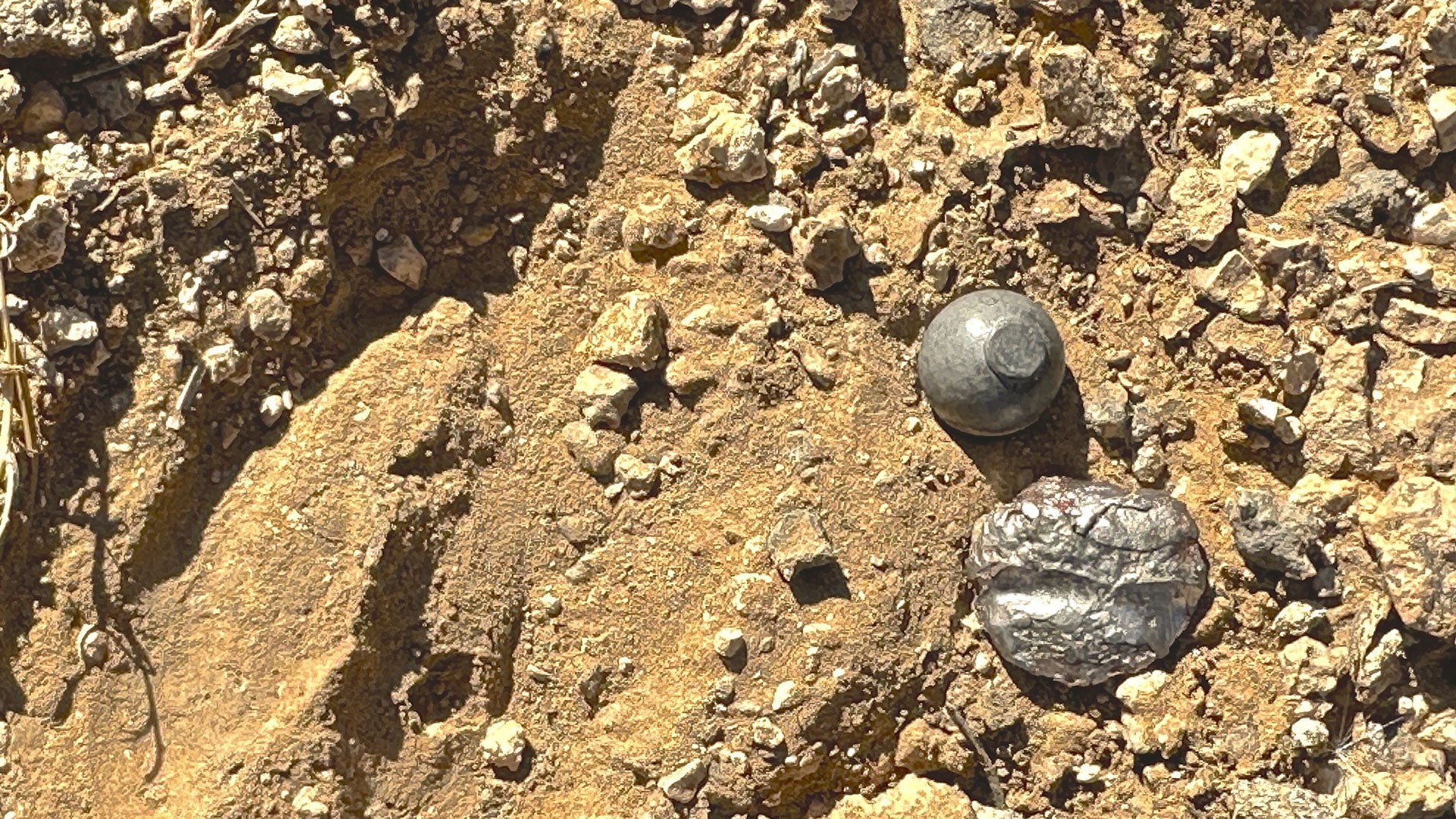
Just like modern cartridge rifles, some muzzleloaders can be picky about their diet. Others are easy and tend to be accurate regardless what you shove down their maw, but Josiah’s proved to be of the previous disposition. Despite being mounted with a top-end barrel by Rice, it didn’t like anything Josiah fed it. He tried .530 inch and .535 inch round balls, the two sizes intended for use in .54-caliber slow-twist barrels. He tested several good materials in different thicknesses for patching, treated with a multitude of different lubricants. He adjusted powder charges. Finally, he found the rifle’s chosen diet: a Hornady .535 swaged round ball wrapped in a .018-inch-thick cotton drill patch lubed with olive oil and seated atop 90 grains of FFFg Goex black powder. With a maximum lethal range of 125 yards, Josiah was ready to go hunting.
Why, you might ask, would we choose to hunt with traditional muzzleloaders instead of taking advantage of technology and modern design? We could hunt with in-line, stainless-and-synthetic, scoped muzzleloading rifles accurate to 500 yards or more if we chose. But the fact is we enjoy the history, romance and beauty associated with traditional rifles—in a word, they have soul their modern counterparts can’t provide.
America has been a nation of riflemen from the beginning. Early settlers developed the first truly accurate muzzleloaders mounted with long, rifled barrels. These long, rifled guns played a significant role in our war for freedom. Frontiersmen used to picking squirrels out of trees had no problem perforating the much larger marauding redcoats. In a sense, we owe victory and the freedom we enjoy today to those long-barreled flintlock rifles of yesteryear.
Another attraction to hunting with a traditional long rifle is the added challenge it brings. What hunter isn’t more fulfilled by a harvest achieved while using challenging equipment? Hence our personal enchantment with gleaming wood, clouds of black powder smoke and long, sleek, iron-sighted barrels. It’s a remarkable feeling to stalk close enough to place a round ball through the vitals of your quarry. We crave that feeling and embrace every opportunity to sally forth with our long rifles in hand.
Josiah had never killed a deer with a smokepole, though two years earlier he’d crawled within 50 yards of a big pronghorn buck and, when it stood from its bed, dropped it with a perfectly placed patched round ball sent from his mama’s long rifle. Now, hunting in one of our favorite mule deer honey-holes, he hoped to shoot a nice buck with his own just-finished rifle. There was a double handful of bucks in the region, including a half-dozen deer big enough make a hunter weak at the knees and shaky of hand.
We were three days into the hunt and so far the deer had outwitted Josiah at every turn. This morning he hot-footed his way across our big canyon in the darkness, hoping to ambush the bucks as they left the canyon and traversed an adjoining mesa toward a bedding area. Mule deer are notoriously inconsistent in their movements, making it difficult to anticipate their travel route. On previous mornings the bucks had passed just out of range. Josiah hoped today would be different.
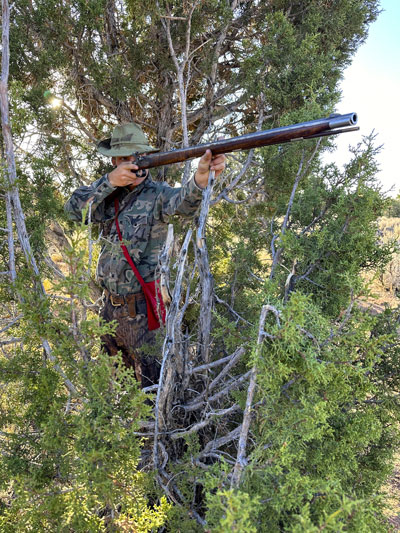
Dawn found him set up between a couple of juniper trees, a big one at his back and a slender one to his fore. As shooting light arrived he leveled his long Southern Mountain rifle, using the slender juniper for support. These bucks were old and wise, and typically departed the open just as dawn arrived. He shouldn’t have long to wait.
Sure enough legs, brown hair and antlers started to show in glimpses through the brush. A bachelor group of bucks was headed almost right for Josiah, and his heart went into overdrive. Grasping his slender juniper and holding the gun’s fore-end against it with his left hand, he focused on holding the long rifle steady. His right knee began to leap about uncontrollably, gyrating so intensely that he couldn’t keep it straight. Giving the knee a slight bend, he managed to quiet the shaking. The bucks paused 50 yards out, feeding behind a screen of trees. His left hand was growing painfully numb, fatigued from clamping his rifle against the tree. He waited, heart beating so loudly he was afraid the bucks would hear the pounding.
Finally the bucks emerged from their screen of trees, walking straight away and offering nothing but a Texas heart shot. Wisely Josiah waited, tracking the biggest of the bucks with his iron sights. When the deer finally did turn and offer a heavily quartered-away shot he was 104 yards distant. Settling the sights on the buck’s last rib, Josiah carefully pressed the trigger.
Smoke obscured the deer behind a rolling cloud of pungent gray but not before Josiah saw it drop, hard-hit by his round ball. In feverish haste he reloaded his rifle. Several more nice bucks walked out of the brush 50 yards distant, just standing there as he rammed a fresh lead ball down the long barrel. They never did that when he was trying for a shot!
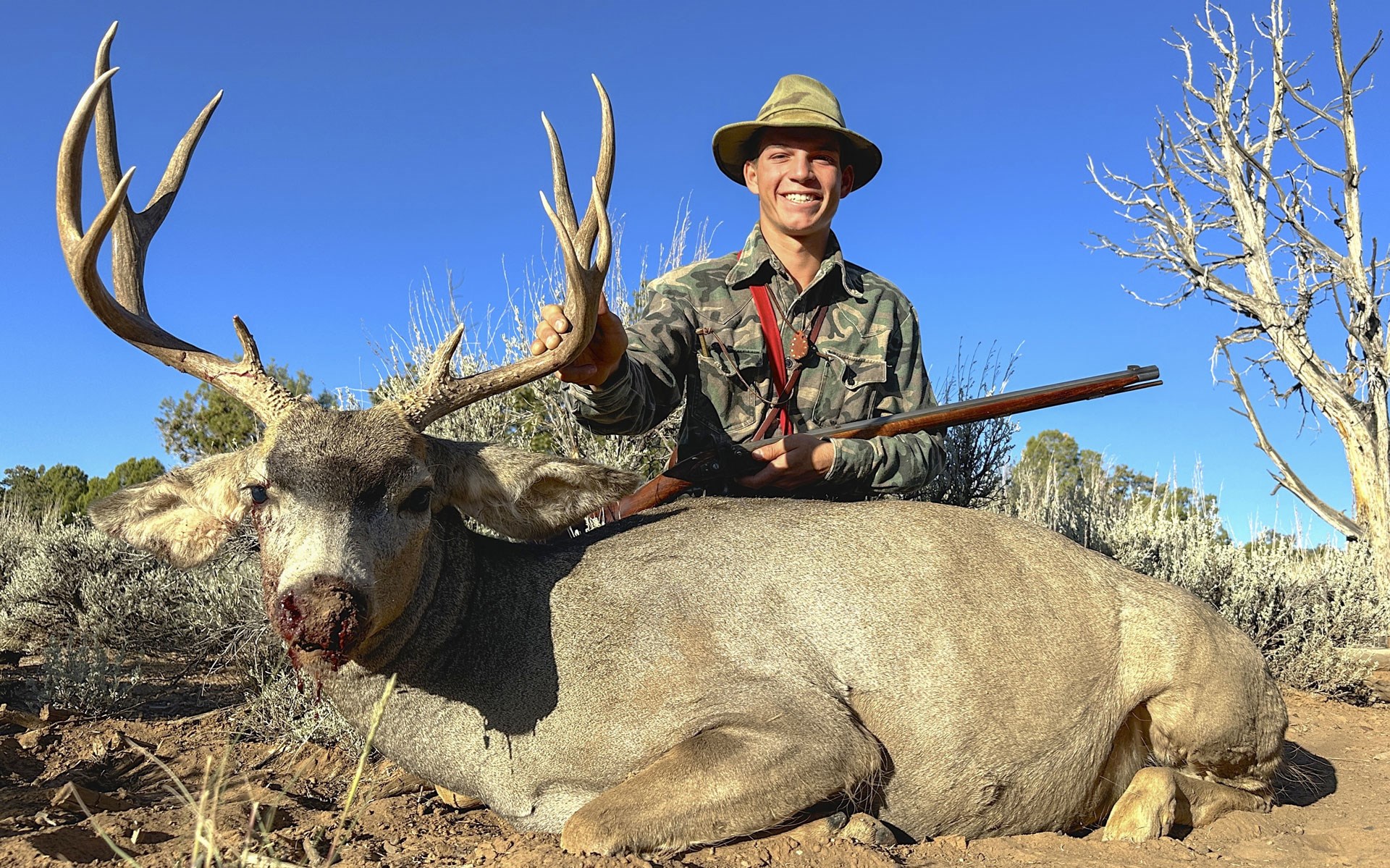
Rifle loaded and primed, he trotted toward his buck’s last-seen position ready to administer a coup de grace. None was needed; the 230-grain bullet had taken the buck perfectly, dropping him where he stood. Soaking in the moment, Josiah snapped a few early-dawn photos and let me know that he’d killed a big buck. As I shouldered my pack to begin the cross-canyon trek, Josiah laid his long handmade muzzleloader across the buck, ran his hand through the deer’s thick gray coat and offered a prayer of thanks.
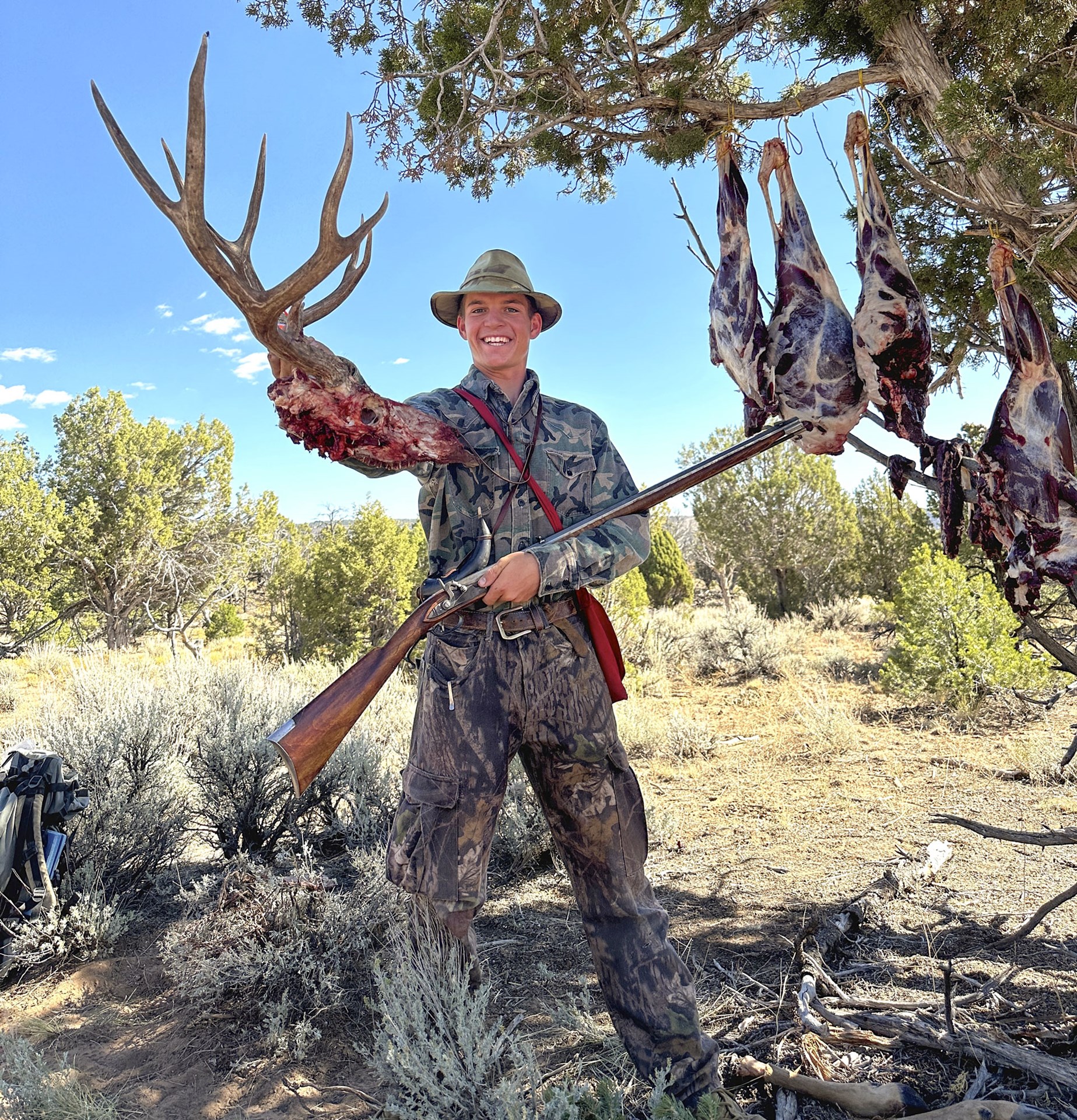
Packing meat is ever a labor of love, especially when we find success in remote, rugged territory. Meat and antlers find special significance when they are hard earned and, despite fatigue, heat and uncompromising terrain our pack out was jubilant. Josiah had managed to make a remarkable harvest using a rifle built with his own hands, while hunting the hard way. Tomorrow I would hunt again, but today was about caring for precious meat and celebrating my young son’s accomplishment. Tired and sore, we arrived at the truck, shrugging grateful shoulders from under our pack straps. Enjoying that funny, weightless feeling that comes after a heavy pack we staggered around, stretching sore muscles and backs. Afternoon was upon us and we headed for a small local convenience store to purchase ice in which to pack our deer meat. It had been a great day.
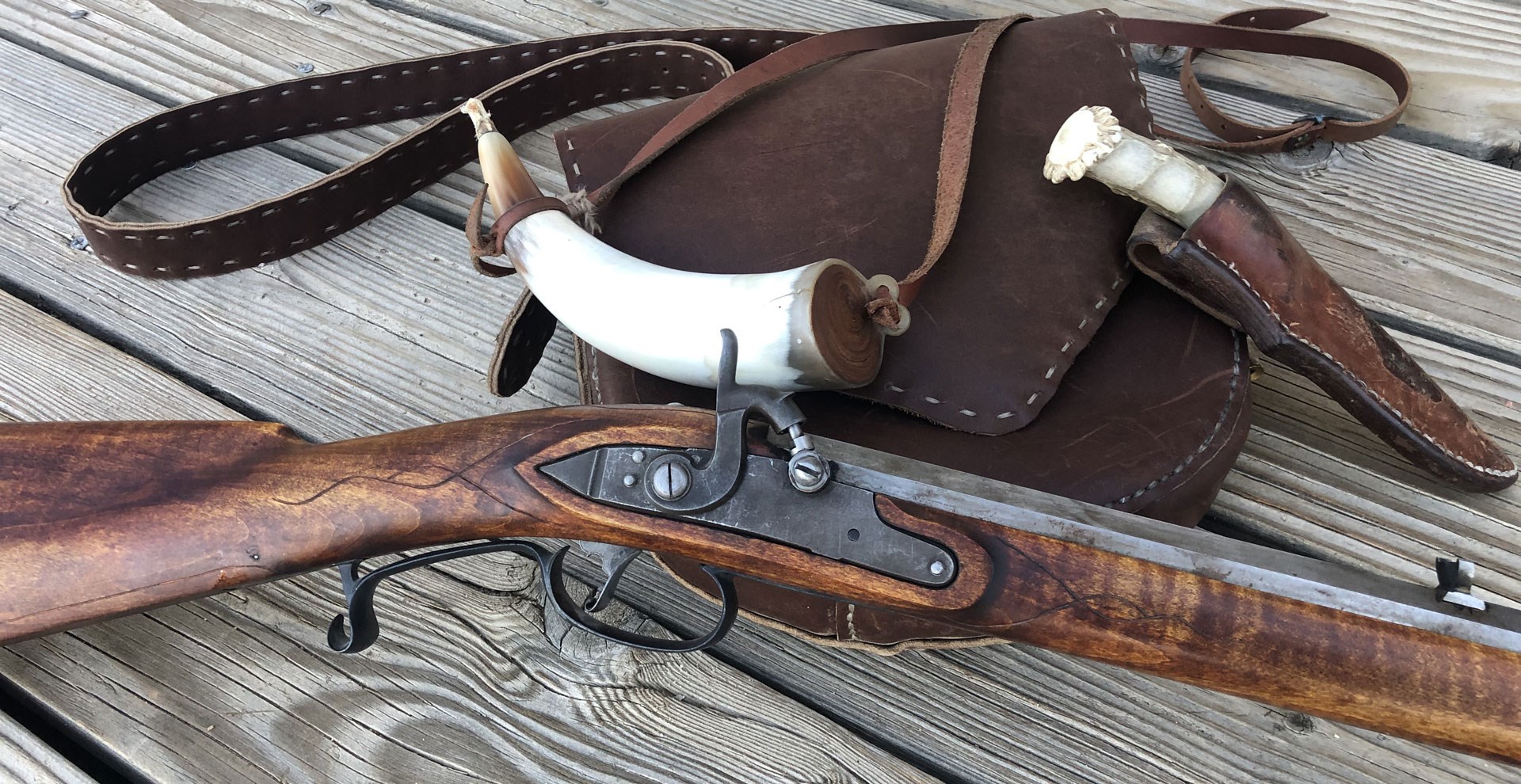
With Josiah’s tag filled it was my turn to hunt in the honey hole. Well before dawn the next morning I slung my leather possibles bag and powder horn over my shoulder and climbed into the darkness; a lovely early Virginian-style flintlock rifle in hand. Handmade by the legendary Steve Baxter of Tennessee, my particular rifle features hardware shaped in Steve’s forge. The Siler lock is tuned to perfection and superbly fast for a flinter, firing the rifle with remarkable speed and reliability. Sporting a wide buttplate and long barrel, the early Virginian design was popular during the late 1700s and is a favorite among today’s traditional shooters, hunters and rifle builders as well.
Breathing deeply and trying to steady my feet as well as my heart rate, I forged my way upward, wending through boulders and dense P.J. timber. An hour had passed and I was mostly across the big canyon, still hiking in the darkness, trying to reach a mesa-top ambush point before dawn. Usually I would bivy camp to hunt a remote spot like this rather than hiking hours in the darkness, but this particular spot didn’t allow that—spending the night atop the mesa would spread my scent through the area. Big bucks don’t tolerate pressure and they would likely vanish for the remainder of the season.
Finally atop the mesa I hurried, following the dancing beam of my headlamp through the brush. I’m not as fast as I used to be and time was short to get into position. I wanted to set up a few hundred yards downwind of Josiah’s ambush from yesterday, figuring the bucks would be suspicious of that immediate area. We had made every effort to keep disturbance to a minimum, but still I wondered if the bucks would even show this morning.
Almost to my destination I slowed down, and in the growing gray light began looking for a good spot to set up. Scattered trees dotted a mostly open area and I slid into the lee of a thin juniper, trying to merge with the stringy dead limbs. It wasn’t awesome cover but my shooting lane was great, allowing me to cover 90 yards without moving, and another 60 yards behind me with a 180-degree turn. I hoped the bucks would pass to my fore so I wouldn’t have to attempt that move. Shaking a thin stream of 4fg powder into my priming pan, I snapped the frizzen closed, checked the flint and laid the long wood-stocked barrel across a wiry dead branch. Then I held still. Shooting light was upon us and the bucks would be moving through soon, if they came at all. I was wearing my lucky hat and shooting my lucky rifle, the morning was still and spectacularly beautiful and my hopes were high.
Standing quietly I listened and watched, wondering if any of the bucks would show. We’d seen a total of 18 bachelor bucks in the canyon a few days earlier, and I felt like there was a good chance some would wander my way. My cranky knee was hurting though, and would give me hell if I had to stand for a long time. Studying the timber toward the canyon I saw movement, something flickering under the trees. Watching like a bird dog on point, I glimpsed it again—deer legs moving through the underbrush. A small 4x4 buck flickered though a tiny gap, moving slowly. Another buck followed, and my heart immediately shifted into overdrive. Big forks hung above main beams like sails on a four-master, and I knew without further ado that I wanted to shoot this buck. A third set of legs moved under the trees, but I was already looking down that long gleaming barrel. The smaller buck emerged into my shooting lane, browsing slowly along and scarcely 60 yards distant. This was going to happen, and this was also when my silly, middle-aged, vastly experienced self attempted a high-speed come-apart.
My heart was beating out of my chest and I grinned to myself, remembering Josiah’s fear that the deer would hear the pounding of his heart. I felt the same concern and tried to quiet my breathing. Hands shaking, eyes trying to blur and legs and lower back shot full of adrenaline I waited, knowing that in one to three seconds that big buck would be in my sights. Years of experience enabled me to throttle the demon that had hold on me, but just barely. The big buck strolled across my lane, enjoying an occasional nibble of browse. A big dead tree lay between us, twisted dry limbs clawing at the sky. I waited for the deer to clear before taking the shot, hoping he would stop and stand. He didn’t, and in three or four more steps he’d be through my lane and gone. I had to act fast or this whole unbelievable opportunity would be just a memory.
At 57 yards his body was massive, and even while he was walking I knew I could hit him well. Still fighting the buck-fever bandit, I settled my iron sights on the deer’s vitals and squeezed the trigger, perhaps a bit too fast. The flintlock flashed and my hand-cast .530 round ball found its mark as blue smoke screened the landscape. Too late, I remembered that my rifle hits about 5 inches high at 50 yards. Reloading quickly, I trotted forward. My buck had gone down in his tracks, hit low through the spine. I administered a coup de grace then looked around in amazement as everything slowly returned to focus.
The rushing in my ears abated, morning’s first rays of sunshine bathed me in light and a faint smell of black powder lingered in the air. Amazed at how excited I’d been and still was, I realized that the closeness of the encounter coupled with the challenge and thrill of hunting with a primitive firearm had aroused sensations and emotions that I’d not experienced in years. Even had this buck not been big, the hunt and the harvest would have been incredible.
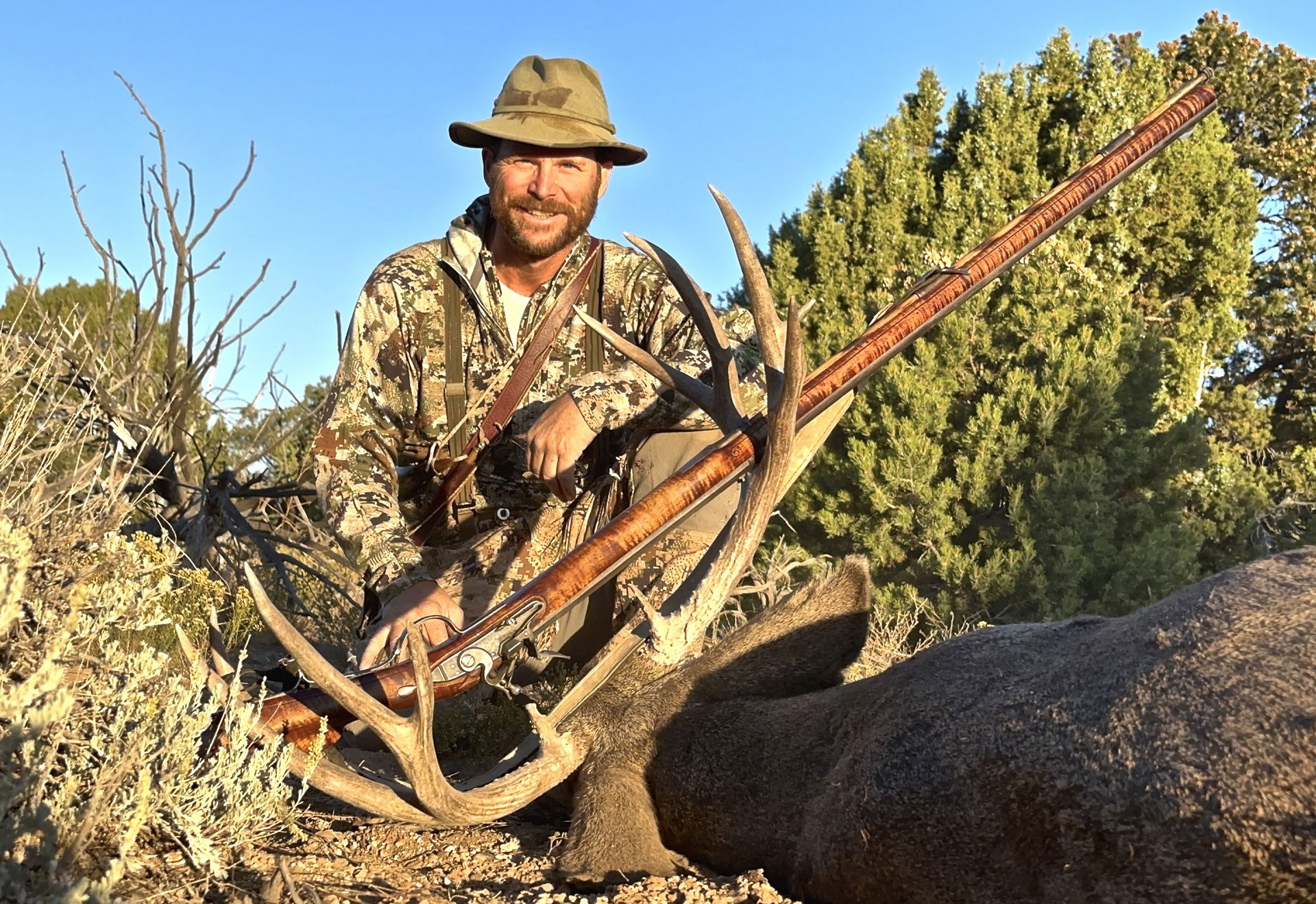
Josiah joined me on the mesa, making the trip across the canyon much faster than I had. Again we took photos, recounted the story and gave thanks. We processed the buck then pointed our boots across the canyon and toward the truck, packs laden heavy with meat. It had been another glorious day of hunting mule deer the hard way.