By Steve Burdick, Titusville, Pa.
Our family owns a camp and 100 acres outside Titusville, Pa. Over the years it has been a very successful place to hunt turkeys. I arrived at camp before daylight to pick up my nephew Michael Stockwell from Akron, Ohio, who was staying at camp with his dad, mom and older brother. This was Michael’s first year hunting turkey and only his third time out. We were participating in the Mentored Youth Hunting Program offered by the Pennsylvania Game Commission.
Michael stuffed his pockets full of snacks, and we headed out into the dark, cold morning. He had heard a turkey gobble on the roost the night before, so we headed to that point. At daybreak the bird gobbled two times, flew down with his hens and walked away.
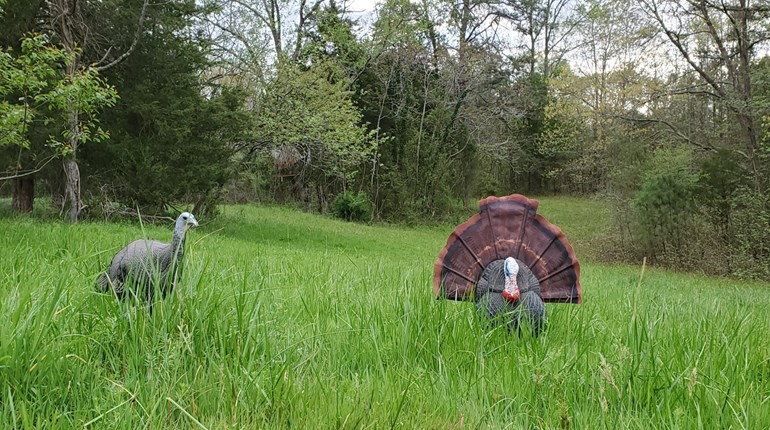
Having seen birds on the other side of the property, we moved and set up along a field edge, placing a decoy within range. We started calling and heard a bird respond to our left. After about 10 minutes the bird went quiet. Michael thought this was going to be the one, but we never saw him.
A few minutes later we heard an odd gobble coming from the other side of the field. 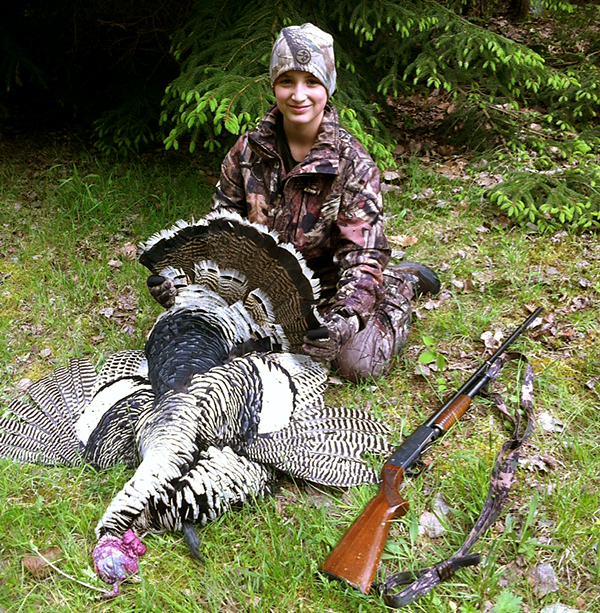 Michael and I both thought it sounded like a hunter with a bad call. We realized we were wrong almost immediately; the bird was very responsive to an old Quaker Boy box call and was heading our way fast. We saw him for the first time as his colorful head popped into view. Seeing the sun shining on him was spectacular. The minute that turkey saw the decoy he closed the rest of the distance. The bird came in strutting and gobbling, and at 25 yards Michael asked if it was time to pull the trigger. Since I didn’t want to put a 12-gauge with 3-inch magnums in Michael’s hands his first season, I told him to let the bird get a little closer. At 10 yards, I told Michael to put the front sight of the 20-gauge Ithaca on the gobbler’s head, wait for him to go out of strut and squeeze the trigger. The gun went off.
The turkey was hit but still standing and wobbling, refusing to fall over. I didn’t want Michael to shoot again so I jumped up, ran and grabbed the bird by the legs. Seconds later the tom expired. I don’t know who was more excited.
Upon looking at the bird we noticed a lot of white coloring on his feathers. Michael tagged him, and we headed back to the camp to show his mom, dad and older brother. Having never seen this coloration on a turkey before, we took it to a taxidermist friend of mine, thinking we just shot a cross between some farmer’s tame turkey and a wild one.
When we opened the trunk, he was amazed. He said, “You have no idea what you have here. This is an Eastern ‘smoke-phase’ gobbler!” He said it was incredible to see a hen with this coloring, but near unheard of to get a gobbler. It is caused by a recessive gene in turkeys. “Smoke-phase” birds are so rare, most people have never heard of one, let alone seen one. He shook Michael’s hand many times. We decided to take the turkey to a world-class taxidermist in central Pennsylvania. He was amazed to see this bird and is doing a competition mount for us that will be displayed at various events.
This was Michael’s first turkey. We scout this property hard, but no one had ever seen a bird like this. The Eastern “smoke-phase” gobbler weighed 20 pounds, had a 7-inch beard and ¾-inch spurs. I told Michael he might as well quit hunting as this trophy is going to be hard to beat. I’m sure he is not going to listen.