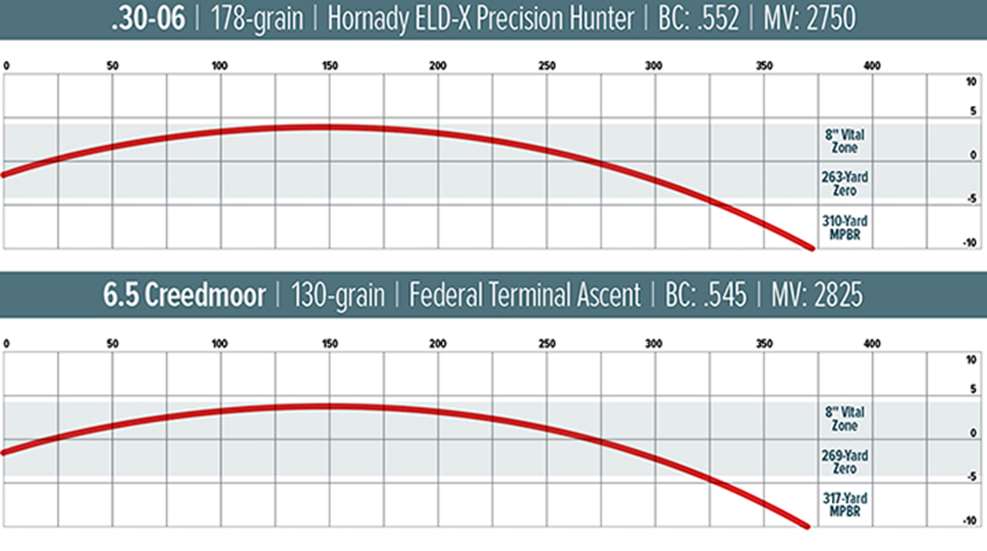
Zero your rifle using the Maximum Point-Blank Range (MPBR) system and you won’t need a laser rangefinder, turret dialing or Christmas tree reticles. For game from 10 to 300 yards, sometimes even 400 yards, you don’t have to touch your scope or even think about it. Just aim for the center of the vitals and you’ll hit them.
This is wonderfully liberating. Imagine spotting antlers spreading wide enough to embrace you and your dog sitting side-by-side. But if that buck takes two more steps, he disappears. You haven’t time to fish out your rangefinder for a precise read. You don’t know if that deer is at 196 yards or 293 yards, but you’re confident he’s no farther than 300 yards. No problem. Aim dead center and whump, you’ve got him!
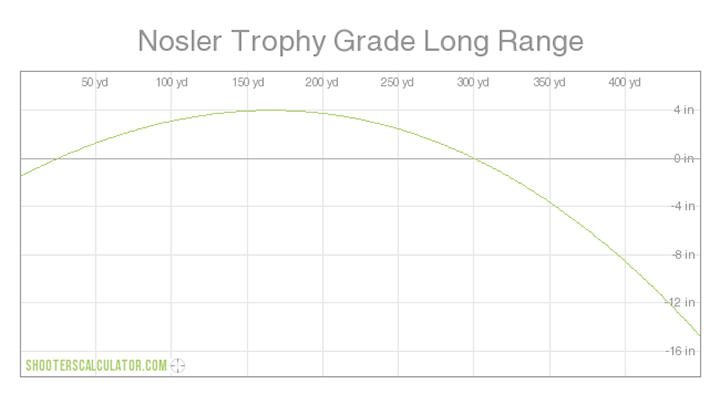
A rifle’s MPBR is the total distance over which its bullet will travel without flying above or below the vital zone when you aim for its center. For all game the size of pronghorn and larger, most modern, popular “deer” cartridges can be set up for a 300-yard MPBR. Faster rounds extend MPBR as far as 400 yards. If that doesn’t accommodate more than 90 percent of your shooting opportunities, you aren’t trying.
An easy way to understand this is to imagine shooting right down the middle of a 400-yard-long pipe the diameter of your target's vital zone. So long as your bullet doesn’t strike the top of the pipe, it remains in the kill zone until it hits the bottom of the pipe far downrange, your maximum point-blank range. Here’s how to set up your rifle for its MPBR.
First, determine the vital zone diameter of your game. Eight inches is a safe bet that covers the heart and lungs of pronghorns, whitetails, sheep and anything larger that is standing broadside. It leaves a couple of inches of “fudge factor” too.
Next, from a solid shooting rest, zero your rifle to strike 3 inches high at 100 yards. Then fire two or three shots on paper at both 150 yards and 180 yards. That’s the peak trajectory distance (maximum ordinate) for most cartridges. If those land more than 4 inches high, re-zero 23/4 inches high at 100 yards and try again. When you’re hitting no higher than 4 inches at 150 to 180, shoot paper at 200 yards, 250 and 300 yards. When bullets drop 4 inches below POA, you’ve reached your MPBR.
As easier way to start this process is with an online ballistics calculator. Play with the numbers and zero ranges until you find the perfect MPBR. Then double-check it with the field-testing described above.
The reason this works is because you’ve angled your barrel up enough that, like a center fielder throwing toward home plate, you’re throwing your bullet high to compensate for the long-range drop. As long as you don’t throw too high at midrange, your bullet will stay in that 8-inch vital zone.
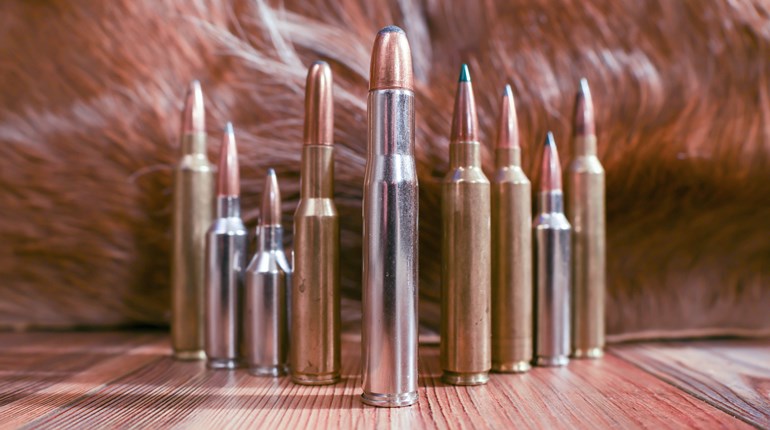
To increase MPBR, maximize velocity and ballistic coefficient. A 6.5-300 Wby. Mag. spitting a 127-grain Barnes LRX 3500 fps and zeroed 2.84 inches high at 100 yards won’t drop 4 inches below POA until 381 yards. A 6.5 Creedmoor pushing a 142-grain Nosler AccuBond Long Range 2700 fps and zeroed 3.45 inches high at 100 yards has a MPBR of 310 yards.