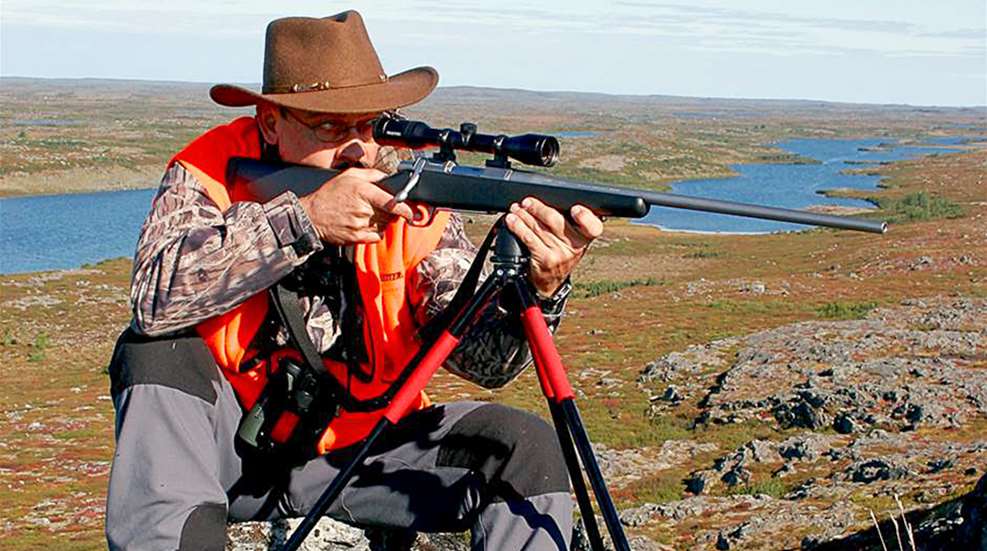
It’s about time hunters take shooting sticks seriously. If you’re leaving whitetail country for the open terrain of the West, then shooting sticks are mandatory. They are as essential as your binocular. And like optics, you need the right type for the terrain and style of hunt you’ll be doing. Going prone on a bipod, for example, is ideal, but you can’t do that in sagebrush or even tall grass. The legs on some bipods extend to let you sit and shoot, but again ground vegetation often means you need to kneel or stand.
Before you travel, ask an outfitter or someone in the know for advice about the place you’ll be hunting. The trouble with most people is they’ll equivocate with statements like, “You have to be ready for anything.” While true, that’s no help at all.
If you’re going to Africa, your PH and likely his trackers will carry wooden tripods. They will set them up quickly and will expect you to come around behind them, out of sight of the game, put your rifle on the sticks and then shoot fast and well. Few American outfitters are going to do that for you. They’re just going to spot the game, help you get within what they think is a reasonable range and then tell you to shoot. Some will even add stress to these already adrenaline-soaked moments by saying things like: “Shoot ’em now! Now!”
Before any trip out West, I always dump out my box of shooting sticks—I have dozens. I then carefully look at the terrain and vegetation in the outfitter’s photos of the region as I select two or three. Here are some other things to consider in order to pick the best shooting sticks for a particular hunt.
First, take a bipod for your rifle. At the very least it’ll help you make sure a scope is zeroed. Outfitters are notorious for having rickety camp tables or some homemade contraption that poses as a shooting bench for hunters to check their rifles.
Consider whether the shooting sticks need to double as a walking stick. This is actually ideal because it keeps the sticks in your hands. An astounding number of hunters pack their sticks in a backpack and never have them available when they really need them.
Some companies have developed shooting sticks that double as walking sticks. Many are monopods, basically walking sticks with “V” notches on their tops. The truth is monopods are less effective as rests than bipods, which are less effective than tripods. As all three legs on a tripod can be bound together in various ways, and quickly and quietly separated to give a steadier rest, why would you want to carry a less effective stick? Go with a tripod.
Determine whether you want solid sticks or those that extend. Many of the tent-pole-style tripods are poor walking sticks, as they bend and come apart. They are, however, light and, if you practice with them, can be set up fast. My favorite is the Double Crossed Shooting Sticks from High & Heavy Outdoors. These sticks give two points of contact with your rifle. Learning to use them, however, takes practice.
My go-to sticks lately have been the Pole Cat Steady Rest from Primos. The Steady Rest gives two points of contact with the rifle and three with the ground. It also makes an excellent walking stick, as its poles are heavy enough to give support.
Finally, a quality tripod will also give you the option of attaching optics to it with a universal .25-inch threaded bolt that fits cameras, binoculars and spotting scopes. The Vanguard Quest T62U is a good example of a tripod with this feature. It makes a solid walking stick, serves as a shooting stick for standing and sitting positions, and functions as a tripod to help you glass big country.
Quick Tip: Steady Practice
Take your shooting stick options to a range where you can move and shoot with a .22 LR rifle. Place targets at various ranges, and practice setting up sticks quickly and quietly to get on target and make clean shots. As you sit, kneel and stand for shots, try to establish other points of contact with something solid. Get your back against a tree or a rock, and so on. You’ll begin to see how the terrain can also help you get steady.