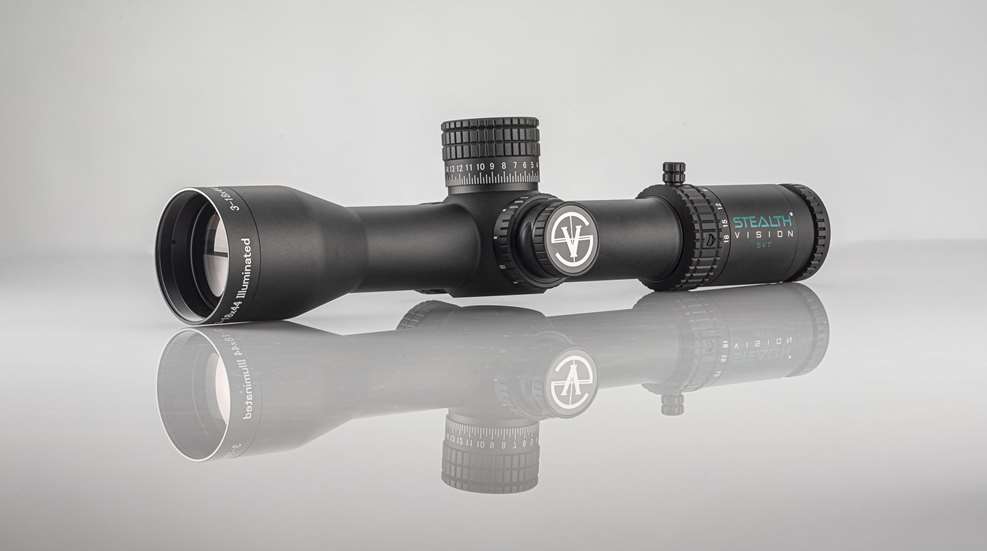
You’ve gotta love Americans’ penchant for identifying problems and solving them.
Doctor John McCall of Crockett, Texas, is a practicing optometrist of 48 years and counting. With a degree in geometrical and physiological optics, he’s the president of the American Academy of Optometric Medicine and Surgery. He’s received numerous awards for his work in the field. He holds a patent for inventing the lens used for glaucoma surgery. I think it’s fair to say that Dr. McCall knows something about vision and optics.
He also knows a thing or two about hunting.
A lifelong hunter who cut his teeth on small game, he’s since been on countless safaris in countries all over the world. His trophy room looks like Cabela’s headquarters. But perhaps the ones that influenced him most were the sheep. After all, some of the sheep species can cost as much as a house, and there are no guarantees, especially when it comes to the hunter’s shooting. He realized that no detail can be overlooked when it comes to long-range accuracy, because a bullet 6 inches off its mark at 500 yards can be the difference in a trophy of a lifetime or a lifetime of haunting disappointment. He realized that if a hunter accidentally cants—or leans—the rifle just 5 degrees—the bullet can be off by as much as 36 inches at 1,000 yards. Sure, plenty of long-range specialists know this, but here’s what most hunters probably do not know: The average cant imparted by riflemen on their rifle is 5 degrees.
“The eye does not like being in a canted position—which is the normal shooting position. It’s being held by six muscles, all straining,” said McCall. “The brain’s interpretation [of what it thinks is vertical] causes the shooter to square the reticle … to the eye. And this is often wrong.”
In other words, most riflemen cant their rifles but don’t realize they are doing so. At modest distances, it’s not a big deal. But at long range it’s huge. This is why serious long-range shooters use bubble levels attached to rifles. But McCall realized something else: The eye has a tough time going back and forth between the reticle and the external bubble level while also keeping the reticle steady and on target.
So he invented an internal, automatic illuminated reticle leveling system within a scope’s eyepiece so the hunter can make sure his rifle is level and on target without switching his focus. After being granted two patents for it, he singlehandedly formed a high-end optics company called Stealth Vision. I recently visited McCall at his office and was impressed with the scopes and with the man as a hunter, shooter and innovator. After all, here’s a guy who was living just fine before dumping a bunch of time (that he doesn’t have) and money into a new company in the highly competitive optics market. But he did it anyway. He flew to Japan, used his expertise to design the finest scopes he could have made by Light Optical Works. (The scopes are then inspected, finished and calibrated in Texas.) So there’s a little background on the company; now for the optic.
Currently Stealth Vision offers three riflescope models including the Extreme SVX 5-30x56mm; Long Range SVL 5-20x50mm; and the Tactical 3-18x44mm. I chose the 3x-18x because I believe the magnification range is perfect for the majority of all hunting scenarios, just as the 44mm objective is a great balance between light-gathering capability and practical size. It features a 34mm maintube, as many of the world’s top target scopes are moving toward. The diameter of the tube really doesn’t offer any downside except having to purchase 34mm rings. The scope is considered compact at 12.8 inches long, although its large turrets certainly increase its overall profile, and at 30 ounces, it’s not light.
It’s got about every modern feature desired, including side focus adjustment, a magnification throw lever, an illuminated first focal plane reticle, and three buttons that control the illumination mode and intensity level. (McCall told me he chose red for the reticle illumination because in patients who have macular degeneration, the last aspect of vision to go is long wavelength vision, and red is a long wavelength.) Internally, however, is where the magic happens with its illuminated bubble level located at the bottom of the reticle. When the scope is canted more than 1 degree off vertical, the bubble stays dark, but when the rifle is level, the bubble glows green, meaning you’re good to go. It’s genius.
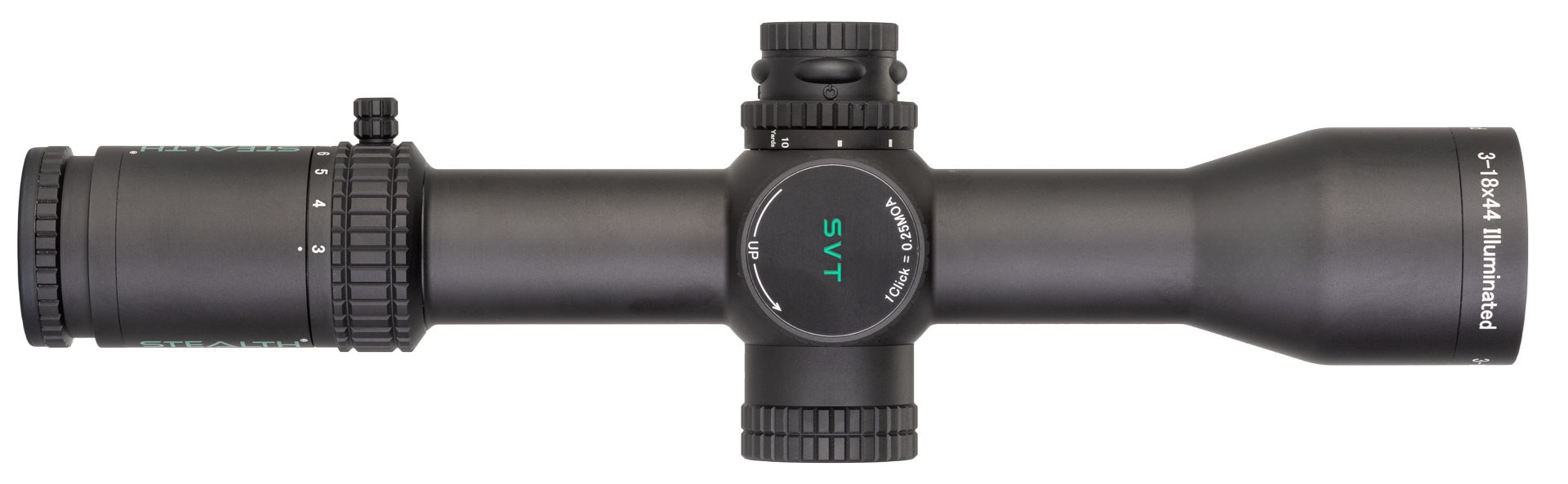
To control the illumination system, one quick push of the top button on the left turret turns the level system/reticle on and off. Once on, the near button brightens the illumination while the far button dims it. Additional 1-second presses of the middle button toggles through the following modes: 1) level light on/red reticle illumination off. 2) level light on/red reticle illumination on. 3) level light off/red reticle illumination on. To conserve battery life, all illumination goes to sleep mode after three minutes of sitting motionless but will come back on if the rifle is moved. After four hours of no movement, the illumination system switches itself off.
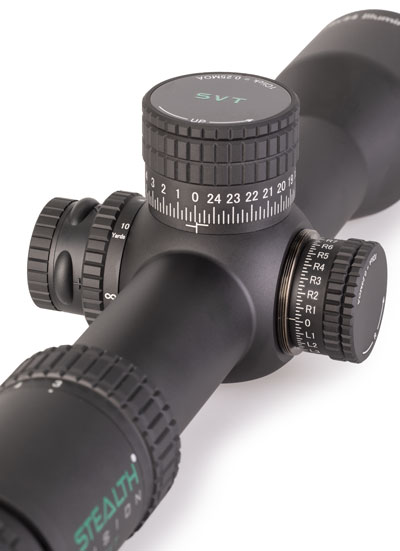
From testing, I believe the Stealth Vision’s preciseness of its click adjustments at least competes with if not beats any scope available today—thanks mostly because McCall teamed with a small-shop precision machinist in Texas to make every brass dial set. Its huge elevation turret is target style, without a cover. For hunting, I wish it had a locking mechanism. It features an adjustable zero stop and 100 MOA of adjustment range. Once you decide on a load and have your data mapped, Stealth Vision will “burn” a custom dial for your setup so its numbers correspond to exact yardages. If you shoot two or more loads or in varying elevations you can have multiple dials made.
In shooting the scope extensively, I found that all adjustments were incredibly precise and consistent. The dials are supremely tactile and just feel good in the way that they are not overly stiff to cause skipping of clicks; they’re anything but mushy; they’re audible. I twirled them wildly in an attempt to break them. I could not. I shot targets from 25 to 1,200 yards, bouncing between gongs as quickly as I could spin the dial, get steady and pull the trigger, each time knowing cant wouldn’t be an issue.
Optics, in terms of glass quality, manufacturing techniques, lens coatings, etc., are very difficult to decipher. The only practical way to judge an optic is to compare it directly against others, side-by-side, at the same time so wind and lighting conditions are identical. Because this scope is in the $3,000 range, it must be compared against the very top scopes in the world, some of which are also made by Light Optical. I can report that this Stealth Vision is one of the clearest scopes in the 10x-20x magnification range that I’ve ever tested.
For me the internal, self-illuminating level is a game changer for long-range shooting. I was amazed shot after shot as my body and mind (that have been conditioned by 40 years of rifle shooting) told me the reticle was level—only to find out that I was consistently canting. I began to doubt the scope—until I compared the reticle to a plumb line. Now I don’t.
Stealth Vision Tactical SVT
- 3-18x44mm
- stealthvision.com
- Type:variable-power riflescope
- Magnification: 3X-18X
- Objective Lens Diameter: 44mm
- Eye Relief: 2.6"-3.6"
- Field of View @ 100 Yards: 37.1 ft. (3X), 6.2 ft. (18X)
- Reticle: illuminated; first focal plane; w/anti-cant level
- Adjustments: .25 MOA click value; 100 MOA elevation range; 50 MOA windage range
- Coatings: fully multi-coated
- Dimensions: 34mm tube diameter; length12.8"; weight 30 ozs.
- Construction: aluminum tube; ED glass
- Battery: CR2032
- Accessories: lens covers
- MSRP: $3,300