The first wild alligators I ever saw emerged from the slow, dark waters of the Myakka River, just downstream from the bridge where Preston and I were fishing. There were two—big ones, we assured one another—that beached themselves on a mudbank, angled to face into the current where they could keep an eye on us. They were long, lumpy and wicked-looking on both ends, especially up front with cold-blooded “smiles” and oversized snake eyes.
“Think they’d steal our fish?” I asked. “What if we hook a gator?”
Preston pointed out that we weren’t catching any and advised, “Let’s just see what they do.”
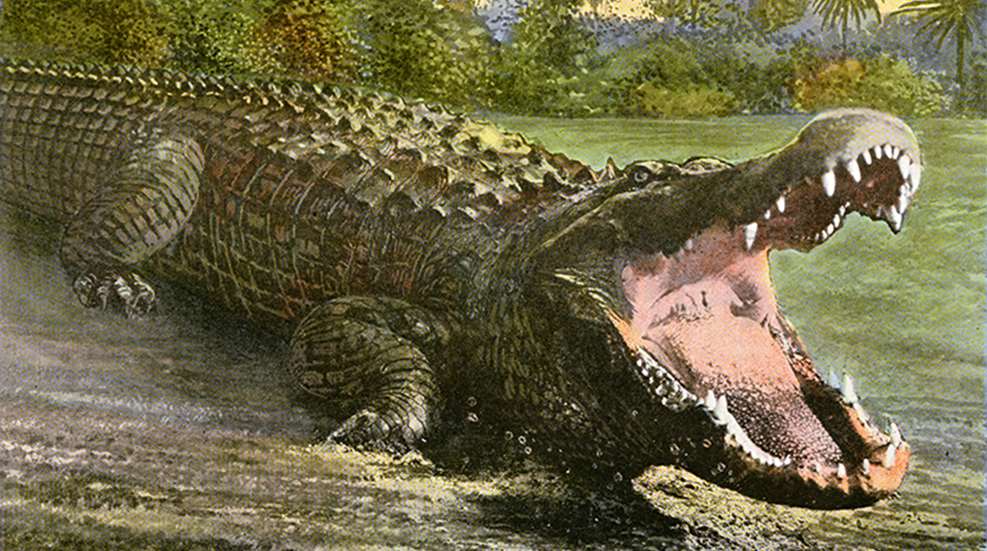
But for me, this was not simply a “let’s see” occasion. Before discovering the great books that captivated so many hunters of my generation, my impressionable adolescent psyche latched onto a couple other influences, somehow connecting 1950s Jungle Jim flicks set in Africa with the familiar splashy postcard art touting Florida tourism. When it came to the latter, it wasn’t imagery of orange groves, beaches or mermaids that grabbed my attention, but rather the wild, jungly scenery featuring big bull alligators. Africa … Florida … somehow I would get to those places and hunt savage beasts like crocs and gators.
Though Preston and I both came from hunting backgrounds, even if we’d had a clue how to go about it, we could not have legally hunted those or any other Florida gators because there was no open season back then. To stem a long-term decline brought on by habitat loss, commercial take and conflicts with humans, the state moved in 1961 to protect the remaining population.
Apart from whatever gator-harvest culture persisted across the Southland, my predisposition to hunt them appears in hindsight to have been pretty odd. If you go back and peruse early American Hunters and other 1960s-70s outdoor magazines, you’d never dream the American alligator would one day become an important game species. There was little, if any coverage, and perhaps it was beyond reason to think the endangered alpha reptile would come roaring back in numbers that could support regulated hunting. But of course that’s exactly what happened, as America’s hunter-financed wildlife management system came to the rescue, and today we enjoy open seasons in eight states in the Deep South. In fact I’d guess that in 2017 alligator hunting is more prevalent than for at least a third of the species on major record-keeping lists of North American big game, lists that ironically omit this animal.
Two times my plans got scrubbed, but the bucket-list hunt finally materialized in September 2015 when I joined the Schearer family of “Shoot Straight TV” for a weekend alligator/hog combo. Among other jobs, Chad Schearer is the longtime press-relations rep for BPI, and so naturally we planned our outing around using CVA muzzleloaders for the pigs. But the gator hunt, he promised, would be an altogether unique experience.
■■■
For Pete’s sake, it hit me upon my midnight arrival, this is exactly where we stayed when we brought the kids to Orlando! It couldn’t be often that the manicured International Drive resort doubles as a hunting camp, but in today’s Florida, hunting isn’t always relegated to some swampy outback. It was a balmy September night when I met Chad and his son Wyatt in the parking lot for the drive south to our outfitter’s place. From there we towed a 20-foot boat to a local lake that’s famous in bass-fishing circles.
In fact the boat was outfitted with heavy-duty casting rods, which I was surprised to learn were part of our hunting gear. Outfitters Jeff Conner and Chris Long explained that most of their guided gator hunts take place at night, during which the predatory reptiles are located and sized by shining lights across the surface. Noting the gleaming yellow eyes, experienced hands can estimate the animal’s size and position in the water. When big enough, they’ll float alongside and deploy harpoons to bring it in for the kill. As some point out, it’s rather like fishing.
Perhaps even more so was the technique we intended to use that morning. The guys had spotted a keeper-sized specimen hanging out in a certain cove and were confident they could call it in. When it drew close, we’d use a rod to snag it with big a treble hook, then reel in a few hundred pounds of thrashing fury fronted by armored jaws. That accomplished, we’d break out the harpoons and, finally, a .44 Magnum bang stick to finish the deed, since using conventional firearms for gators is prohibited on public waters. Call it fishing if you like, but to me it amounted to an incredible sport-hunting challenge.
Visible in the distance were lights of lakeside houses, and the sky was starting to turn a grey-pink when Jeff said he could see an alligator. I couldn’t—not then, and not for several more minutes as the guides began calling. When I finally did spot the dense blot on the glass-slick surface, it was at least 150 yards away. Convinced it was the big fellow, Jeff and Chris revved up the calling, using both mouth calls and recorded sounds to replicate the animal’s chirping vocalizations. I couldn’t help but think how fitting it all was with an ace game caller like Chad in the boat. He’s a former world elk-calling champ who wows seminar audiences with his uncanny multi-species mimicry.
But now it was the Florida boys at work, pulling in our quarry gradually. It would slither our direction a little, sit tight, then flip its tail and come again. That sequence repeated for an astounding half hour—until Jeff deemed the gator close enough to break out the casting rod. It took me a couple tries to loop the line over the beast, and as soon as my hooks bit into the animal’s scaly hide, I felt its power. It took most of the 30-pound-test line and though I was sure it would break free, eventually my cranking paid off and the tide turned. By far, it was my biggest rod-and-reel battle ever. My arms were cramping badly as I grew increasingly desperate to win it.
Finally alongside the boat, the thrashing reptile looked almost black in the increasing daylight. With a bit of coaching, I buried two harpoon points, and then with the gator lashed in tight to the gunnel, the bang stick ended what had been an incomparable encounter.
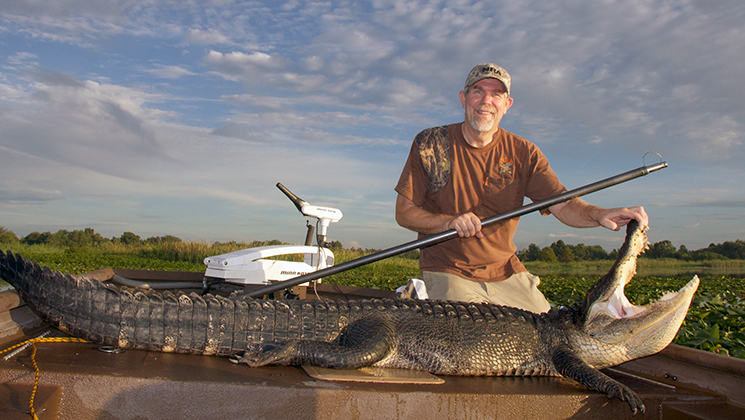
Before hauling our kill into the boat, Chris and I wrapped its mouth with electrician’s tape, a precaution for an animal known to come back from the dead. The craggy topside of the hide was a dull OD green, contrasting with its pale-yellow belly. Its upper half was as lumpy and its eyes as menacing as those gators I wished I could hunt so many years ago. Stretched out on the deck it measured 9 feet—not a giant, but plenty big. The tropical sky was lit up with patchy clouds in a way you won’t see in any state but Florida, and it made for some of the best trophy photos I’ve ever taken.
Less than 12 hours after arriving, I had learned a ton about gator hunting and found it even more thrilling than expected. Later I would learn that managing Florida’s sizable population of this top-of-the-food-chain predator involves myriad harvest opportunities and methods, ranging from nuisance-animal removal by licensed trappers to varied public- and private-land hunting scenarios (see sidebar).
Florida has changed tremendously since its gaudy self-promotion first fired my imagination, but all that appears to be having little effect on an ultimate survivor species, one now pursued by more hunters than ever.