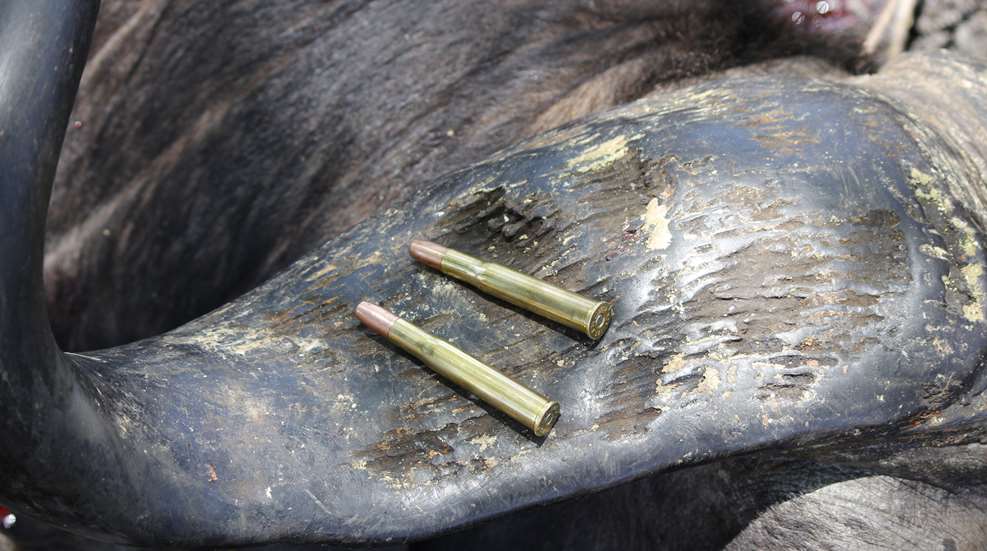
Crawling through the thick Mozambican forest, thorns piercing our hands and knees, we eased to within 50 yards of the herd of Cape buffalo. The bull we wanted to take had decided a nap was in order, and had laid down on our edge of the herd. Sitting against a tree, I brought the Heym double rifle to shoulder, waited for the bull to offer a clear shot, and broke the right trigger. Thus began the gun fight that culminated in the first head of African game taken with the new Heym 89B, and first experience hunting with the .450/400 3” N.E.
Among the lot of Nitro Express cartridges—a term coined by James Purdey to compare the power of these cartridges to a locomotive and newly loaded with smokeless powder—the .450/400 3” N.E. represents one the best blends of hunting power and ease of shooting. It was released in 1902 by W.J. Jeffery’s of Britain, being a derivative of a succession of black powder variants of the family cases based on the .450 Nitro Express. The case of the 3 ¼-inch version was shortened to an even 3 inches, and a .410-inch-diameter bullet of 400 grains was loaded to just over 2,100 fps; it should be noted that the modern standard velocity for the .450/400 3” N.E. is a bit lower, at 2,050 fps. The rim—which measures 0.625 inches—handles the headspacing duties, and that was an extremely important feature when it came to the propellant of the era: cordite. Yes, cordite is much better than blackpowder to attain the desired velocities, but it was also highly susceptible to changes in temperature. That ammo which was tested in the cooler environs of England might show extraction problems in the heat of equatorial Africa or in India, and the voluminous cases were used to help keep pressures low. The rimmed cases made extraction easy in the single shot and double rifles so popular at the time. The 7 ½-degree shoulder gave a bottleneck which helped hold the projectile firmly in place, aided by a crimp.
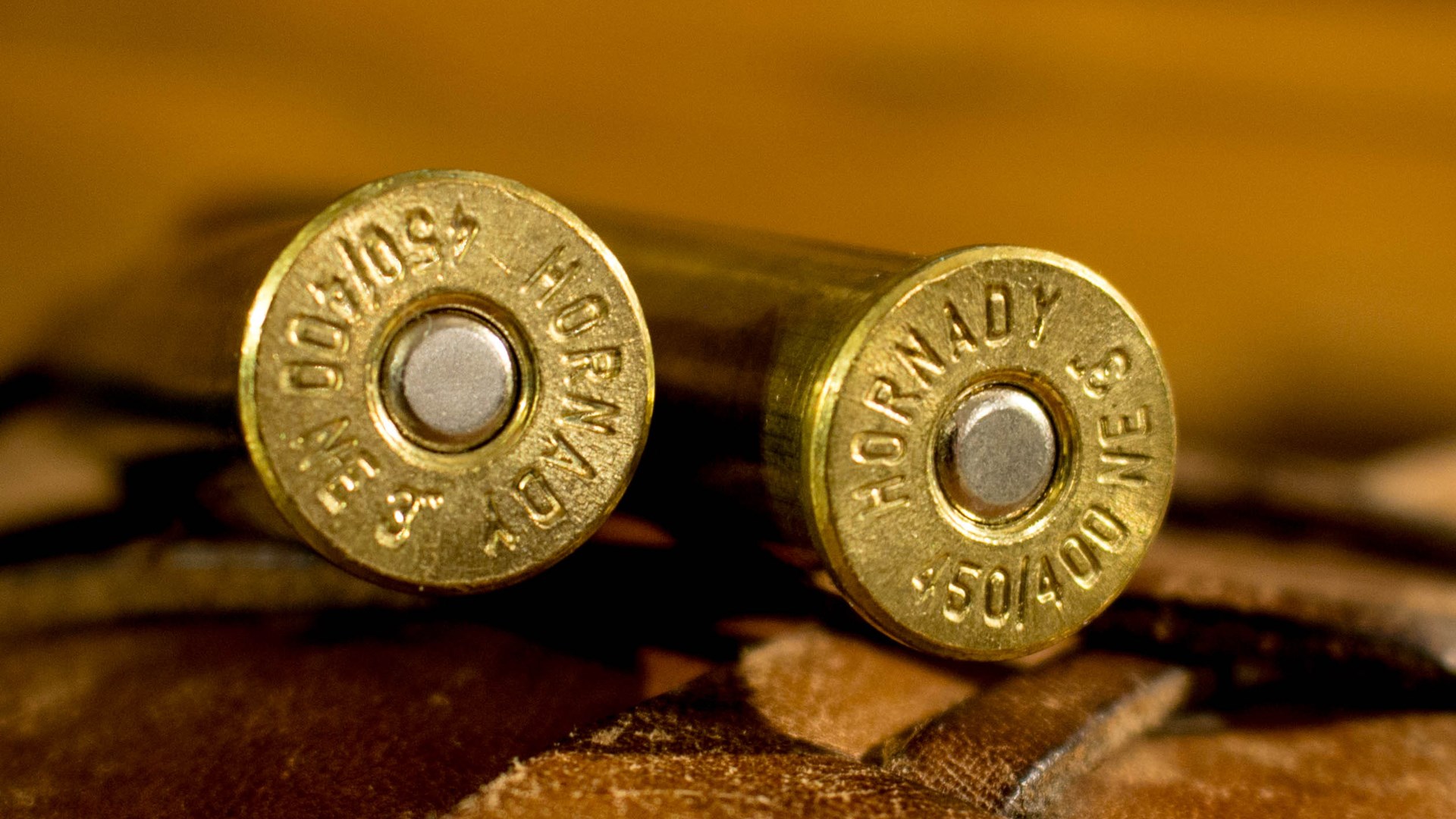
At 2,050 fps the .450/400 3” N.E. will generate just over 3,700 ft.-lbs. of energy at the muzzle, with that figure dipping just below the 3,000 ft.-lb. mark at 100 yards. Things drop off pretty hard past that distance, as with a 100-yard zero you’ll have almost 10-inches of drop at 200 yards, where the bullet has slowed to 1,600 fps, carrying 2,300 ft.-lbs. of energy. For these reasons, I like to see a .450/400 NE kept inside of 150 yards, unless the shooter is very familiar with the rifle, and even then only on plains game. Unwounded dangerous game shots should be inside of 100 yards, at least in my opinion. But that’s not really an issue here, as the vast majority of shots on dangerous game are taken at 75 paces or less. And as the .450/400 3” N.E. was developed in an era when iron sights assuredly ruled the roost, that’s a sensible limitation.
Comparing the .450/400 3” with the most popular of the rimmed Nitro Express cartridges—my beloved .470 NE—you can look at the recoil characteristics to see why the smaller cartridges has appeal. In a ten pound rifle, the .450/400 NE will generate 46 ½ ft.-lbs. of recoil energy, as compared to the 470’s 78 ft.-lbs., and will do so at a slower recoil velocity (17 ½ fps vs 21 ½ fps). Now that’s not to say that there aren’t advantages to the .470—another 100 grains of bullet weight, larger frontal diameter and another 100 fps of muzzle velocity—but you can see how the .450/400, being easier on the shoulder, is appealing. The double rifles built for the .450/400 NE are generally lighter and smaller than those for the .450 NE, .470 NE and .500 NE, and are easier to carry on those long tracking sessions for buffalo and elephant.
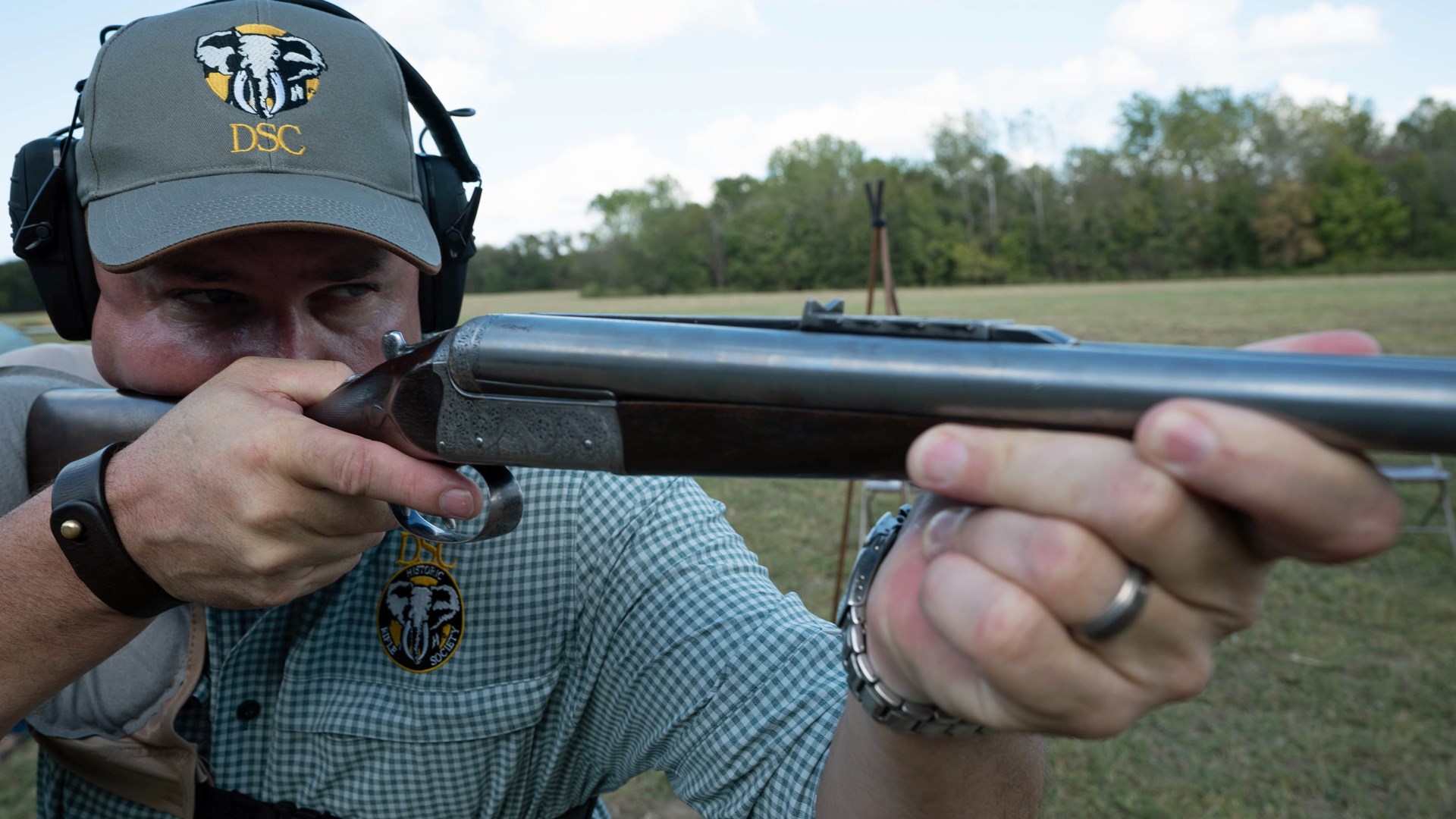
I consider the .450/400 3” NE just about perfect for a low-recoiling option for Cape buffalo, and I know many hunters who love it for elephant and hippo. While I usually opt for a heavier or speedier cartridge for the pachyderms, I wouldn’t hesitate to use the .450/400 NE for either of those species. HeymUSA’s Chris Sells is a huge proponent of the cartridge—using one for the majority of his personal hunting—and takes many orders for double rifles so chambered. When I asked for his thoughts on the classic cartridge, he related the following:“With manageable recoil, lighter overall weight and superior penetration, the .450/400 3” NE is arguably the most well-rounded double rifle caliber for a modern dangerous game hunter. It's almost perfect for any buffalo on any continent, and more than adequate for any pachyderm.”
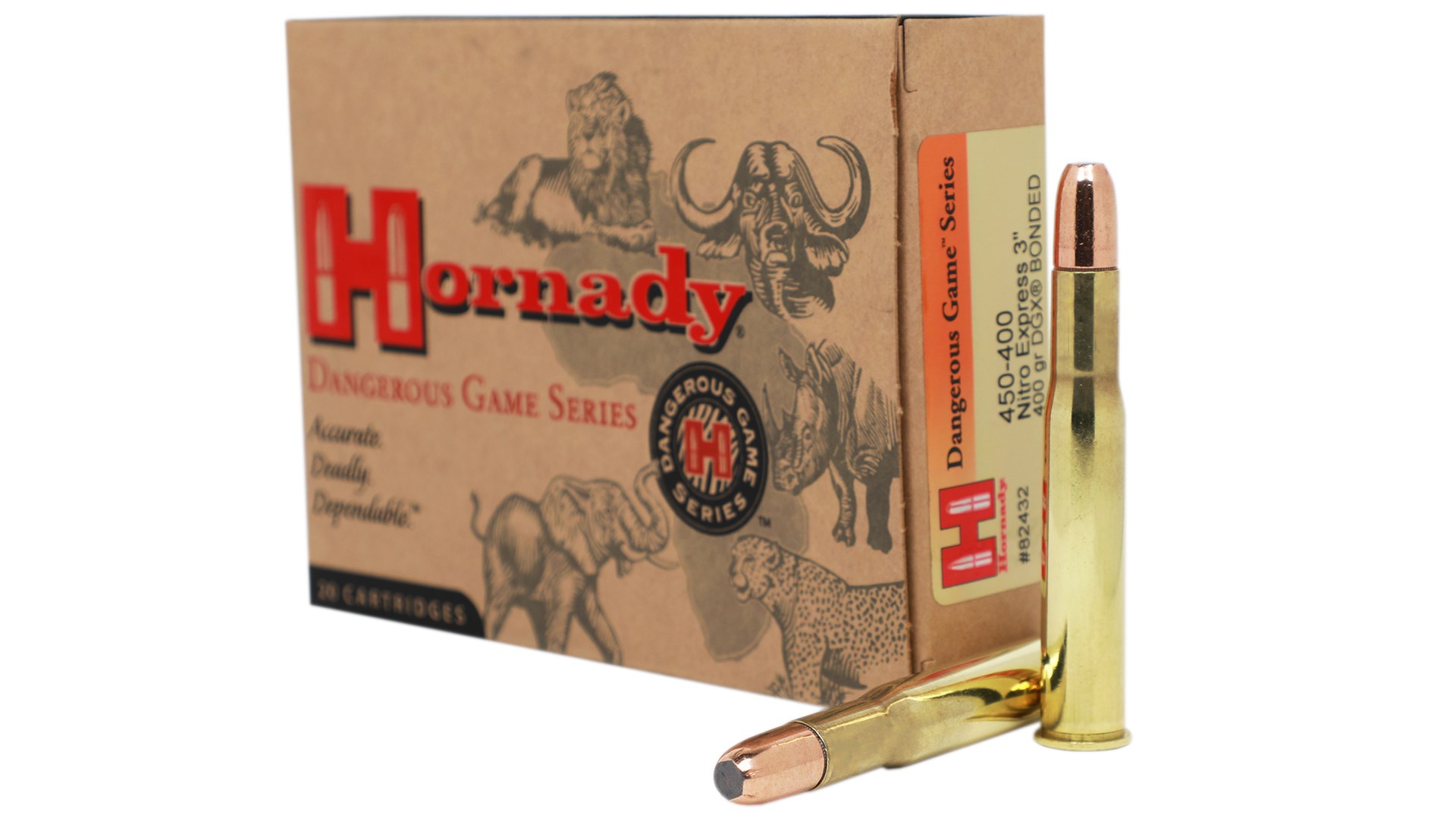
The main issue with the .450/400 3” N.E. today is that there is one source of factory ammunition, though it is excellent stuff. Hornady offers the effective combination of the 400-grain DGX Bonded softpoint and the 400-grain DGS non-expanding solid. There aren’t any hunting situations suitable for a .450/400 that couldn’t be handled with this pair. If you handload your ammunition, there are many component bullets available to you, including the Barnes TSX, Woodleigh Weldcore, Swift A-Frame and Breakaway Solid, as well as the aforementioned pair of Hornady bullets. Hornady offers component cases as well.
Being an aficionado of both African hunting and big-bore double rifles, I've seen a good number of folks who share the same passions gravitate toward the .450/400 3”. It might not be their first choice, but for those who hunt enough with a double rifle, they usually add a gun so-chambered to their arsenal. And despite the fact that there are other big-bore rimmed cartridges more popular, that .450/400 has many attractive qualities. It was the chosen double rifle cartridge for Col. Jim Corbett, the famous man-eating tiger and leopard hunter (whose rifle I was privileged to shoot), as well as being used by W.D.M. ‘Karamoja’ Bell for a time, and Pondoro Taylor had nothing but good things to say of the cartridge in his African Rifles and Cartridges. I share his sentiments; it’s a great cartridge.
Most Popular