Modern ammunition has changed considerably over the last couple of decades, with our projectiles offering a level of performance previously unattainable. In both construction and conformation, our modern bullets have changed so much that the previously accepted minimums—with respect to cartridge choice—have been rethought. While I’m not going to get into the ethics of long-range hunting, many of our projectiles are designed to maximize long-range performance. Among the touted characteristics of today’s bullets is the higher ballistic coefficient—abbreviated as BC—values.
But just what is ballistic coefficient? And how does apply to the hunter’s choice of projectile? Unlike sectional density, which is a simple ratio of bullet weight to diameter, ballistic coefficient is a more difficult concept. Without delving into the actual physics formula—which include parameters such as density, mass, cross section and more—a bullet’s ballistic coefficient value is a unitless number representing the bullet’s ability to resist the effects of atmospheric drag and wind deflection. The figure is arrived by comparing a projectile’s parameters to a model of known dimension; the two most common models are the G1 (a flat-base spitzer bullet) and G7 (a boattail spitzer bullet).
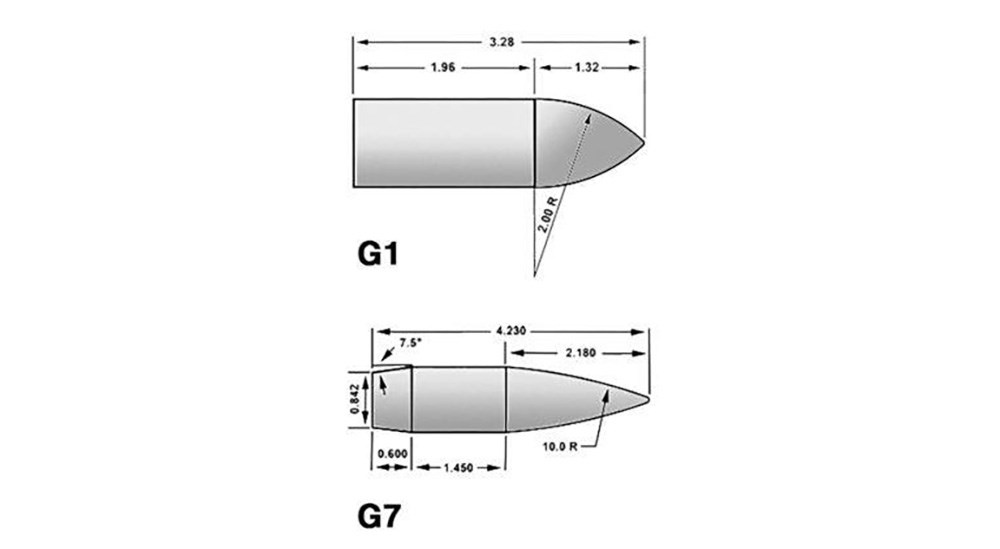
The models have a value of 1.000, and the vast majority of our hunting projectiles will have a value represented by a decimal value, less than 1.000, out to the thousandths place. The higher the number, the better the projectile will resist those atmospheric effects, and therefore will offer a flatter trajectory. You see, all objects will drop downward to the earth at the same rate, but the bullet which best retains velocity during flight will cover more ground before it drops. Think of it as a comparison of a sports car versus a garbage truck; the aerodynamic sports car will maximize the energy delivered to the wheels. So, for the flattest trajectory, as well as the least amount of wind deflection, a bullet with a high-BC value is desired. But where do these advantages begin to show themselves?
Your style of hunting, the habitat and terrain, and the species itself might dictate the type of bullet best suited for the job. For the deer hunter who spends the majority of their time in the woods—where shots rarely exceed 200 yards—a flat-nose or round-nose bullet will pose no handicap, as more often than not a hunter will use a 200-yard zero. If you spend more time on the prairie in pursuit of mule deer, pronghorn antelope, prairie dogs or coyotes, the longer shots in the open terrain and generally windy conditions make a bullet with a higher BC value a smart choice.
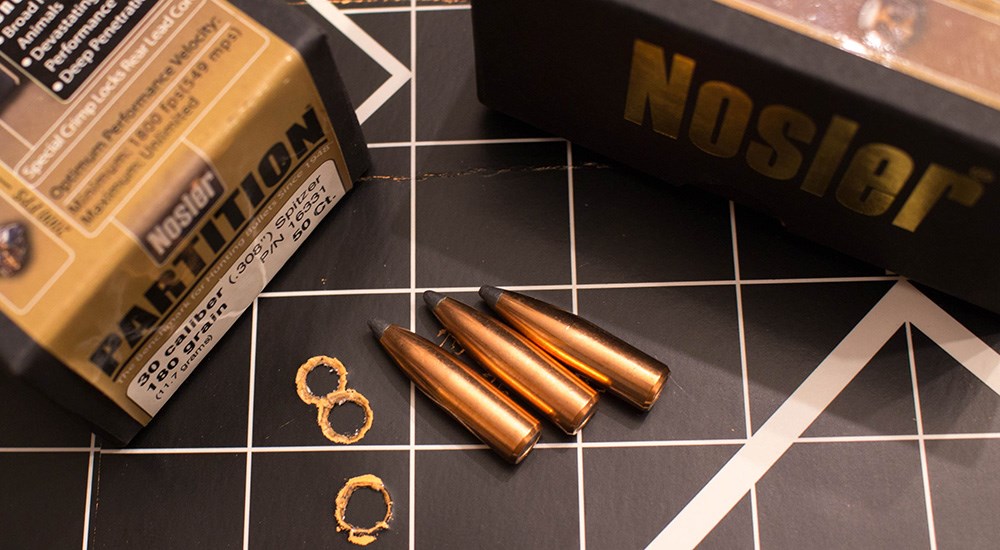
Does a high-BC bullet pose a problem at short ranges? Not necessarily, but as the BC value increases, the length of the bullet generally increases with it. Sleek ogives and longer boattails result in a bullet which will take up more room inside the case, as well as having a longer cartridge length. A flat-based spitzer with a more traditional ogive will still do well at longer hunting ranges, while freeing up a considerable amount of case capacity. For those who hunt at truly long ranges, the BC value will mean as much to them as it does a long-range target shooter, as the flatter trajectory and lesser wind deflection values will aid in making consistent hits.
Many manufacturers will give the BC value of their bullet in reference to a G1 model, even though the bullet clearly resembles the G7 model. Perhaps this is to simply show a higher—and apparently more attractive—number, but in my experience with ballistic calculators the G7 value gives a better solution at long ranges. Please also understand that the BC values listed for any particular bullet are an average, as the true value is fluid, and will change with varying velocities. To my knowledge, Sierra Bullets is the only company to list their BC values at different velocity ranges.
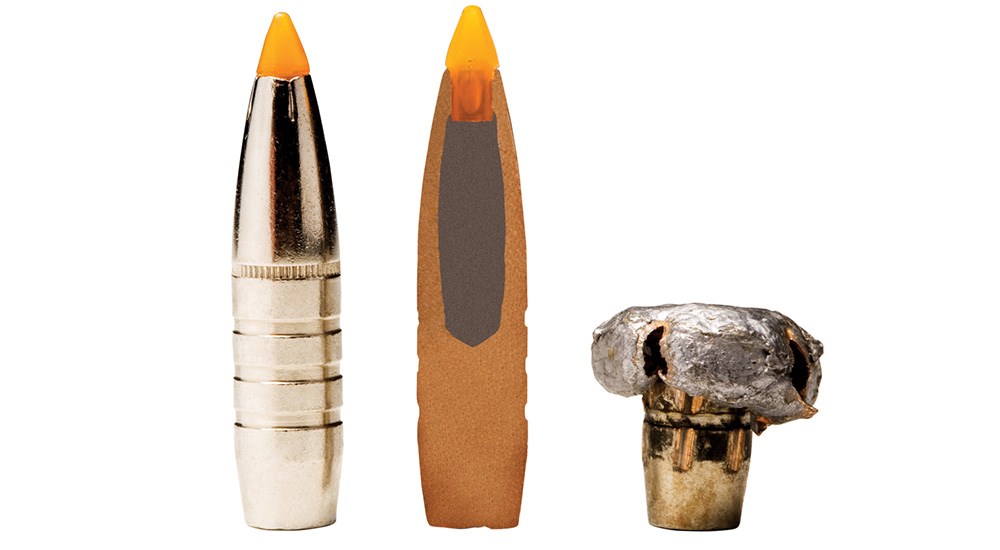
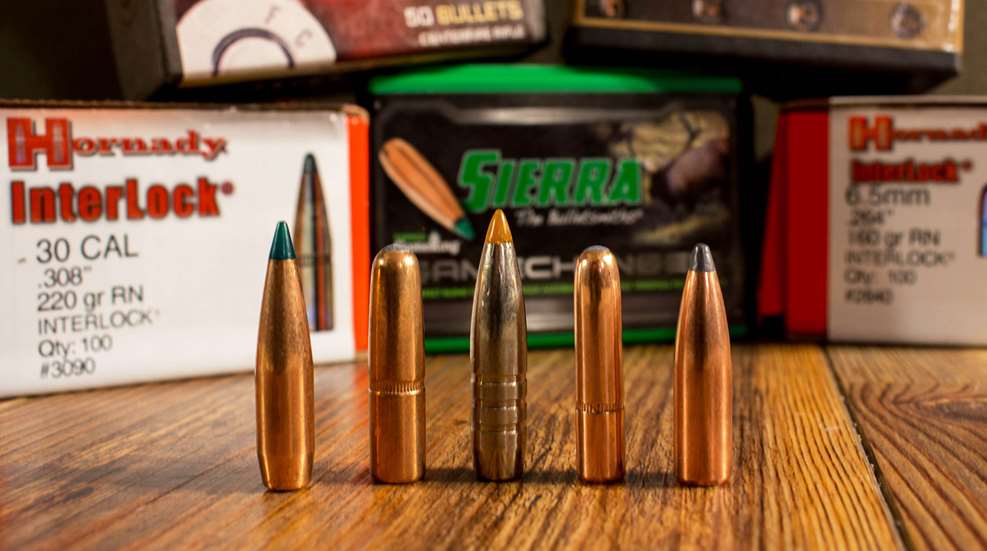
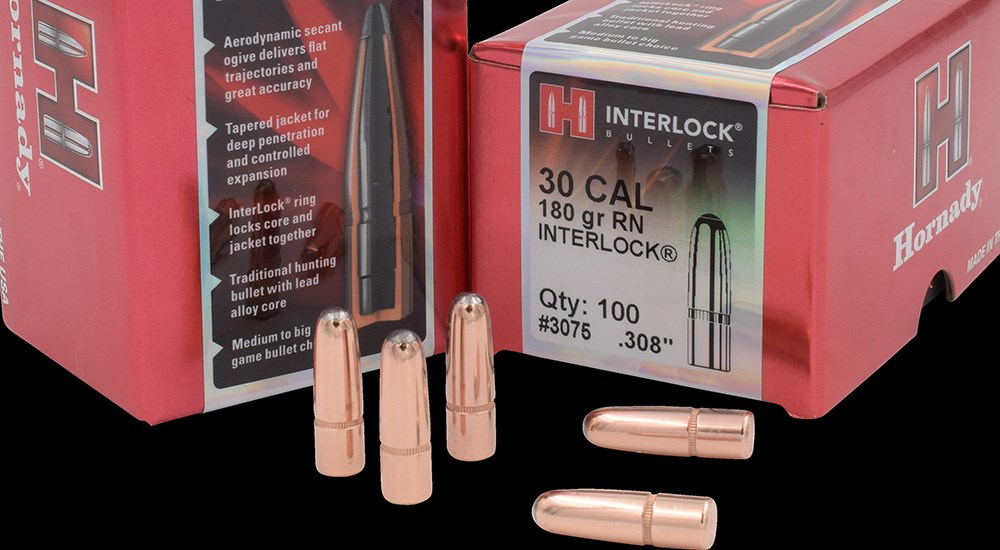
For the hunter, the absolute need for a high-BC bullet comes when pursuing game species which are regularly taken outside of 500 yards; I believe that inside that mark, a more traditional bullet can and will get the job done. Let’s compare four different 180-grain .30-caliber bullets launched at the .300 Winchester Magnum muzzle velocity of 2960 fps, and their trajectories out to 500 yards to best illustrate the effects of ballistic coefficient. To give a good mix, and best demonstrate the effects of BC, I've chosen a Hornady Interlock round-nose (G1 BC .241), Nosler Partition flat base spitzer (G1 BC .474), Federal Trophy Bonded Tip polymer tip boat tail (G1 BC .500) and a Berger Elite Hunter spitzer boat tail (G1 BC .567). For comparative purposes, let’s use a 200-yard zero and a 10 mph crosswind; all loads will generate 3,500 ft.-lbs. of energy at the muzzle.
The round nose will, quite obviously, be the worst at longer ranges. We’ll see 8.9 inches of drop at 300, 27.6 inches at 400, and 59.7 inches at 500, with the bullet being pushed 43.4 inches by the wind at 500 yards. At that distance, that blunt bullet will be moving at 1,365 fps, retaining 745 ft-lbs of energy. Switch to the three spitzer bullets, and you'll see a radical change in comparison to the round nose, but not a whole lot between the three. The trajectory difference at 500 yards is 2.7 inches, with the Partition dropping 39.7 inches, the Trophy Bonded Tip dropping 38.9 inches, and the Berger dropping 37.1 inches. At the 500 yards mark, the Partition is still moving at 2049 fps, for 1,677 ft.-lbs. of energy, the Trophy Bonded Tip is cruising at 2091 fps for 1,748 ft.-lbs., and the Elite Hunter moving at 2196 fps, delivering 1,928 ft.-lbs. of energy. The sleek Berger bullet is deflected 14.5 inches in a 10 mph crosswind at 500 yards, the Trophy Bonded Tip drifts 17 inches and the Partition 18.2 inches—a definitive improvement over the 180-grain Hornady round-nose, which will be blown 43.4 inches in that same wind.
Bullet construction aside, I feel that the “middle-of-the-road” choices are the best balance of flat trajectory, good wind performance, available case capacity, and retained energy. Accordingly, I tend to choose these styles of bullet for hunting, if I anticipate there might be the possibility of a long shot. Being fully transparent, I don’t personally feel that I have any business shooting at unwounded game outside of 400 yards; I could maybe push that envelope to 500 yards under optimum conditions. When hunting in my native New York, where I can pretty well guarantee that my shots are inside of 200 paces, the bullet’s BC is irrelevant to my choice; and I frequently choose round-nosed and flat-nosed projectiles. The same can be said for the majority of hunting in Africa; the distances are—generally—on the closer side of things, and BC just really doesn’t come into play.
For the elk hunter, where cross-canyon shots are a reality, for the caribou hunter out on the nearly-barren Tioga, for the antelope hunter who enjoys working the pronghorn herds on the sagebrush flats, ballistic coefficient is certainly a consideration. Take a look at a few of your potential hunting loads, plug them into a good ballistic calculator—I like the Hornady calculator, available free on their website—and compare and contrast to see what will best suit your needs.