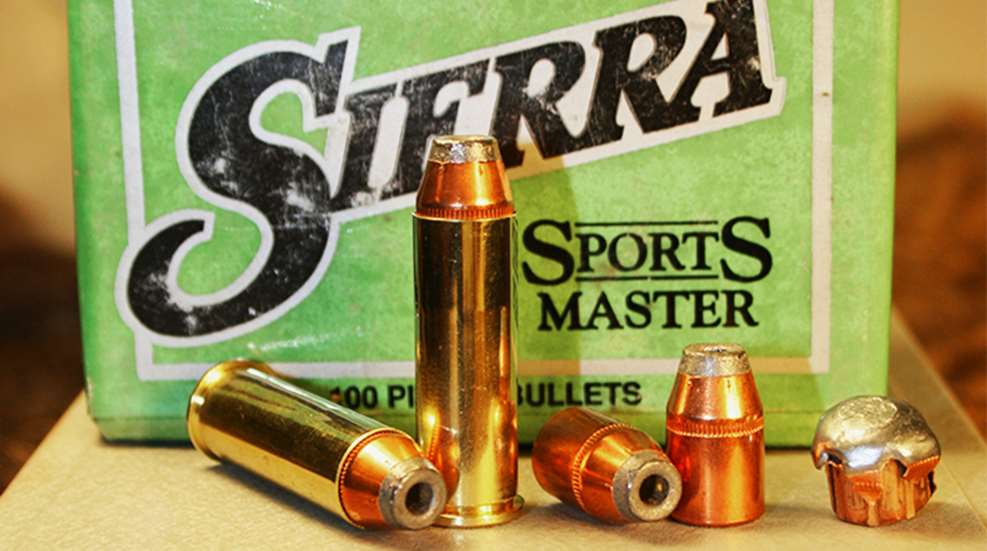
In the timeless fairy tale Goldilocks and the Three Bears, young Goldilocks happened upon an unoccupied cottage in the forest, into which she entered—illegally, mind you—and proceeded to sample three bowls of freshly-made porridge. The first two weren’t to her liking; however, the third, being neither too hot nor cold, was “just right,” so she ate it—all. Like Little Wee Bear’s porridge, the .41 Remington Magnum is “just right” for handgun hunters.
Background
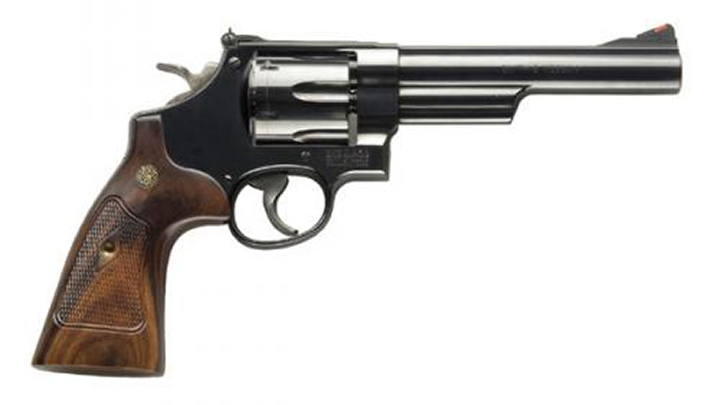
Introduced in 1964 alongside the then-new, single/double-action, six-shot Smith & Wesson Model 57 revolver, the .41 Rem. Mag. was envisioned as a dual-purpose—law enforcement and hunting—cartridge. Echoing that belief, Remington’s initial loadings consisted of a reduced-velocity, 210-grain lead semi-wadcutter for police work, and for hunting a full-house, jacketed hollow point, also in that weight. Some sources suggest that the latter appeared earliest, and it was a primary cause in its demise. The .41’s 0.410-inch-diameter projectile effectively split the difference between the stalwart .357 Mag. (0.357-inch) and glitzy, newfangled .44 Rem. Mag. (0.429-inch), offering more stopping power than the former and somewhat better controllability than the latter. On paper, it appeared to be a Godsend.
Sales proved otherwise; the cartridge/handgun combination received a lukewarm reception from most law enforcement agencies, with few actually adopting it. It was a bad fit—literally. Not only was the “N”-frame revolver overly large for some officers’ hands, the .41’s recoil and attendant muzzle blast exceeded the threshold for many, too. Still others believed that it was needless, as the .357 Magnum was an established manstopper. It remains so today.
Whereas law enforcement saw little value in the .41 Rem. Mag., the love wasn’t lost on handgun hunters and ringers of distant steel silhouettes. That’s because, until the advent of the .41, those who elected to use a revolver for big-game hunting and competition had no middle-of-the-road cartridge from which to choose. The .357 Mag., for instance, generates mild recoil and, with a quality bullet well-placed, easily downs deer-size game and feral hogs. According to Cartridges of the World, 13th Ed., “It has been used successfully on deer, black bear, elk and even grizzly bear. However, it is not fully adequate for these larger animals, unless used by an excellent marksman.” That’s an understatement! It’s also good for varmints and dispatching small predators.
Conversely, the .44 Rem. Mag. can quickly down the largest game worldwide at-distance. “This is one of the few commercial handgun cartridges that can be considered fully adequate for big-game hunting,” states Cartridges of the World, 13thEd. But its recoil is such that many shooters cannot grow accustomed to it. Such power without precision is pointless.
Observant hunters immediately recognized that the .41 offered notably better external and terminal ballistics than .357 Mag., and yet was slightly more shooter-friendly than the .44 Rem. Mag. Performance-wise, it compared favorably with the .44. Here’s proof:
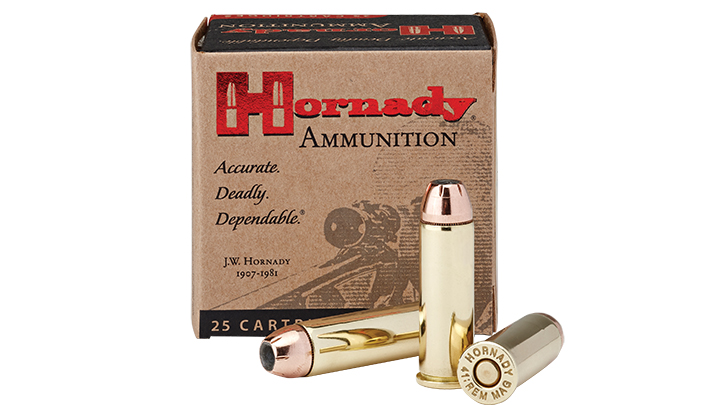
When propelled to 1545 fps—as it is in Hornady’s Custom .41 Rem. Mag. loading—and zeroed at 50 yards, a 210-grain XTP bullet (with a .182 G1 BC) will impact 3.08, 6.66 and 11.79 inches low at 100, 125 and 150 yards, respectively. At those same distances, the projectile has 720, 653, and 598 ft.-lbs. of energy remaining. In comparison, the .44 Rem. Mag. Custom load propels its 240-grain XTP (with a .205 G1 BC) to 1350 fps. With the same 50-yard zero, “drops” at 100, 125 and 150 are 4.26, 8.86 and 15.28 inches, respectively. On-tap energy at 100 yards is 684 ft.-lbs., and at 125 and 150 it’s 637 and 598. The astute will note that, at 150 yards, both the .41 and .44 Rem. Mag. cartridges have the same energy remaining. Given this performance, you can understand why Cartridges of the World, 13th Ed. states, “The .41 Magnum covers small-game, medium-game and varmint-through-deer classes quite adequately.” I have personally used the .41 Magnum to take whitetail and axis deer, and I wouldn’t hesitate to pursue elk, caribou, and black bear with it. I have never been left wanting more energy. When hunting Kodiak Island, a .41 Mag. loaded with heavy, hard-cast lead bullets was my personal-protection combo of choice.
Given the above ballistics, you’d think that the .41 Magnum would be the go-to revolver for big-game hunting. It’s not. Unfortunately, the .44 Rem. Mag.’s 1955 debut and push into the limelight with the 1971 movie “Dirty Harry,” cemented its place in the American psyche as the magnum of choice. Plus, it can be argued that the .44 has greater versatility, due to the larger variance in projectile weights. Still, a cadre of fans keep the .41 Rem. Mag. going.
Still Going
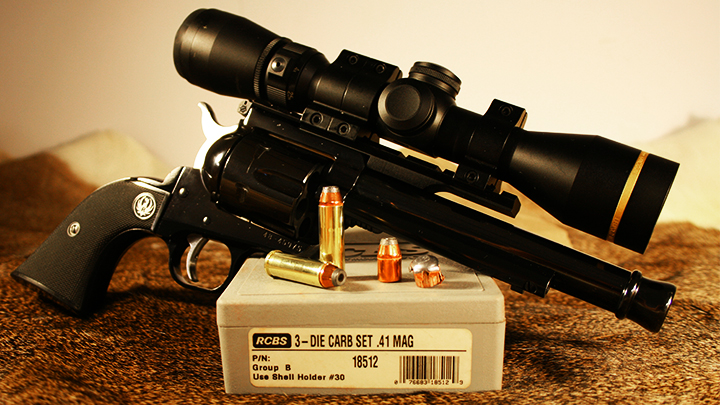
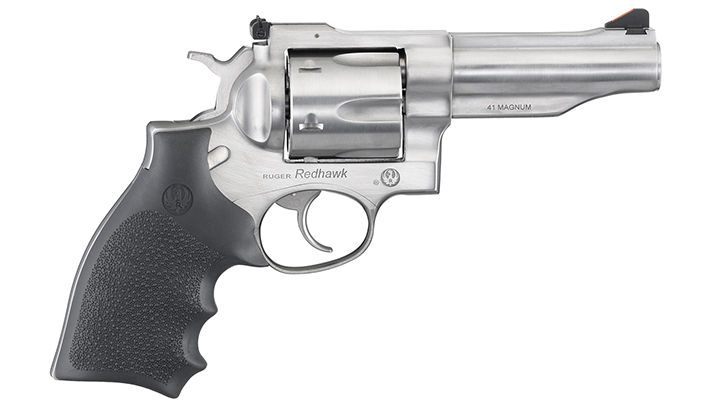
New revolvers chambered in .41 Rem. Mag. are fewer in number than .357s and .44s, but they do exist. For example, there’s a 6-inch-barreled, six-shot Model 57 S&W Classic not unlike the original. Ruger, however, is the unattested champion of the .41, as the company offers the New Model Blackhawk with a 4.62 or 6½-inch barrel. I had SSK Firearms re-barrel—with a premium, custom, canon-profile barrel—and tune one of the latter for me. Moreover, as a distributor exclusive, Ruger builds a 4.2-inch-barreled Redhawk and 7½-inch-barreled New Model Super Blackhawk Hunter. As its name suggests, the latter is particularly well-suited for hunting.
Good deals can also be found on secondhand .41s, such as the Taurus 425 Tracker, Smith & Wesson Model 657 and 58 and Dan Wesson revolver. There’s also the single-shot Thompson/Center Contender to consider. Likewise, the cartridge can be had in a lever-action rifle, such as the Marlin Model 1894S and Henry Big Boy Steel Carbine.
Fortunately, many companies have upgraded and diversified their .41 Rem. Mag. ammunition greatly. Hornady, for example, loads the abovementioned, 210-grain XTP bullet, as well as the tipped, flatter-shooting 190-grain FTX LEVERevolution. Remington’s High Terminal Performance (HTP) round features a utilitarian, 210-grain jacketed soft point (JSP), and Barnes loads a leadless 180-grain XPB.
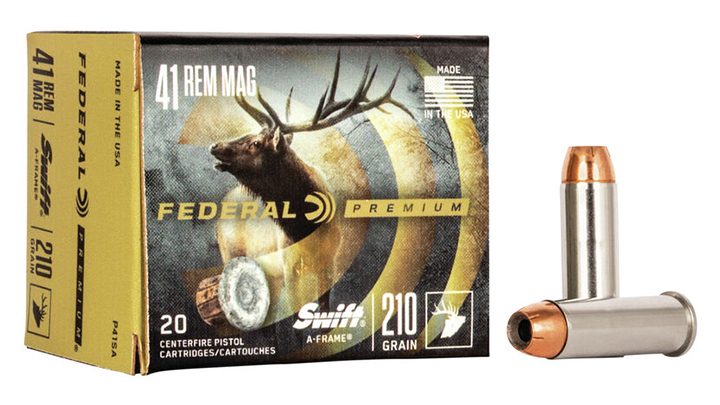
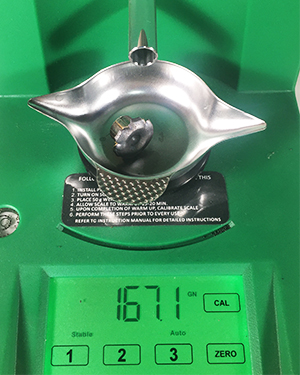
Remington uses the same projectile in its HTP Copper Handgun line. Federal offers a 210-grain Swift A-Frame option, which is ideal for the largest quarry you’ll tackle with a .41, as well as a basic 210-grain JHP suitable for deer-size game. In the Super-X line, Winchester employs 175-grain Silvertip JHP—essentially a defensive bullet—as well as a 240-grain HP in the Platinum Tip series. Don’t overlook the Silvertip for hunting deer, as I’ve used it to down several without issue. One bullet I recovered had expanded to 0.685-inch and weighed 167.1 grains.
Underwood Ammo has the greatest variety, loading a Lehigh Defense lead-free 150-grain Xtreme Defense, 210-grain JHP, 230-grain Keith-type semi-wadcutter and 265-grain lead wide nose gas check. The latter is also used by Grizzly Cartridge, and it has a 250-grain variant, too.
Other companies offering .41 ammo include: HSM, Swift, Precision Cartridge, Inc. and DoubleTap. DoubleTap loads the unique 300-grain Equalizer, which has a 210-grain JHP atop a 90-grain solid bullet for multiple wound channels and deep penetration. You’ll find that most companies use one of a select few bullets.
As with other large-caliber cartridges, ammunition in .41 Rem. Mag. is pricey; expect to pay $20 to $25 per 20 rounds for run-of-the-mill fodder, and in excess of $30 for premium loads. To cut costs and afford additional practice, not to mention attain top accuracy, I’d suggest handloading the cartridge. Dies are offered by all large diemakers, and bullets can be had in a much greater variety than is factory loaded. The loading process is uncomplicated, too; it differs none from the that of other rimmed, straight-wall cartridges, such as the .357 Mag., .44 Rem. Mag. and .454 Casull. Many of the same magnum-type propellants for these rounds cross over into the .41 as well. Brass can be had from Remington, Hornady, Starline and Winchester. It costs about $23-$25 per 100 rounds.
“In summation, the .41 Magnum is not quite as powerful as the .44 Magnum, but it is all the gun the average handgun hunter needs,” reported Cartridges of the World, 13th Ed. Indeed, it is just right.