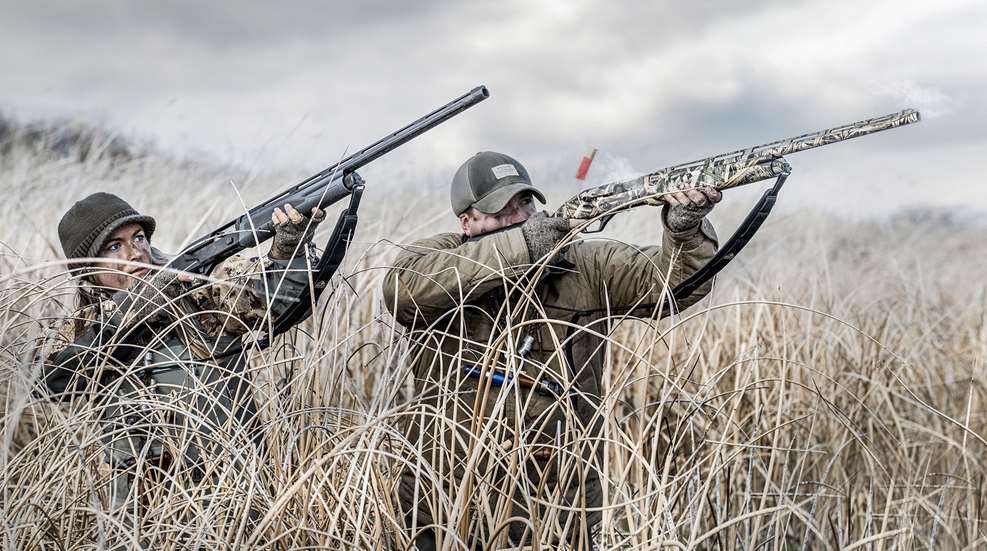
Volumes have been written about how to become more proficient with a shotgun, and if you comb through the expansive literature on the subject and put those principles into practice, you’re very likely to hit more birds and break more clays this year. But do you really have time for an exhaustive in-depth review of the nuanced game of shotgunning? Do you have to study the various methods and apply all the techniques described to hit more birds?
Probably not. That’s why we’ve boiled the basics of shotgun shooting into three standout principles that will help you hit more birds quickly. We’re avoiding nuanced topics and gamesmanship and boring into the root cause of most misses. Here’s how you can improve your wingshooting skills in just a few short weeks.
Step One: Shotgun Tuning and Practice
Fifty years ago, when you purchased a shotgun there wasn’t a lot you could do to improve its performance. Fixed chokes, walnut stocks and limited ammunition options meant that shooters simply had to play the hand they were dealt. You could pay to have a stock altered (if you had the money and could find someone to do it correctly) but very few hunters actually did this.
Today wingshooters have better options. Many shotguns come with shim kits, and if you’re willing to take the time to learn what the pitch (angle of the buttstock relative to the topline of the gun) and cast (angling the stock slightly left or right) shims do for your performance, you can improve how your gun shoots. Length of pull can also be adjusted, and when your shotgun fits properly and is mounted on the shoulder correctly, the dot sight should be sitting on the rib without any portion of the top of the rib itself being visible. Right-handed shooters will likely benefit from a cast-off gun (stock angled slightly right), and lefties will work best with a cast-on gun (stock angled slightly left).
No discussion of how to hit more birds truly begins until you’ve patterned your shotgun. When I test shotguns for my own use, I pattern them at 25 and 40 yards and very few hit dead-center right out of the box. Sometimes you can adjust the stock angle using shims to correct this, and sometimes your gun simply hits slightly high or low—but at least you’ll have some idea where it’s patterning. As you adjust the pattern, try different loads and chokes. I’ve found aftermarket chokes truly are worth the money. That’s not always the case, but high-quality aftermarket chokes have turned some so-so shotguns into slayers.
Once you’ve patterned your gun you need to practice with it. Shotgunning is a perishable skill, but the more clay targets you break the better your odds of success. Suggesting that you shoot clay targets to kill more birds may elicit an eyeroll from some readers, but when’s the last time you shot a hundred rounds through your gun? Failing to practice with your gun is akin to lamenting your slow 5K time without having run once in a year.
Step Two: Shotgun Mount
The single best piece of advice I’ve ever heard for killing more birds with a shotgun goes like this: When you’re shooting a shotgun your eye acts as the rear sight of the gun, and you wouldn’t do well shooting a rifle with a wobbly rear sight. Why should shotgunning be any different?
Most shooters know when they’ve really messed up their gun mount, such as when their recoil pad lands on their bicep and leaves a bruise. Most shooters cannot, however, detect subtle variations in gun mount because they haven’t practiced enough. You can correct that in your home in about 10 minutes a day.
Using an unloaded shotgun, mount your gun so it rests in the pocket of the shoulder and your eye is parallel with the top line of the rib. Normally, shotgun shooters are instructed to avoid looking at the front bead, but for this drill the bead will serve as your point of reference. Is the bead in the center every time you raise the gun? Is the rib flat? Mount your gun 50 times and see how many times the rib and bead line up correctly.
What you’re accomplishing with this drill is building muscle memory and forming a more consistent gun mount, which is one of the easiest ways to quickly improve your performance with a shotgun. What’s more, you need to practice this skill in the clothes you plan to wear hunting. Mounting a gun on your shoulder a hundred times while wearing a T-shirt doesn’t translate to mounting the gun in a vest or while wearing a waterfowl coat. If you’re going to devote time to improving your gun mount you may as well make the drill as realistic as possible.
Step Three: Follow Through
Shotgun coaches have been preaching follow through since time immemorial, and most trap and skeet shooters are very good at committing to following through the target. But these skills that were developed on the range tend to dissolve the first time a wad of teal buzzes by the front of your blind.
Ask most wingshooters why they miss a bird and they’ll tell you they shot behind it, which is usually true. Why? They stopped their gun mid-swing. It’s usually an involuntary action, the result of a split-second pause to see if the bird is hit, and then it’s a race to catch up to the target. If you’re following through there’s no need to frantically catch up to the bird because your gun is in motion.
Failure to follow through with your shots is exacerbated under field conditions, but everything really goes haywire when you’re trying to shoot a bird out of a flock because your brain is overwhelmed by an abundance of targets. This is the time you must be the most focused on the task, which is identifying a single target and following through the shot. Of course, your ability to do so may be limited such as in a duck blind where we must adhere to the 10-to-2 shooting window for safety, but that only means you must pick up your target quickly, maintain proper lead and continue swinging.