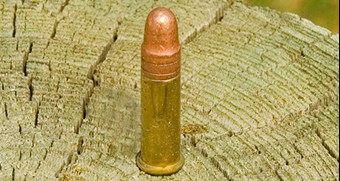
 For some two or three years finding .22 Long Rifle (LR) ammunition has been quite a challenge. There are several reasons for this, but most are centered on the fact that demand is far outstripping supply. The .22 LR is so ubiquitous that many of us still can’t seem to wrap our heads around the fact that it is virtually impossible to run down to the local hardware store and pick up a few boxes for an afternoon of plinking. That same 50-round box that used to go for 50 cents is now going for as much as $10, and the store will limit you to two boxes (if your wallet hadn't already). So how—in this day of super-overbore magnum cartridges—did this comparatively pipsqueak cartridge get so popular?
Rimfire cartridges are the oldest of the self-contained cartridges we have. The earliest versions were put together in copper cases. Copper is a relatively soft metal with great malleability. During the mid- to later-19th century when repeating rifles and pistols were first being developed they were made for low-powered rimfire cartridges. There were a couple of key reasons for this: First, the initial development of repeaters was a complex task for the time, and early mechanisms were comparatively weak by today’s standards. Secondly, low-powered rimfire cartridges were less expensive to produce, thereby cutting development costs, as well as providing a high volume of product to hungry consumers. Brass cases came later after smokeless powder and high-velocity ammo came into the picture.
Smith & Wesson was the first to introduce a .22-caliber rimfire cartridge in 1857. It was chambered in the company’s First Model, a small, spur-trigger revolver that featured a bottom-hinged barrel that tipped down raising the cylinder to be unloaded and reloaded. That first .22 was loaded with a 29- to 30-grain lead bullet in front of 4 grains of black powder yielding about 600 fps from a 3-inch barreled revolver. Initially, S&W’s .22 was intended for quiet recreational shooting, but it gained popularity as a self-defense round in a pocket pistol. Around about 1871 somebody got the “magnum” ball rolling when they lengthened the case .192 inch so they could get another grain of black powder (for a total of 5 grains). A 25-percent increase in powder gave the same 29-grain bullet a velocity of 1,028 fps from a rifle. Since the case was longer, this cartridge gained the moniker of .22 Long, and the parent case’s name was changed to the .22 Short.
In 1880 a .22 Extra Long cartridge was introduced. It featured a heavier, 40-grain lead bullet in front of 6 grains of black powder. The case was a full 3/4-inch long, and the cartridge enjoyed a fair amount of popularity as a small game hunting round. However, it was not as accurate as the .22 Short, so target shooters largely shunned it. Seven years later the J. Stevens Arms & Tool Company took the 40-grain bullet of the Extra Long cartridge and loaded in the Long case, calling it the .22 Long Rifle. Finally someone found the best balance of bullet weight and velocity that provided the accuracy that target shooters longed for with the terminal performance that small game and pest shooters pined for. A tremendous amount of research and development has been poured onto this cartridge to enhance its accuracy and terminal performance. Cheap to produce, making it virtually universal in acceptance worldwide, the .22 LR has been chambered in every kind of rifle and handgun made. I cannot find a number for the amount of firearms chambered for the .22 LR, but I feel confident that the number is in the billions.
The initial loading for the .22 LR was a 40-grain bullet at 1,048 fps, but Remington introduced a High Velocity loading for the cartridge in 1930 that kicked that 40-grainer out at 1,300 fps from a rifle barrel. One should note that older semi-automatic firearms like the Colt .22 Automatic (forerunner of the Woodsman) that were made before 1930 should not shoot High Velocity loads unless the gun has been altered to allow it to fire these loads. It doesn’t take many high-velocity rounds to shoot these early, unmodified guns loose.
As a part of all that research and development in this cartridge bullets as light as 29 grains and as heavy as 60 grains have been made. They have made hollow points, solids, FMJs, copper washed and shotshells loaded with No. 12 shot in a plastic capsule. Industry estimates that annual production of the .22 LR is somewhere between 2 and 2 1/2 billion rounds. A few intrepid souls have managed to handload .22 LR ammunition, but most mortals have found this a case of diminishing returns. The risks and time needed to roll your own rimfire ammo doesn’t square with the ability to simply go to the local store and purchase a brick—even in today’s condition of excessive demand vis-à-vis supply.
The .22 LR is a result of what many like to term “the stars were aligned” to make an accurate, cheap-to-shoot cartridge that’s as home on the target range as it is in the small-game and pest fields. Every shooter and hunter has at least a couple of them in their safe—offhand I’d estimate there are a dozen or so of them around my humble abode. One of these days, guys will quit trying to hoard this ammo. Prices will drop and availability will soar. Be patient.