The Henry Repeating Arms Co. was founded in 1996 and at first exclusively offered rimfire repeaters styled after the famous Henry lever-action rifle that changed the face of hunting and warfare in the late 1800s. Conversely, its Golden Boy smallbore lever guns are almost as fun to behold as they are to shoot. Today it might surprise you that the Bayonne, N.J., firm is one of the five largest producers of long guns in the United States. Lately it has introduced modernized lever-action rifles for hunters as well as a couple shotguns, including a cool lever-action .410-bore. Now the company is going in the opposite direction for which it is known with the release of the Single Shot Rifle.
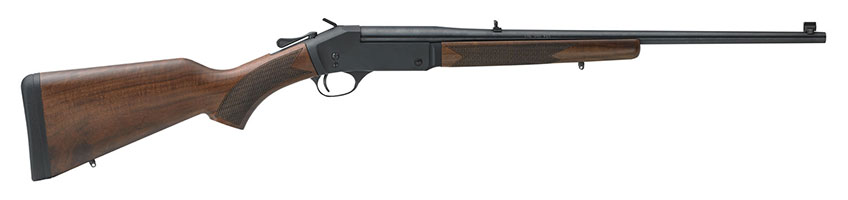
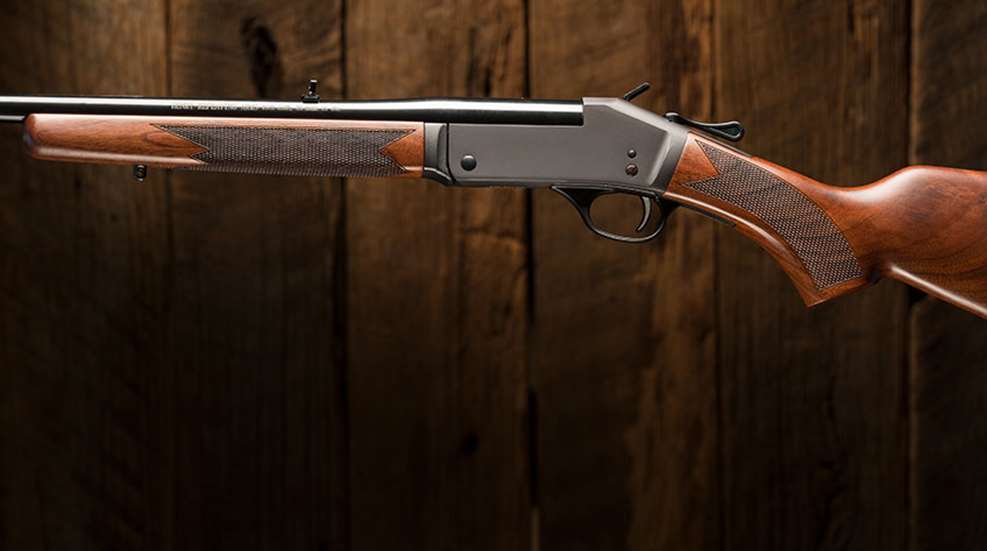
Henry has always taken a fairly simplistic approach to building its guns, and the Single Shot Rifle follows suit. It has only a few moving parts, and that means fewer to break. When I first lifted the rifle from its box, I was pleased at how nimble it felt. With its 22-inch tapered barrel, slim fore-end and compact break-open action, the Single Shot Rifle seems lighter in the hands than its 7.1 pounds would suggest. While a shorter buttstock would make it ideal for a kid, the rifle as it comes from the factory will make a perfect ATV, truck or trail gun due to its carbine-like feel and modest price. Without a scope, it slides into a scabbard smoothly and there’s virtually nothing to break no matter the roughness of the ride.
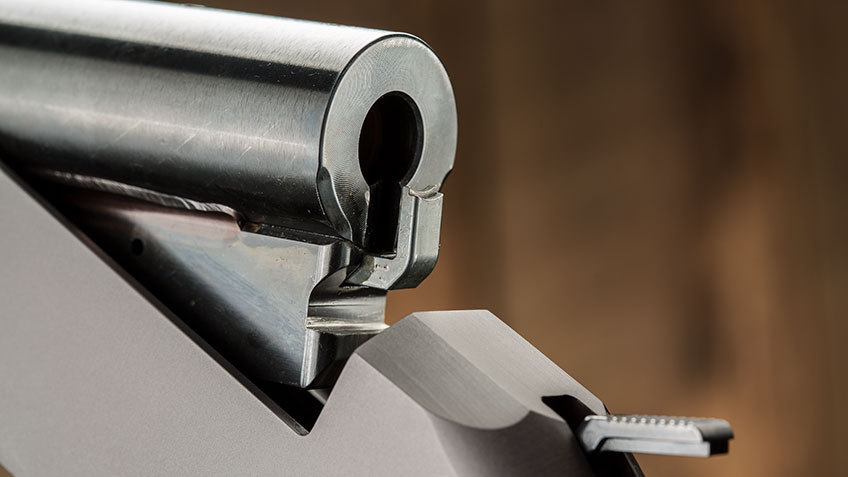
The rifle’s action is based on a simple design with a single hinge pin and an opening lever located near the tang. When opened, the action uses leverage provided by tipping the barrel downward to push a centered extractor rearward so the shell can then be removed by hand from the chamber. Without a spring-loaded ejector, it’s as simple and reliable as extraction methods get. The opening lever can be pushed either way to unlock the action, making the rifle ambidextrous.
Despite the rifle’s lack of a trigger-blocking safety, Henry placed great thought into making the gun safe. Of course its external hammer functions as a safety because it must be deliberately cocked in order for the gun to fire. In addition, the rebounding hammer cannot touch the firing pin unless the trigger is pulled fully to the rear. This prevents discharge if the rifle were to be fallen upon or dropped, or if the hammer were to slip from under the thumb while cocking. The hammer can’t be cocked while the action is open, and the action can’t be opened while the hammer is cocked.
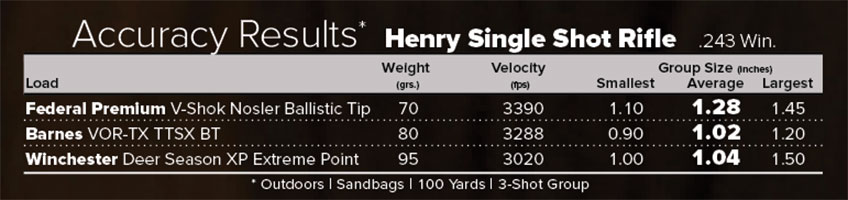
While the Single Shot Rifle is simple and safe, Henry could have done better with the trigger. Despite a factory-specified pull weight of 5-6 pounds, the trigger in my test rifle required 9 pounds of pressure. A second sample rifle had an average trigger pull weight of 6.75 pounds. Neither promotes great accuracy. In shooting from a Lead Sled, however, I recorded surprisingly good groups with several loads. My offhand and field-position groups were larger, of course, and at least some of the blame I attribute to the heavy trigger.
I’ll also note that during the early stages of testing I experienced misfires with two loads. Upon inspecting each unfired cartridge, I found that the firing pin appeared to have struck the primer but not hard enough to detonate it. As testing continued, however, the issue went away. I can only speculate that there was a burr or rough spot on or near the firing pin that smoothed out as testing progressed. When I shot the rifle during subsequent range sessions, no misfires occurred.
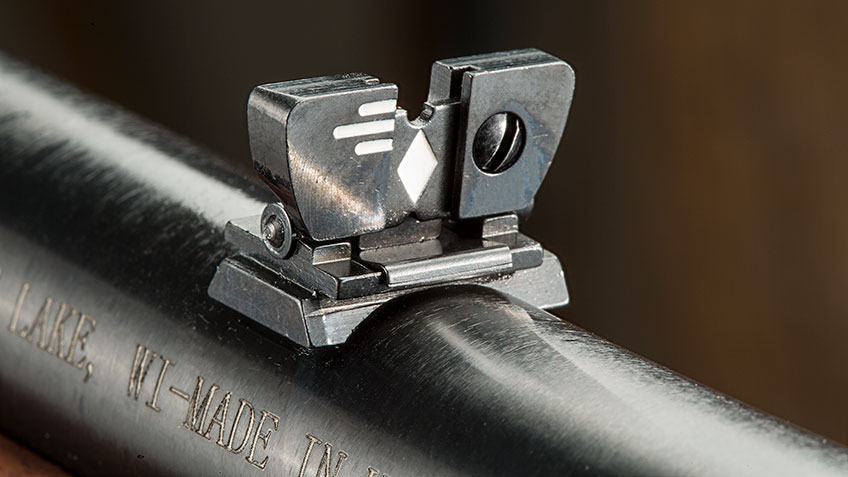
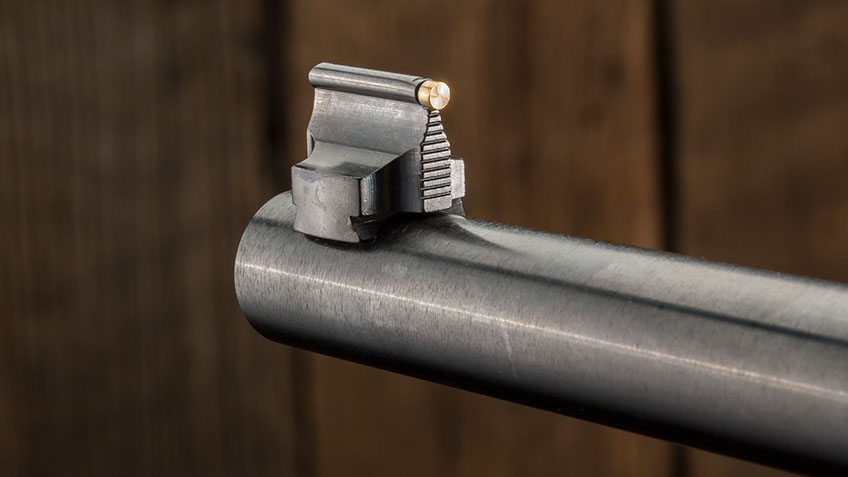
I really liked the Single Shot Rifle’s robust iron sights. The folding rear leaf is a shallow U-notch style, while the elevated front bead is capped in brass. The brass bead nestles perfectly into the rear notch for consistent accuracy. To adjust windage, the rear sight leaf can be loosened via a screw and moved left or right on its base. Elevation adjustments come via the sliding metal insert that contains the notch. The rifle’s barrel is drilled and tapped for a scope mount, but a scope on this lithe little dude hardly seems fitting.
Another of the rifle’s strong suits is its stock. Made from nicely figured walnut, the stock on my test unit provided aesthetics that were surprising when I considered this rifle’s low cost. Both the splinter fore-end and buttstock grip are deeply checkered for outstanding purchase, and each has a sling swivel stud. The well-designed recoil pad is soft to the shoulder, but slick and rounded at the heel so that it doesn’t catch on clothing.
The rifle is disassembled by simply tapping out the hinge pin; avoid the temptation of removing the fore-end as is necessary with other single-shots. It breaks down in seconds, and can be stored or transported in two pieces that are no longer than the barrel portion.
Henry chambers the Single Shot Rifle for five cartridges. No doubt the .45-70 would generate serious recoil in such a light rifle, but it sure would be cool. The .243 Win. version, which is what I tested, would make a perfect first deer/predator/target rifle for a new shooter. All rifles in the line have a blued finish and a pistol-grip buttstock; the .44 Rem. Mag. and .45-70 single-shots are also available with a Golden Boy-ish polished brass receiver and a straight-grip buttstock.
Whatever chambering and finish you choose, the Henry Single Shot Rifle is a nifty little tool that is handy and accurate despite its stiff trigger. While it is definitely not the rifle you can load on Sunday and shoot all week, there’s no need; the one-shot, one-kill rifle is coming back into style.
Technical Specifications
• Type: break-action, single-shot centerfire rifle
• Caliber: .223 Rem, .243 Win. (tested), .308 Win., .44 Rem. Mag., .45-70 Gov’t.
• Barrel: 22″; chrome-moly steel w/sporter contour; button rifling, 6 grooves; 1:10″ RH twist
• Trigger: single-stage; 6.75-lb. pull weight
• Safety: rebounding hammer
• Sights: fully adjustable folding leaf rear, brass bead front; barrel drilled and tapped for bases
• Stock: American walnut w/pistol grip, matte finish; LOP 14″
• Metal Finish: matte blued
• Overall Length: 37.5″
• Weight: 7.1 lbs.
• MSRP: $448; henryusa.com