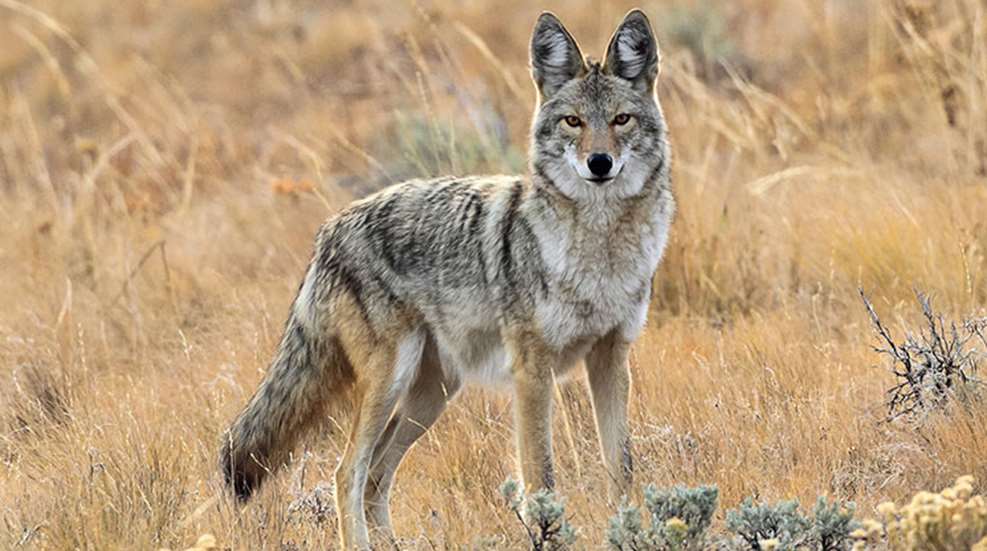
By Valentine’s Day you’ve probably felt the pain: the agony of having coyotes shun your calls. It’s not out of the ordinary for coyote-calling success to dwindle as the days begin to grow longer with spring’s approach. Educated coyotes are top misery makers, and many of the less wary are MIA due to a date with fur-shed destiny. Dr. Phil consultation won’t help this pain, but tweaking your coyote strategy could assist you in landing one more fawn-eater in your truck bed. Here are late-winter tactics from four experts to help you close out the season.
Play Love Songs
Nineteen-year coyote-hunting veteran and Mossy Oak pro-staffer Heath Wood has hunted coyotes across the Great Plains, but he spends most of his time pursuing Show Me State ’yotes. He understands the tests late-season coyotes pose, but also knows coyotes have a weakness during this period: love.
“One of my favorite calling techniques for late season is adding estrus whimpers, whines and female howls,” says Wood. “I start off the setup with three to four subtle howls on a diaphragm call or an open-reed howler. After the howls I wait four to five minutes then continue with some type of distress sound. I add coyote vocals to the end of the sequence, usually doing this on the last stand of the day after the distress sounds have played for around 30 minutes.”
Wood believes this strategy delivers because instead of giving coyotes just one reason to visit his calls, he piques their interest in everything important to a coyote. However, he stresses it’s the ending vocals, female whimpers and submissive howls that play a major role in late-season success.
Feed Them Crow
Steve Criner, host of “Dog Soldier TV” on the Sportsman Channel, realizes late-season coyotes pose a threat to his production schedule. When he hits a wall with other calls, Criner immediately switches to a standby he’s used for years: crows. Crows, magpies, jays and other scavengers of the air provide coyotes with information about kill sites, and they instill coyote confidence through their keen observations from above.
“Like most coyote hunters I hunt ranches that are beat up and shot up by me or other hunters,” admits Criner. “To call in educated coyotes I rely on crow mobs for late-season success.” Criner starts his set with a long, drawn-out, subtle howl. After watching for a few minutes, he introduces the sounds of a crow and hawk quarreling. A few minutes later he adds more crows fighting with a single hawk. As this all heats up he augments the disturbance with one more ingredient: the sound of a rabbit in distress. To mix the sounds he utilizes an electronic caller along with mouth calls.
“You usually call in crows, and they see everything, so you need to be well camouflaged to prevent them from sounding an alarm. If you create a crow mob you’ve created what I call the Dog Soldier smoke signal. It’s a confidence visual that coyotes run to as their territoriality, curiosity and hunger impulses kick in. It creates the perfect situation,” asserts Criner.
Mock the Talk
Levi Johnson has 30 years of coyote hunting experience, including decoy-dog adventures that provide content for his popular online video series, “Doggin’ with Levi.” He hunts coyotes the entire year and understands the trials late in the fur season. To make wary coyotes show themselves, Johnson prefers to challenge them—or as he puts it, “irritate the living heck out of them.”
It’s easy to find a challenge howl recording on most electronic callers these days, but Johnson goes beyond that sound. In fact, he often shies from a true challenge howl since it can be too threatening to young or subordinate coyotes. He prefers to return the same message a coyote sends to him.
“I don’t use a lot of challenge howls, but I use a lot of lone howling,” shares Johnson. “During the breeding season and even later I make the howl long and draw it out. When I get a coyote to challenge or howl back I immediately respond with the same howling. I talk the same talk he’s talking to me. It’s the same as two adults talking and one mocking the other by repeating everything. It’s irritating and makes coyotes come in to look.”
In addition to repeating every sound a coyote yips back, Johnson sets up to make a coyote look for his calls. He places his FoxPro caller some distance away from his position and upwind, plus he hides it in brush tall enough to cloak a coyote. If a coyote arrives on scene and can’t see the responding “coyote” in the brush, the irritated canine is forced to come closer for a look.
Stage a Fight
Predator Quest pro-staff manager Matt Piippo specializes in coyote vocalizations, and few hunters can match the canine realism he produces with a mouth diaphragm. He refers to late-season coyotes as “fool me twice” coyotes and realizes they’ve heard it all. For him a new sound is in order, and his go-to is the ruckus of quarreling coyotes.
“I kick off 90 percent of my stands with a female howl. In the late season I make it pathetic to send a message of a female asking if anyone is out there,” explains Piippo. “If there isn’t a response I answer it with a more aggressive howl and then wrap it with a yip howl.”
All along, Piippo ramps up the aggressiveness of the message. A response from a distant coyote prompts him to possibly send a challenge howl back. Nevertheless, in the middle of his theatrics he initiates the growls of a fight, complete with coyote distress cries.
“These sounds tell coyotes within earshot that a fight has started in their territory,” he notes. “It could be over boundaries or it could be about breeding, but the fighting sounds are central to fooling coyotes late in the season. Stay on stand for up to an hour and be prepared for a coyote to show up anytime.”
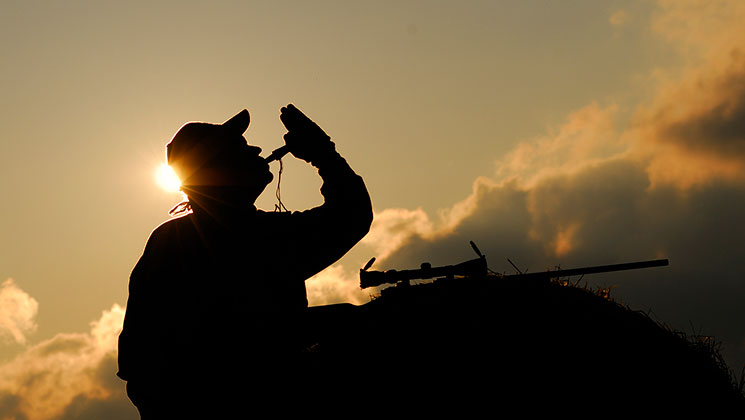
Hot Times to Howl
Brian R. Mitchell conducted a two-year coyote vocalization study at the Dye Creek Preserve in California for his doctorate degree. During the study Mitchell discovered coyotes have individual voices identified through spectrogram deciphering. He also noted that howls recorded from real coyotes and then played back made radio-collared subjects approach from at least a kilometer away.
“Approaches were most common when playbacks were within the responding animal’s home range, during the first half of the year, and at or before sunrise,” Mitchell documented. “Territorial coyotes were twice as likely to respond as transients.” His study also noted that barks didn’t send the same, attractive information. As you can see from your own canine pal, barks oftentimes send an alarm message. Mitchell included human imitations of coyotes in his study. When compared to recordings of real coyotes, human calls “generated similar levels of approach responses.” This is great news for hunters who don’t rely on electronic callers.
Last March I had a free weekend to give the coyotes one more chance to ride in my truck. Instead of carrying on a lengthy message I simply howled several times and shut up to watch. Forty-five minutes later a coyote walked leisurely out of a brushy draw with a suspicious, yet brave approach. The slap of my Hornady V-Max signaled a successful ending to my coyote season with nothing more than a howl for attraction.