The base layer is your first line of defense against the cold, yes, but what about moisture? It’s safe to say (at least I hope it’s safe to say) we all know the dangers of being wet in the field. A wet body has a tough time keeping your core temperature in the functional range. Rain is one thing, but it’s the body’s own moisture-producing ability that is often overlooked, especially when dealing with base layers. As the body heats up, sweat glands produce moisture to keep our bodies cool. It’s a wonderful benefit in hot weather, but can produce potentially deadly results in the cold. You can have all the outer garments in the world to keep you warm, but if there is moisture next to your skin your core temperature will eventually drop. Many outer garments actually trap that moisture within your clothing, hindering evaporation, placing you in, at best, an uncomfortable situation and, at worst, a life-threatening one.
Thus, properties of an effective base layer are two-fold: insulation and moisture removal.
I’ve trusted base layers from Cabela’s for years, and the company’s newest piece, the Insulated Stand Hunter Base-Layer, is touted as its warmest. It’s what I call a hybrid base layer, as it incorporates the softness and moisture-wicking properties of merino wool with the insulating magic of PrimaLoft. PrimaLoft, designed as a water-resistant alternative to goose down, is a synthetic fiber that acts much like natural down in that it traps heat, but does so more effectively than down and with less bulk. Cabela’s has placed it in the areas you’ll need it most, like the upper torso and thighs. The addition of a merino wool lining not only makes it a comfortable, next-to-skin layer, but a moisture-wicking one, too. Just know that if you plan to walk or hike for miles this might be a bit too proficient at trapping heat. This is a base layer for the coldest of climates, for long sits in a treestand or duck blind.
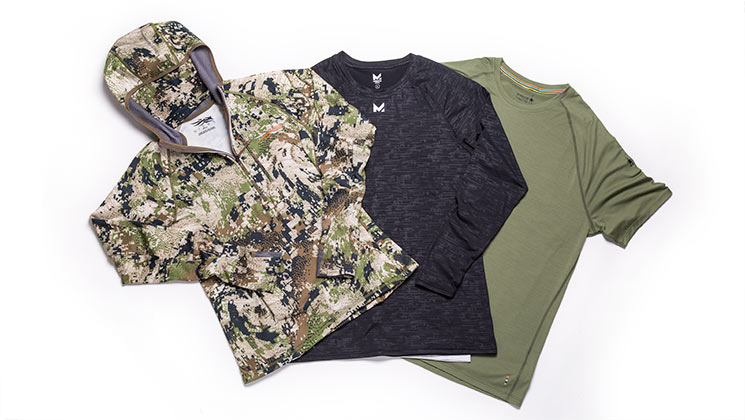
Merino wool has qualities that make it an excellent choice for base layers. Unlike the itchy wool your grandfather wore, merino wool fibers—like those found in ultra-thin, lightweight base layers from Smart Wool—are extremely fine and flexible, making them soft to the touch and elastic so they stretch and form to your body. Merino wool is breathable, as the space between the fibers allows air to flow. And it’s moisture-wicking, as the fibers absorb water and move it away from the skin to evaporate. Even on warm days, merino will remove moisture, maintain airflow and keep your temp regulated and cool. One thing that still amazes me is how many hunters head out with cotton underwear. Cotton kills. Avoid it at all costs, especially in areas as important as your groin. It traps moisture, in fabric has poor insulating qualities, and in an area that already gets increased blood flow and thus churns like a furnace, it is just a bad idea. Lucky for you, Smart Wool makes boxers, too.
Synthetic materials such as polyester, spandex and fleece, like those found in Sitka’s Heavyweight Hoody, work exceptionally well as a base layer due to their high warmth-to-weight ratio and moisture-wicking properties. A grid-fleece interior provides travel corridors for air flow while pulling moisture away from your body for evaporation. The addition of a hood and a built-in facemask helps keep in warmth and adds concealment. Speaking of concealment, the new Optifade Concealment Subalpine camo pattern from W.L. Gore is an impressive pattern designed for hunting in timber and vegetation. It’s a pattern that will be as at home in the timbered West chasing elk as it is on the East Coast for whitetails.
For lighter-weight synthetics, look toward garments from Mission, like the company’s VaporActive Base Layers, which incorporate spandex, polyester and Cocona 37.5 technology. Imbedded with particles from volcanic sand and activated carbon from coconut shells, 37.5 Technology is advertized to remove sweat as a vapor when your body heats up, keeping your body at an ideal 37.5 degrees Celsius (99.5 degrees Fahrenheit) in hot or cold climates. While I’ve never taped a thermometer to my chest to test it, I can tell you it’s an awesome lightweight base layer.
Let’s suppose you’re one of the unlucky ones with ice in his veins: Another hybrid design from the online-exclusive folks at Pnuma takes the company’s effective IconX Hunting base layer and adds an electric heating element. Powered by a small, rechargeable battery pack, the IconX Heated Core Top is touted to keep you warm for a minimum of five hours. With the top’s seven performance zones for maximum warmth and breathability, and the addition of electric heat, your core is sure to stay warm, keeping you afield longer.