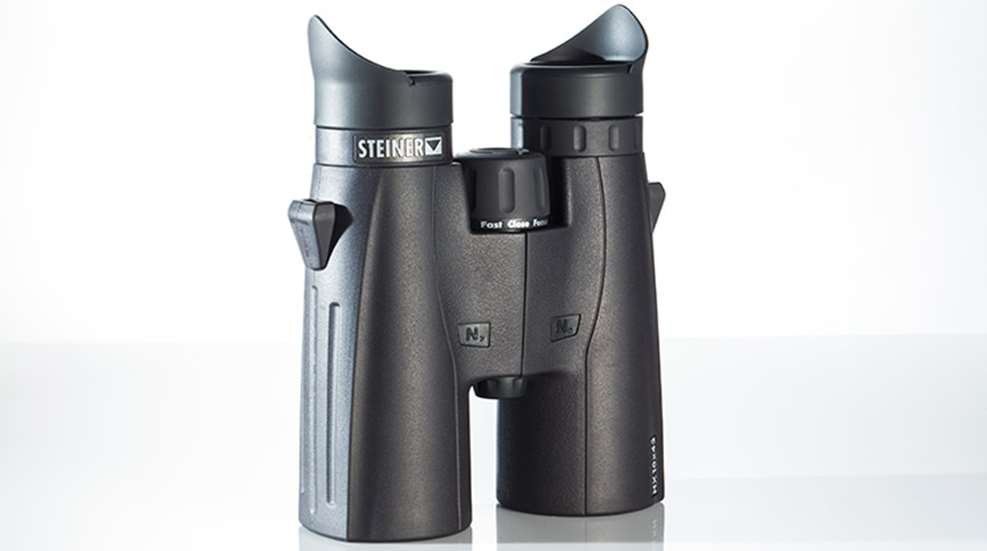
It’s no secret that some of the finest hunting binoculars hail from Germany. Europe has long produced good glass, and at some point Germany became the eye of that storm. It’s easy to get lost in the sea of high-quality optics, though, especially if it’s your first sojourn into a particular price class. It’s important to note that European glass sometimes comes with European-style binocular designs, which don’t always sit well with hunters in North America. Steiner is hoping to bridge that gap with the release of its new HX series.
Founded in 1947, Steiner has produced high-quality hunting optics for decades. In 2008, Beretta Holding’s U.S.-based Burris division acquired the company. Operations are still located in Germany—so much so that, prior to the HX series, Steiner USA didn’t have much say in new product development. That’s changed, though, as Steiner works to further entrench itself within the American market. For the HX series, the two sides worked hand-in-hand to develop a binocular that would replace the company’s Nighthunter line in a way that would make it desirable on all continents.
The Nighthunter was originally crafted for low-light situations—specifically for hunting at, well, night. And while feral hogs and similar critters have helped bolster twilight hunting in the U.S., the majority of big-game hunting takes place during the day. That’s not to say the HX doesn’t deliver in low-light situations—it does so in spades and includes two models with 56mm objective lens diameters, to boot.
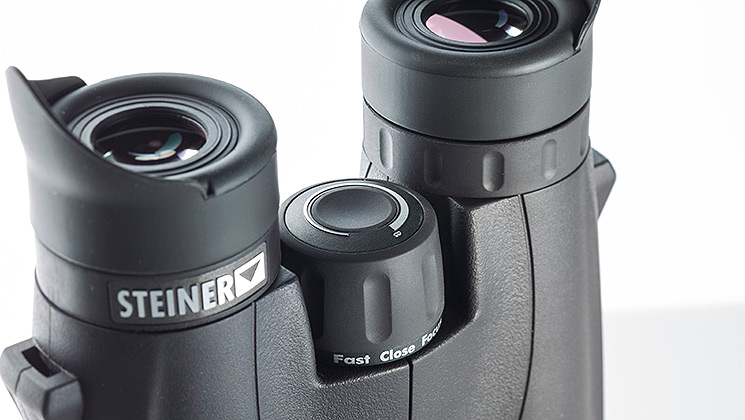
Among the changes is an updated frame. It’s not as rounded as some European designs and is meant to provide a more comfortable, ergonomic grip for extended glassing. The Makrolon polycarbonate housing and NBR rubber armor provide a unique, reliable grip, and make the binocular as durable as it feels. The company’s recognizable eyecups shield against side light and drafts for a clearer view, and can be folded down if you wear eyeglasses or simply don’t care for them. Steiner—which, in 1973, was the first company to produce nitrogen-filled binoculars—treats the HX series with its standard nitrogen pressure purge. Each binocular is sealed full of dry nitrogen pressurized to 14 psi to keep the optic’s interior fog-proof.
One of the hallmarks of the HX series is what Steiner calls its Fast-Close-Focus system. In short, the binocular’s central focusing wheel requires minimal rotation, allowing you to get a clear picture of your objective all that much faster. The concept was created for birders, who often have to be quick on the draw, so to speak, to get a good look at their subject. Though some birders might balk at being compared to hunters, Steiner realized the two groups shared some of the same priorities, and so the Fast-Close-Focus system was carried over into the hunting lines. It works, too: I had to apply surprisingly little rotation to adjust my focus while comparing turkeys at vastly different distances.
The binocular’s lenses are coated with a hydrophobic molecular coating, which keeps the surface smooth enough to repel most dirt, dust, snow and fingerprints. Water shouldn’t cling to them, either. The view is excellent. Light transmission doesn’t disappoint, and images are crisp and bright. In this industry, it’s not uncommon for an editor to use more than a dozen different binoculars in a given year. It’s not often one stands out as much as the HX.
At its core, the Steiner HX series is designed as an olive branch to the U.S. market—it packs high-quality German glass into a package that’s meant to be familiar to the American hunter, and at a price that’s upper-middle class yet not eye-popping. The result is a binocular that will find a home with more than a few big-game hunters here in the States.
Technical Specifications:
• Type: roof-prism binocular
• Magnification: 8X, 10X (tested), 15X
• Objective Lens Diameter: 42mm (tested), 56mm
• Focusing Range: 8'-infinity
• Eye Relief: 16.5mm
• Exit Pupil: 4.2mm
• Field of View @ 1,000 Yds: 326'
• Coatings: fully multi-coated lenses w/Nano Protection; phase-corrected prisms
• Construction: polycarbonate chassis, rubber armor; Schmidt-Pechan BaK-4 prisms; nitrogen-filled; waterproof to 10'
• Dimensions: height 5.8"; width 4.9"; weight 28 ozs.
• Accessories: carrying case, neoprene neck strap with ClicLoc attachment, lens covers, rain protection cap
• MSRP: $999.99