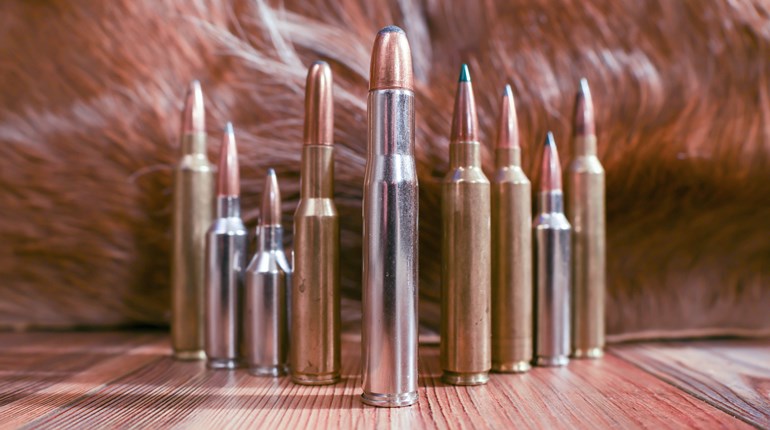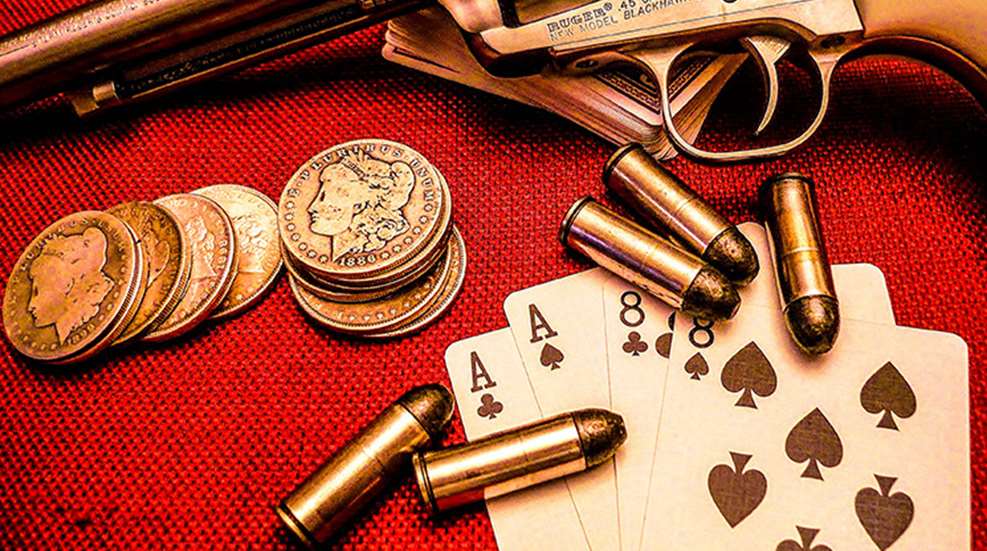
1873 was a landmark year for cartridge development, giving us two pivotal designs that remain popular to this day: the .45-70 Government, and the .45 Colt. The Civil War was over, and the westward expansion was booming. Firearms had gone through radical developments in the last couple of decades; the large caliber muzzleloading rifles had given way to the breech-loading metallic centerfire cartridges of smaller diameter, which gave a much faster rate of fire, as well as unprecedented reliability.
Developed as a joint venture between Colt Firearms and the Union Metallic Cartridge Company, the .45 Colt was introduced in the Colt Single Action Army—which would be known as the ‘Peacemaker’ of Western fame. In 1875, it became the standard issue for the U.S. Army, and remained so until replaced by the .38 Long Colt in 1892, though it wouldn’t be long until the Army adopted yet another .45 caliber pistol cartridge, but you know all about that one.
 The .45 Colt—or .45 (Long) Colt as it is irritatingly known—was originally loaded with 40 grains of FFg black powder, under a 255-grain lead bullet, at a muzzle velocity of just over 875 fps, as has been shown by testing original loads over a modern chronograph. This made for a very powerful combination, and for the stuff of legend. The combination of the Colt Peacemaker and the new cartridge gave what was at the time the most power a cowboy could put in his hand. Yes, Winchester’s release of the .44-40 in the same year as the Colt gave it some stiff competition, as the Winchester ’73 rifle and the Colt Peacemaker were both chambered for the smaller cartridge. Having both a handgun and rifle that can effectively use the same ammunition made things very convenient for the pioneer/homesteader/cowboy, but the military adoption of the .45 Colt made ammunition regularly available. The combination of Colt’s pistol and this cartridge would be the title of a Western movie (starring Randolph Scott, in 1950), as well as the name of a Major League Baseball team. Few cartridges can claim that!
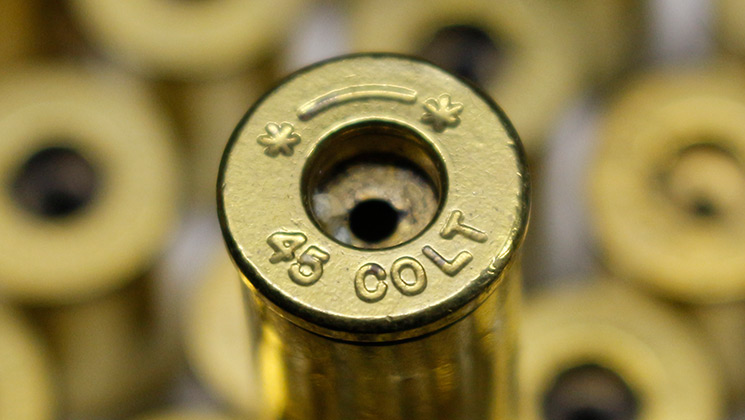
The .45 Colt is a semi-rimmed design, in that in comparison to the .44-40 or the .44 Magnum, its rim is slight, measuring 0.512”, while the case body measures 0.480”. It is a true straight-walled cartridge, having no taper whatsoever, and it is sparked by a standard large pistol primer. In recent times, the cartridge has experienced a resurgence, in both its original conformation, as well as a much-improved hunting cartridge. The Colt Single Action Army pistol, and its clones, can only handle a certain pressure, while the modern handguns - like my personal favorite, the Ruger Blackhawk—can handle much higher pressures, bringing the .45 Colt to unprecedented levels. My own Blackhawk, with its 7½-inch barrel, will drive the modern copper-jacketed 300-grain bullets to over 1,300 fps; we’ve got an entirely different animal at that point in time. My pistol will put five 300-grain Hornady XTP Magnum bullets into a three-inch group at 45 yards, which is about as far as I feel comfortable shooting while hunting with this gun. It generates 1,125 ft.-lbs. of energy at the muzzle, maintaining 937 ft.-lbs. out to 50 yards, making it a perfectly viable choice for deer, black bear and hogs.
There are heavier bullets available, like the Grizzly 335-grain hard-cast flat nose at 1,175 fps, which will hit like the hammer of the gods, or the Buffalo Bore 325-grain cast load at 1,325 fps, for a bone-smashing 1,267 ft.-lbs. of energy. Both of these loads are far too hot for a standard Colt SAA, but work perfectly in the Blackhawk and Redhawk handguns, and engender a whole ton of confidence while fishing in bear country, or pursuing bears on purpose. The .45 Colt also makes a perfectly viable self-defense handgun; the case is fully capable of firing the 185 and 230-grain bullets designed for use in the .45 ACP, which are equally effective and affordable. If you’re into speed, look to the 150-grain Cutting Edge Handgun Raptor—a monometal hollowpoint that is designed to have the nose section break into blades that cause all sorts of impact trauma. These light-for-caliber wonders can be driven to over 1,600 fps! As you can clearly, see, the .45 Colt is fully capable of handling a wide variety of shooting situations, from self-defense to plinking to hunting.
The concept of improving the performance of a .45 Colt is certainly not a new one; Dick Casull began building a better mouse trap in 1958 and ended up developing the .454 Casull. Extending the .45 Colt case by 0.098”, the .454 Casull delivers a definite improvement over the .45 Colt, yet the Casull chamber can effectively fire the .45 Colt ammunition, making a great choice for practice or plinking.
Considering that the .45 Colt has been with us for 143 years, it remains a completely relevant, powerful, and well-balanced handgun cartridge, that is equally at home at a Cowboy Action Shoot as it is in the hunting fields. A performance record like that is hard to refute, and I think it’ll be with us for another century and more.
Looking for previous installments of Behind the Bullet? We've got you covered.