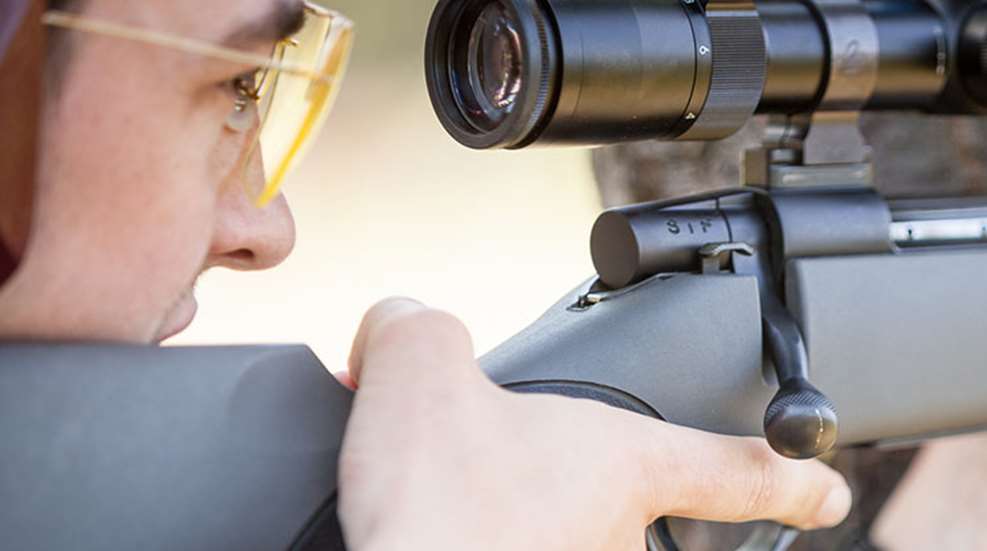
Nobody likes being hit hard in the shoulder every time they squeeze the trigger on his or her favorite shotgun or rifle. But recoil is a reality of the nature of firearms: The more power, the greater the bite.
Newton’s Third Law of Motion states that for every action there is an equal and opposite reaction. Applying this principle to recoil, it means as the bullet or shot charge moves forward to leave the barrel, a reverse motion is created in the form of recoil. The force of the recoil is dependent on Newton’s Second Law – Force = Mass x Acceleration. To put it simply, faster and heavier payloads create greater recoil.
Also factoring into recoil is the expansion of powder gases created from ignition and powder burning.
Nothing can change the recoil created from the bullet. That said, the weight of the gun, action type, recoil pads and compensators can change the felt recoil perceived by the shooter.
Light Weight Contender
The reality facing shooters and hunters is the lighter the gun, the greater the recoil. Mountain rifles and lightweight shotguns are easy on the back when hoofing it up and down mountainsides and through thick woods but are harder on the shoulder at the range.
It’s a decision to be made—carry a lighter gun that causes greater recoil or a heavier gun with less recoil. The decision depends on individual circumstances. For instance, if you hunt exclusively from a treestand or blind that isn’t a long hike, the heavier gun might be a better option. The extra pound in that same gun will feel like 10 pounds more at the end of a day spent stalking on your feet, though.
Cushion the Blow
Aftermarket recoil pads can make a significant difference in the amount of recoil absorbed before it reaches the shooter’s shoulder. I replaced the recoil pad on my Winchester 1300 turkey gun—which is fairly light, with an aftermarket pad and noticed a substantial difference. If your gun is an older model, the rubber may have hardened with age. New aftermarket pads from manufacturers like KICK-EEZ, LimbSaver and Pachmayr can save bruised shoulders.
If the recoil pad is installed in such a way that it does not add length to the gun—which would change the way it shoots—there are no disadvantages to changing recoil pads. Having it installed properly is essential though.
Automatic Reduction
The original purpose of harnessing a portion of the gases, or recoil, to operate a gun action was to cycle shells into the action more quickly. The unintended natural by-product of the semi-automatic design is a reduction in recoil. If you are recoil sensitive and haven’t tried shooting a semi-automatic, you should. The recoil difference can be quite substantial.
With rifles, semi-automatic actions are generally considered not as accurate, strong or reliable as bolt actions. For several years I have used a Remington semi-automatic without it jamming. Using handloads, I can achieve one-inch groups at 100 yards. But maintenance is crucial.
In the shotgun world, the semi-automatic has become a standard in goose and duck blinds where more power is needed and 3½-inch shells make a difference. As long as the gun is properly maintained, it can provide flawless performance for many years with less kick.
Braking Recoil
Muzzle brakes are a growing fad in both shotguns and rifles. Recoil reduction is one of the intended results of using a muzzle brake, but it comes with a price, and not just in dollars and cents. Before adding a muzzle brake there are a few things to consider.
So what exactly is a muzzle break? In short, it is a device attached to the muzzle end, usually integrated with the barrel, which uses the emerging gas behind a projectile to reduce recoil. In other words, muzzle brakes lessen the recoil from the expanding power gases created by ignition. By redirecting a portion of those gases in a different direction, muzzle brakes reduce the felt recoil
The terms muzzle brake and porting are sometimes used interchangeably, but muzzle brakes generally refer to an attachment screwed on the end of the gun with holes or slots. Most muzzle brakes are a slightly larger diameter than the barrel and add length. Muzzle brakes are not rifled and don’t come in contact with the bullet.
Porting describes holes drilled directly in the barrel.
The biggest drawback is an increase in noise. In fact, the noise increase can be so great with some calibers it is above the threshold that will cause permanent hearing damage even with hearing protection in use. Do not use a gun equipped with a muzzle brake without proper hearing protection. In fact, the noise increase is so great that some African countries banned the use of muzzle brakes due to hearing loss among hunting guides.
Since recoil is the greatest in magnum calibers, muzzle brakes have become standard on guns that shoot the most powerful cartridges. In fact, Weatherby – known for its magnum calibers—won’t ship a gun in a caliber above .30-378 without a muzzle brake unless the purchaser signs a waiver. But Weatherby’s AccuBrake, Browning’s BOSS and Ruger’s muzzle brake all offer an insert that can be screwed onto the gun in place of the ported attachment with no holes in it. This allows a target shooter to use the muzzle brake at the range, and remove the porting for hunting.
Generally, gun manufacturers and after-market companies claim a 30- to 50-percent reduction in felt recoil through the use of a muzzle brake when used on a rifle.
With shotguns, muzzle brakes are a different beast. Whereas the concept works well on rifles, it isn’t as effective in shotguns, as most gases are burnt by the time the shot reaches the muzzle.
Mag-na-port International, an aftermarket company offering both muzzle brakes and custom porting, claims recoil reduction of 15 to 20 percent on shotguns with its Pro-port system.
One bonus with muzzle brakes and porting is that they can reduce on muzzle jump for quicker follow-up shots.
Technology Tools
Recoil reduction aids are most common in shotguns. Two decades ago, prior to mandatory steel shot, aftermarket recoil reduction devices usually involved a variety of devices that were inserted in the stock to dampen recoil. Most of these devices involved some sort of a weight, or a mercury-filled tube, to slow recoil with inertia.
Today, several manufacturers use technology unique to each gun to further reduce recoil. Beretta and Benelli were considered pioneers in this regard when they introduced respective Xtreme and Black Eagle series. More recently, Mossberg joined the ranks of manufacturers with models using built-in recoil-taming technology.
Power Down
Part of the contemporary problem with recoil is the fascination of shooters with magnum loads. There are applications where power is needed, but many times it’s overkill. If you are sensitive to recoil, consider a lighter load. With the emphasis on involving youth and women in shooting sports, reduced recoil or light loads are an option from many manufacturers.
Final Bite
Recoil can be nasty. Not only does it hurt, but it can also cause a shooter to flinch—which can develop into many other bad shooting habits. If you are sensitive to recoil, seriously consider one or more strategies to lessen its impact.