The degree to which waterfowl camo patterns have evolved over just a couple decades is rather remarkable. In my pre-adolescence, Dad’s “duck hunting coat” was a green, waxed-cotton parka. I vividly recall waiting by the window for him to return wearing it and hopefully carrying a few birds. It wasn’t until I was almost of hunting age that he picked up an exciting innovation: A jacket featuring ink-blot style camouflage. It was designed to break up hunters’ outlines and hide them from the ducks—sophisticated stuff!
In recent years Drake Waterfowl has revived the ink-plot pattern with its “Old School” line. It’s proven popular with hunters who, like me, are nostalgic for the look, but also because—despite its basic appearance—it really works. However, other major companies have gone the photorealistic route. Their patterns’ ever-evolving designs use real-to-life imagery and the very biology of waterfowl eyesight to hide us from ducks’ wary eyes. Here’s how history, technological innovation and science have led to the patterns we now enjoy.
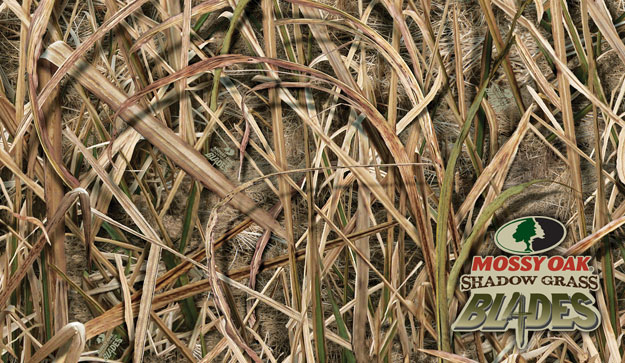
Mossy Oak Shadow Grass Blades
On my first duck hunt ever, I wore a jacket adorned with the old Mossy Oak Bottomland camo. It looks a little primitive by today’s standards, but in that era—and to my 12-year-old eye—it was the closest thing to real tree bark.
“It was by far and away the best choice for the ’80s and early ’90s, because in those days flooded, green timber shooting was the hot ticket,” explains Chris Paradise, Mossy Oak’s Chief Sales Officer. “Bottomland camo allowed hunters to hide against timber or wooded brush along sloughs.”
However, it was also during that era that hunting strategies began to change. As is the case today, hunters looked to agriculture and upland-type habitats to find birds—a response both to waterfowl behavior and ease of land access. Bottomland proved too dark for some of these landscapes.
“We knew we needed to develop more of a grass/field-style pattern for grain fields and grassy areas around sloughs, flooded crops and really anything where natural reeds were relevant for the hide,” Paradise said.
The result was Original Shadow Grass, which was essentially Bottomland camo with various marsh grasses layered overtop. It did very well in any habitat with moist soil plants, cattails and natural slough grasses. More importantly it coincided with a new way of thinking about waterfowl camo. Consistent, blot-type patterns were out, and those consisting of actual environmental elements were in.
“Original Shadow Grass morphed into even more specific patterns with relevance for just about any duck hunter’s region,” said Paradise. “Many of the habitat elements included in those subsequent patterns were combined when we introduced Duck Blind.”
Mossy Oak Duck Blind was the company’s first foray into a three-dimensional, digital pattern. In addition to Mossy Oak’s experimentation with different habitat elements, it took advances in digital printing technology to achieve. Personally I believe it’s one of the few patterns that are light enough in color for hunting marsh-grass sloughs and certain other mallard-friendly environments.
However, those looking for something slightly darker in color need look no further than Mossy Oak’s newest pattern: Shadow Grass Blades. It has a similar look and vibe to it as the original Shadow Grass, but with greater complexity and the advantage of modern digital camo capabilities.
“After the introduction of Duck Blind, we continued to research the inevitable changes in the waterfowl resource and how hunters hunt,” Paradise said. “We took into consideration that today’s waterfowler is hunting in the wide open in many cases, near grasses, reeds and standing or harvested crops. We also discovered some proprietary technologies that allowed us to use actual photos of duck habitats, not just an artistic rendition. Shadow Grass Blades has proven by far one of the fastest growing patterns in our company’s history.”
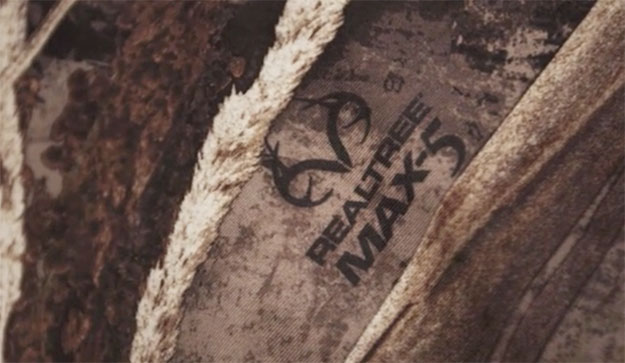
Realtree Max-5
Like the earliest Mossy Oak pattern, the original Realtree pattern was tailored best to timber hunting. Introduced in 1986, it was intended as a camo for the everyman, an effective choice for any terrain.
“Bill wanted his camo to work in rocks as well as trees, including flooded timber,” said Dodd Clifton, marketing manager for Realtree. “By the time he designed the Realtree All-Purpose pattern in 1991, he had broadened his thoughts on versatility to include brush and cropland elements—primarily by opening up the pattern and creating zones that truly disrupted the human outline, even at a distance.”
Realtree expanded its line in 1996 to include its first real waterfowl pattern—Advantage Wetlands—but Jordan’s eye for versatility remained.
“It was the first Realtree pattern that most people would consider primarily a waterfowl pattern,” Clifton added. “Still, Bill intended it for bowhunters after big whitetails in cornfields, too, or any other animal that inhabited marshes, crops or open brush.”
In my opinion it was the company’s 2003 introduction of Max-4—a purely waterfowl-dedicated pattern—that really won over the duck-hunting community. With its mix of three-dimensional marsh grasses and reeds, it grabbed a huge market share.
“It added more depth, more realistm, more elements and just simply worked great in a huge variety of open, marshy, brushy and crop habitats.”
The company’s latest pattern, Max-5, includes these habitat elements and more plus modern printing techniques. It’s perhaps what the company would’ve liked to do with Max-4, but lacked the technology to accomplish a decade ago.
“Bill used these new printing technologies to really create three distinct zones in the pattern: a sharp foreground, hazy mid-ground, and a completely blurred background,” Clifton said. “As a result, Max-5 truly appears three-dimensional.”
Gore Optifade
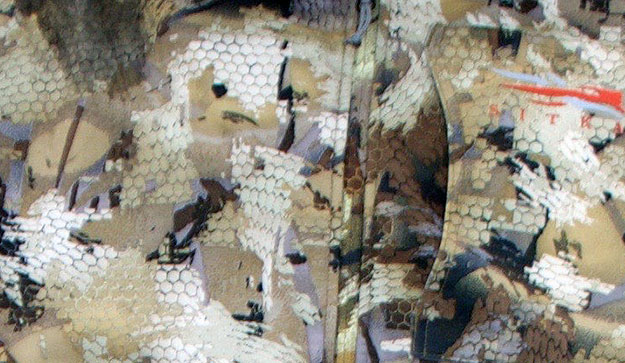
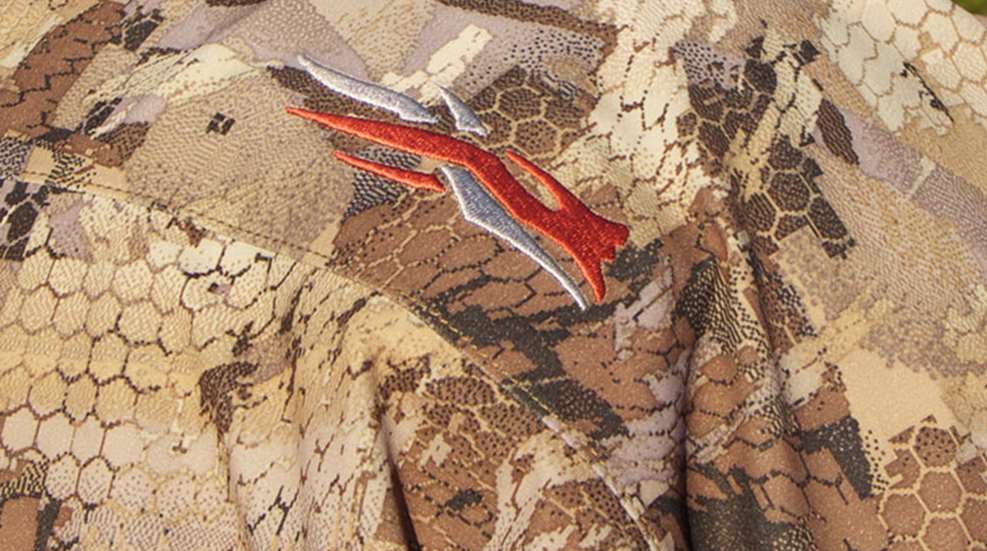
Best known for making GORE-Tex, Gore hasn’t been in the waterfowl pattern business long but is making big waves. Unlike most patterns, which mimic vegetation, Gore’s Optifade Waterfowl pattern consists of swirled hexagons and other shapes. Rather than simply blending the hunter with the environment, Optifade is designed to confuse ducks’ powerful abilities to detect motion and color. Given that ducks are highly sensitive in these regards—thanks to a high concentration of blood vessels in the retina—could this swirling pattern help hide a fidgeting hunter? Gore contends that ducks don’t perceive photos at all the way humans do, which would suggest today’s popular photo-realistic patterns are all for naught. Mossy Oak and Realtree, not surprisingly, beg to differ. Regardless Optifade is an intriguing concept.
So, where are waterfowl patterns headed next? That likely depends on the speed of technological advancements and the habits of waterfowlers ourselves.
“Make no mistake, the way we hunt waterfowl today has changed drastically even in the last five to 10 years,” said Paradise. “Our patterns have always been generated based on the changes waterfowlers are facing, and that will continue to be the case.”