Two years ago Bushnell’s then-new Fusion laser rangefinder/binocular made me feel blue. It nailed a 1,413-yard measurement off a black cliff face on the first try, and views through it were impressively sharp. But I didn’t like it, because it gave everything a weird blue-green cast that appeared to reduce brightness. Turns out this was necessary so the red LED distance readouts would show clearly.
Not anymore. The new Fusion 1 Mile ARC laser rangefinder/binocular has no blue color shift, is brighter than the old model, and the orange LED display is powerful enough to read against yellow grass under a klieg light. Images are pretty much color neutral, and ranging performance is impressive. This is perfect because, as a hunter, I don’t want to see the world through blue-colored glasses for hours and hours just so I can get a distance reading for a second. And I don’t want second-rate rangefinder performance, either.
The challenge for optical engineers is to combine good glass and rangefinding capability without compromising either, and they’ve done it with the Fusion. Before we dig into the guts of the system, let’s review how it performed in the field. For a benchmark, I compared it directly against a Swarovski EL Range 10x42, arguably one of the finest laser rangefinder/binoculars on the market. It sells for twice the price of the Fusion.First, a subjective observation: A natural hold of the Fusion, with thumbs under the balance point, positioned my index finger naturally over both the mode (left side) and power (right side) buttons, but I had to reach upward uncomfortably to find the focus wheel. If I moved one hand higher up a barrel to better position my focusing finger, the strap attachment point fell annoyingly under the ball of my index finger. The width of the unit forced me to stretch to reach the focus wheel, too, but I have shorter fingers than average. Ergonomics isn’t the biggest concern in binoculars but worth considering.
Esthetically, I find the Fusion klutzy looking. This is due to the necessity of cramming a laser rangefinder into a binocular. Swarovski does it by building two projecting bumps under the EL’s barrels. Bushnell chose to put steps in the barrels, making them fatter in the middle than on the ends. The shape is reminiscent of a Porro-prism design, but the Fusion is a roof-prism unit. The battery compartment extends forward from the central hinge, adding additional clutter to the design.
If you believe pretty is as pretty does, however, the Fusion is downright gorgeous. In performance, this unit hung right with the Swarovski, starting with image quality. While looking directly toward the setting sun about 30 minutes before it set, I detected almost no glare. I could clearly see detail in the shadows of backlit trees. The view was slightly darker than through the EL, so I measured the same scene through each unit’s exit pupils with a photographic spot meter. The Bushnell registered one stop darker than the Swarovski.
What did this mean in practice? An hour after sunset under a clear sky, I watched dark boulders 80 yards away, noting a black spot and a white spot on them. My goal was to time how long I could still see each with the Swarovski after the Bushnell’s image grew too dark, but that never happened. There was a nearly full moon, and the Fusion revealed not only the white spot, but also the black one. Two hours before sunrise the next morning, the black spot was still visible. Yes, it was slightly brighter through the Swarovski, but the difference wouldn’t have cost me any hunting time (or even scouting-by-moonlight time).
My impression was the Swarovski was slightly sharper than the Fusion, so in extremely dim light I tried reading tiny black lettering on a creamy white background from 10 yards. The Fusion clearly resolved letters 1/8-inch high. The Swarovski resolved them to 1∕16 inch. At dusk, when the Bushnell could no longer resolve small lettering from 25 yards, the Swarovski did so for another two minutes. That’s a fine distinction with, again, limited application to general hunting.
In edge sharpness the EL, with its famous field-flattener lenses, outperformed the Fusion, which began growing fuzzy near the perimeter. I didn’t find this distracting, since I typically scan using the center of a binocular’s image anyway, and the sharpness found at the Fusion’s center extended outward about as far as can be expected of most upper-echelon binoculars.
The Fusion owes its excellent optical performance to top-tier ingredients and precision construction: phase-coated BaK4 roof prisms with 60-layer mirror coatings, and multiple anti-reflection coatings on every air-to-glass lens surface. Bushnell’s RainGuard HD coating minimizes external fogging. Shining a flashlight into the objective lenses revealed a flat-black interior with pristine glass; I found no glue, pinched o-ring seals, marred bolt heads or any other manufacturing flaws.
The laser half of this instrument’s pedigree kept pace with optical performance. The LED display—adjustable in four stages from extremely dim so as not to overpower low-light views to extremely bright for full daylight use—was crisp and easily read. Pressing the power button activated the display; a second press and hold resulted in a distance reading. Most of the time, readouts popped up in about a half second, but I sometimes had to hold the button for up to three seconds to get readings from far or low-reflectance subjects. While rated to range from 10 to 1,760 yards, in my hands the Fusion measured no closer than 15 yards but twice read its reflection from a red brick wall at 1,843 yards. When hand-holding the unit, I could consistently range grassy hillsides, trees and sagebrush out to 1,000 yards. Steadied on a boulder, the Fusion hit beyond the extreme edge of its promised range.
In “scan” mode, the LED readouts almost instantly changed from 22 yards through 33 and 44 to 50. Then I ranged a rock on a ridge top and lifted the unit to hit a tree at 664 yards. It measured both perfectly, again and again, back and forth, with the early morning sun at my back. Ranging toward the morning sun proved just as successful, the yardage readings zipping from 88 to 41 to 543 to 1,808 in a continuing cascade as I panned over the landscape. Occasionally the unit would lock on one distance during a scan, but I merely had to take pressure off the power button and then start it again to be back in business. In “brush” mode I shot through a light screen of yellow grass stems 15 yards away to read 1,100 yards to a distant building.
I did not test the accuracy of the Angle Range Compensation (ARC) ballistic calculator by shooting at long range uphill or downhill, but I did compare the Fusion’s readouts with those from an older Bushnell Legend 1200 ARC rangefinder. They agreed on angles of degree and holdover numbers. The Fusion can be easily user-adjusted to match a variety of rifle trajectory groups. While not perfect, these classifications have proven accurate enough to become an industry standard. Holdover solutions can be chosen in inches, minutes of angle or milliradians.
I didn’t torture-test this tool by pounding nails, but after two hours in the kitchen freezer, it fired up instantly and gave accurate readings of 34 to 95 yards before the lenses frosted over so badly I could barely see images. Even then, it still read to 268 yards, but nothing past that until the frost melted off. Once defrosted, the Fusion was back to 1,000-plus yards. After languishing an hour in a sink of water, the unit emerged fully functional and dry as popcorn internally.
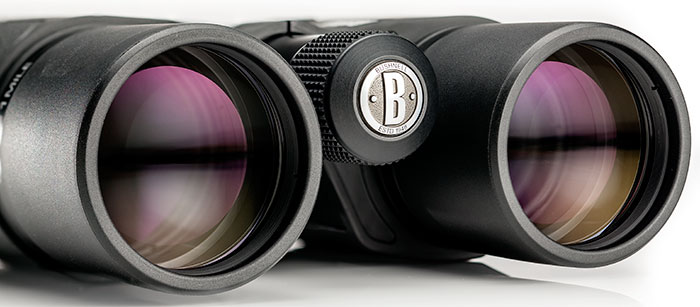
One additional small gripe: I’d like more tension in the diopter adjustment rings under the twist-up eyecups. They turn so easily they can be inadvertently bumped out of focus. It takes but a second to refocus, but who wants to bother? Stiffen these, and you’ve got the best laser rangefinder/binocular under $2,000 in the business. Good job, Bushnell.
Technical Specifications:
Type: roof-prism, rangefinding, ballistics-compensating binocular
Magnification: 8X, 10X (tested), 12X
Objective Lens Diameter: 32mm, 42mm (tested), 50mm
Focusing Range: 10.5' to infinity
Eye Relief: 18mm claimed; 14mm measured
Exit Pupil: 4.2mm
Field of View @ 1,000 yards: 305'
Coatings: fully multicoated lenses with RainGuard HD; phase-coated prisms with 60-layer mirror coatings
Dimensions: length 6.5"; weight 31 ozs.
Construction: aluminum body, black rubber armor
Min./Max. Range: 10/1,760 yds. claimed; 15/1,843 yds. measured
Modes: rifle, bow, scan, bullseye, brushAccessories: eyepiece lens covers, neoprene neck strap, CR123 battery, nylon padded case
MSRP: $1,676