I was pleasantly surprised when I removed Trijicon’s new VCOG rifle optic from its box and held it in hand. Thanks to reviewers and bloggers, and lots of social media chatter, I was sure the VCOG was one heavy beast of a scope, bulky, a regular boat anchor.
All untrue.
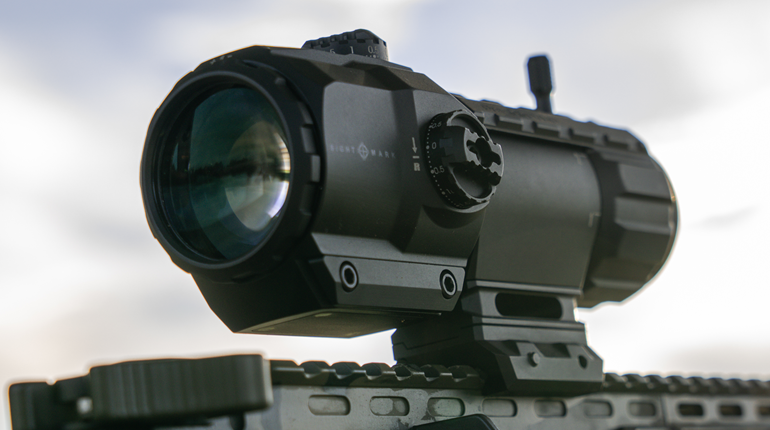
What I discovered was a solid optic, not a lightweight one but certainly not the truncheon it was made out to be by so many. At just 10 inches long, it’s nicely compact with a lower profile than many other scopes designed for AR-style rifles. Atop an AR, the 27 ounces of scope-plus-integral-mount sits well to the back of the receiver, giving the rifle a nice rearward balance. I came to the conclusion that in addition to the tactical application for which it was made, the VCOG has good hunting potential.
Trijicon is best known for its ACOG optic—the Advanced Combat Optical Gunsight—the little scope that’s made a big name for itself and is currently employed on many U.S. Army and Marine Corps battle rifles. Though rugged, compact and very reliable, the ACOG is a fixed-power optic. Magnification can’t be adjusted to fit conditions and ranges.
Enter the new variable-power VCOG, a 1X-6X-24mm scope. Trijicon makes no bones about it—the optic is made for combat-type applications. Each horizontal hash mark in the ballistic-compensating reticle, for example, equals approximately 19 inches across at the given, corresponding range—the width of your average bad guy measured from shoulder to shoulder—to provide ranging capability. Yet, the VCOG has been showing up on the competitive 3-gun tour, which got me thinking: If 3-gunners are using it, why not hunters?Given the size of the scope and its power range, the VCOG screams “hog hunting,” especially in areas of thicker vegetation interspersed with pasture and mesquite—the kind of landscapes I often hunt in South and West Texas. Here, you might get a 200-yard poke at a rooting hog or a sudden 50-yard shot when a boar trots out of the bush. Hunters in the East regularly encounter similar scenarios with deer and bear, making the VCOG applicable there, too.
The VCOG has Trijicon’s “integrated power fin,” a large magnification adjustment ring that completely covers the ocular bell and offers a raised ridge (the “fin”) for easily manipulation. Changing magnification with the VCOG was faster and smoother than with any other scope I’ve used. It should work great with cold hands or when wearing gloves.
The VCOG’s illuminated, ballistic-compensating reticle also has a place in the hunting field. Trijicon offers the VCOG with two reticle designs: a series of hash marks on a vertical line partly surrounded by a segmented circle or topped with an upside-down horseshoe-dot aiming point. Both are located in the first focal plane. At close range and low magnification, the circle or horseshoe provides a quick aiming reference, while the hash marks form conventional crosshairs for longer shots when using a greater magnification.
Seven reticle variations are calibrated for particular cartridges and bullet weights: 55- and 77-grain .223 Rem., 175-grain .308 Win., and 115-grain .300 AAC Blackout. The hash marks under the central crosshair provide holds for targets out to 800 meters, with the subtensions corresponding to the drop of the specified bullet at the given ranges (assuming a 100-meter zero). However, since muzzle velocity and trajectory vary by ammo manufacturer and type, range time is required to verify actual point of impact in relation to the designated reticle marks.
All reticle variations are illuminated by an internal LED, with the main crosshair or dot, and the surrounding circle or horseshoe, lighting up. The side-mounted rheostat offers six brightness settings. Power comes from a single AA battery; the battery compartment is tucked under the objective lens, and the battery is easily accessed by unscrewing a cap. With a good lithium AA, Trijicon rates battery life at 700 hours when illumination is kept at level 4.
Trijicon notes the VCOG and its forged 7075-T6 aluminum body have “exceeded” mil-spec endurance testing. That normally includes dropping a scoped rifle onto concrete from a height of 1 and 2 meters. To pass the test, the scope has to not only function after the drop but also hold zero.
My test VCOG had the segmented-circle reticle made for the 55-grain .223 Rem. load, so I used the new Silverado 55-grain rounds made by Liberty Ammunition. I mounted the VCOG onto a Katana rifle, an AR manufactured by MHT Defense of Wedowee, Ala. The attached, one-piece mount easily slid onto the upper receiver’s Picatinny rail. No rings or separate mount required. I finger-tightened the knobs and then, per the owner’s manual, gave them a quarter turn with a flathead screwdriver. Done.
Zeroing the VCOG was fairly easy thanks to the large windage- and elevation-adjustment knobs that clicked cleanly and precisely. After zeroing and shooting a few 1.5-inch groups, I simulated different hunting-based scenarios. I placed one target at 100 yards and another at 60 yards. Sitting on a bag of seed corn, I rested the rifle on a Primos Trigger Stick. The sun was full in my face. I set the VCOG’s magnification level at 4X.
Twisting my body from right to left as if I’d just spotted a hog, I pivoted the rifle on the Trigger Stick, lined up the crosshair on the 60-yard target and shot a quick four rounds. Then I swung the VCOG onto the 100-yard target and let loose with four more shots. I did that sequence twice more, and each time the VCOG got on target quickly. My four-round bursts measured about 3 inches on the 60-yard target and less than 2 inches on the 100-yard target, discounting a couple fliers. Had I been hunting, dead hog.
At 200 yards, I shot hand-sized pieces of plaster from a recent home renovation, which exploded nicely when "painted" with the central crosshair. I hit a 300-yard target three out of five shots by using the appropriate reticle mark. There was nothing to brag about as far as the group, but I was satisfied given the fact I was shooting from sticks, not a bench.
Images were crisp at all ranges and in lighting that ranged from overcast to sunny. Even just before dark, I could clearly see the targets and illuminated reticle. However, the crosshairs struck me as just a little too thick. I wouldn’t use the horseshoe-dot reticle for hunting, although I know it has a great reputation in combat. I want to see what’s beyond the target, and the horseshoe reticles I’ve used in the past blocked my field of view. Some hunters will find the VCOG too heavy, but toughness usually comes with some heft.
Like most variable-power, tactical optics on the market today, the Trijicon VCOG is pricey. Too pricey? That’s a question each individual hunter will have to answer. Given the quality of the glass and the durability of the body, the VCOG represents an investment that will last for years and years of hard hunting. ah
Technical Specifications:
Type: variable-power riflescope
Magnification: 1X-6X
Objective Lens Diameter: 24mm
Eye Relief: 4" (constant)
Exit Pupil: 10.4mm @ 1X, 3.8mm @ 6X
Field of View @ 100 Yards: 95' @ 1X, 15.9' @ 6X
Reticle: illuminated; segmented circle or horseshoe dot; holdover marks calibrated for .223 Rem., .308 Win. or .300 AAC Blackout
Adjustments: 1/2" @ 100m
Coatings: fully multi-coated
Dimensions: length 10.05"; weight 27.2 ozs. (w/mount)
Construction: forged 7075-T6 aluminum tube w/integral mount; hard-coat anodized finish
Power: AA battery; 700-hour life with lithium battery on illumination setting 4
MSRP: $2,800