If you’re entertaining the appealing idea of tying the knot with a flushing/retrieving breed—one of those friendly, energetic springer/Labrador/golden retriever types that’ll dive into the thickest thicket to roust birds at your feet—good luck overcoming its inherent defect.
Defect? I can hear the retriever lovers screaming already. What defect?
Okay, I’ll bite (pardon the pun, dog lovers): The defect is the 100 acres of field the dog fails to explore. Or 500 acres. Whatever the size of the area you’re hunting, your flushing dog won’t cover as much of it as a pointing dog. And it’s not the dog’s fault. Flushers are bred and trained to stick within gun range of you, the shooter. So they’re limited to a narrow band of cover bordering the linear trail you can hike in a day. And that limits the number of birds you encounter.
No such problem with pointers. Big-running English setters, English pointers, red setters, Gordon setters, Brittanies and the like have been engineered to take full advantage of all four legs, reaching out to scour far ridges, valleys, fields and farms while you enjoy a pleasant fall hike—until invited to a feathered bonanza. “Over here, Boss. Right here, right under my nose. Birds!”
Aha, you flusher fans might now gasp: the infamous runaway pointer. Instead of hunting for birds, you spend all day hunting for your doggone gone dog.
Well, both sides have valid arguments. But why bother making them when you can circumvent them by getting and hunting one of each simultaneously.
Wait. What? Two dogs? A flusher and pointer? Am I nuts? Probably. But that doesn’t mean I’m wrong. I know it works, having trained and hunted a couple of paired springer/setter teams. All it takes is training.
Here’s how: You procure one flusher and one pointer of good genetic stock. Train each (usually at the same time) to stop (whoa or hup) and come (here) when commanded. For the flusher, add niceties like quartering within 25 yards. Teach the pointer to stop at the report of your gun for those times you shoot a bird put up by the flusher. Train both dogs to remain steady to wing and shot. So long as both will stop and return when commanded, instincts should pilot most of the rest. Retrieving can be reserved for the flusher or trained into both.
The above accomplished, a short hunt might look like this: You release both dogs at the start of a valley. In its bottom runs an intermittent brook bordered by 10-yard belts of nasty brush and cattails. Beyond, fields of grass stretch 300 yards to ridge-top wheat stubble. “Hunt ’em up, Fleet,” you command the pointer. And off she streaks, sucking drafts for bird scent. “Hunt ’em up, Rowser,” you command your cocker spaniel, giving him a line into the cattails. “Hum de dum and twiddle dee,” you sing as you stroll along, one eye on the racing pointer, another on the thrashing flusher, gun loaded and ready for a sudden flush.
But there is no flush from the thick stuff. Instead, Fleet stops near the top of the ridge, tail standing like an exclamation point. “Rowser, here. Here.” With a crunch and crash, Rowser breaks from cover and dashes to your side. “Heel.” And the two of you walk up to the point. “Rowser, hup.” Rowser sits. “Whoa, Fleet, whoa.” You ease toward Fleet from her front, pinching the birds between you. And then they’re up. A dozen gray partridges beat the air like frantic, oversized bees—except you’re the one doing the stinging. Pop, pop, your 20-gauge barks, and two birds tumble. You look down to see Fleet intently watching the remaining birds sail up the valley, across the brook and into the grass on the far side.
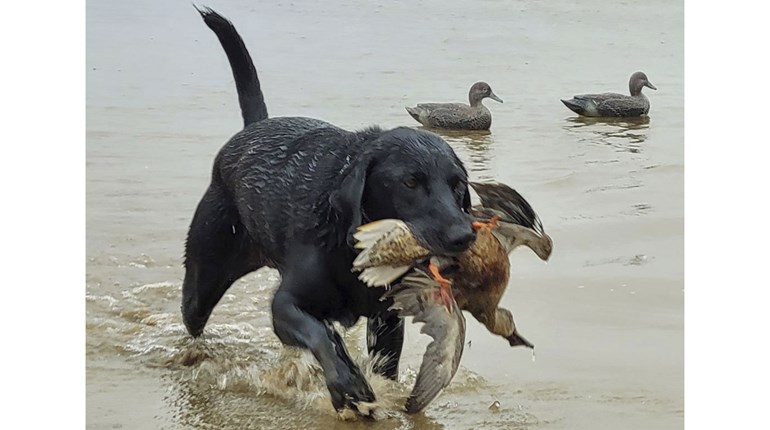
You look back to see Rowser trying his best not to break, quivering with the struggle. “Hup. Whoa.” You make both dogs hold for several seconds to reinforce control. “Rowser, fetch.” The flusher dashes toward the first fall, darts, spins, scoops it up and races to your side. He spins and sits. “Good boy, good Rowser. Good fetch.” But you are watching Fleet, who is about to explode with pent-up desire. “Whoa, Fleet,” you warn her. “Good whoa. Good Fleet.” You count off 10 seconds, put your hand under Rowser’s chin and command, “Give.” Rowser drops the bird, shuffles his feet, but stays in place. You raise your palm in the “stay” command to reinforce both dogs, and count to 10 again. “Fleet, fetch.” Now the pointing dog races out to scour the grass for the second bird. It takes longer to find, but she persists and brings it to you. “Give.” Her jaws relax and you take the heft of soft feathers from her. “Okay! Good dogs, good dogs.” You give each a rumple about the ears and a pat on the side before heeling the pair as you walk back to the brook, thrash through the brush, jump the water and break out on the far side.
Here you again cast Fleet to hunt the vast uplands while Rowser beats out the thickets. Within seconds a long-tailed rooster roars up, cackling. You swing with him as he clears the cattails and brush on the far side, then dump him in a shower of rusty feathers. Taking no chances, you immediately command Rowser to fetch. Having seen the birds’ flight, the little spaniel is on the attack, so you glance out to find your pointing dog. As trained, she is standing in response to your shot, awaiting your command to release and resume hunting. You won’t give that until Rowser comes back with the pheasant. Within seconds he does, again sitting at your side to await the release command.
And so your hunt continues. You have the team, the dog power, manpower and firepower, to handle anything the uplands throw at you.
Good luck with that. Sometimes it does go that smoothly, especially if you’re a good, consistent and persistent trainer. More likely you’ll use a few additional commands to get your desired results. The pointer may get possessive as the flusher approaches a covey, and the flusher may break from time to time to “steal” a pointed bird, but practice and training can prevent or remedy that. A well-trained pointer should stand steady to wing and shot and to the flusher being sent in to retrieve. This is useful for those times the pointing dog stands at the edge of thick and nasty cover to indicate the distasteful necessity for “someone” to dive in and beat out the birds. The flusher will relish the chore, and you’ll enjoy the best of both dog worlds.
There’s no need to flush one type of dog out of your hunting life. Use one of each to point out the benefits of both.