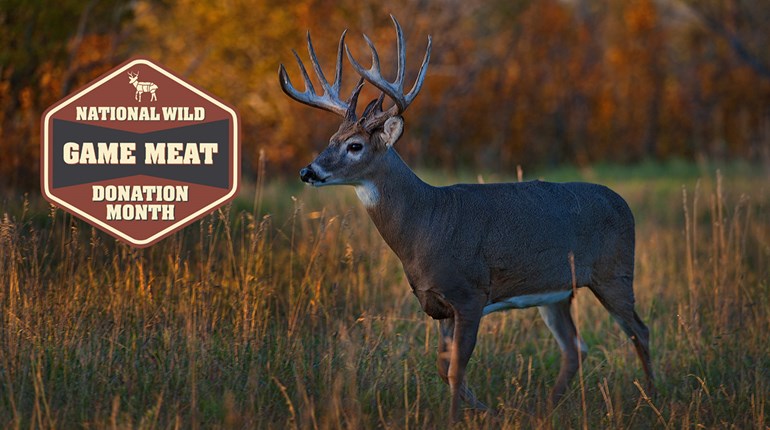
My husband, Phil, and his buddy lease 48,000 acres in western Kansas that they manage for whitetails. Their rule: Don't shoot a buck unless he's 4-1/2 years or older. That's typically when a buck is considered mature, or fully developed, to the point nutrition goes full speed ahead toward antler production. I've studied many deer through the years and considered myself a good judge of age class—until this small-statured buck (above, left) tricked me while hunting there over Thanksgiving. Here's how he did it.
On my second evening, the buck came in and posed at 20 yards as Rex, Phil's TV show cameraman, and I sat in a blind near a crop circle. I counted his 12 points, looked at the rack, noted he was narrow but heavy, and eyeballed his body proportions. I was about to shoot, then a mature tank of a buck walked up next to him. Dilemma. The buck I wanted was beautiful, but his body was quite small by comparison. I could have shot him multiple times but hesitated for a good minute until I was certain. Of course, by the time I went to draw my Mathews Chill SDX, I no longer had a shot. Wanting to redeem myself, I decided to hold out for him and was fortunate to get him on the last hour of the last day.
The Lesson
Some deer are just physically smaller-statured—even in Kansas where whitetails can weigh more than 300 pounds—compared to the deer I'm used to seeing in states such as Virginia, for example.
The Facts
Have faith that a buck's overall proportions are a solid indicator of age. If a buck's neck appears thick, its head seems short, and its belly is about even with his brisket, you're looking at a mature deer. My buck caused me some hesitation, but looking back, he had all the earmarks of maturity.
The Moral
The better we can field-judge a buck's age class, the better we can manage our deer populations. And because we don't always get a second crack at a given buck, being able to judge them quickly can make the difference in filling that tag!