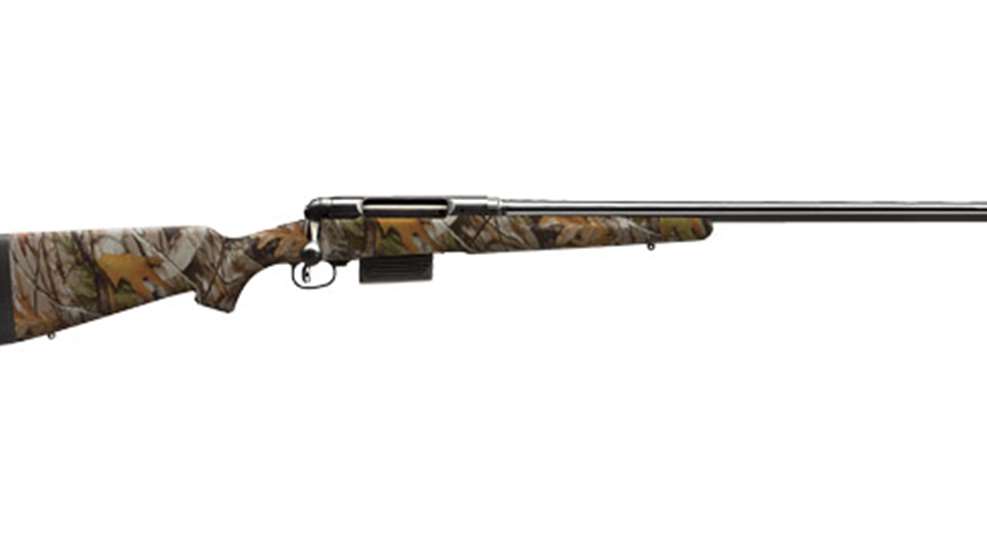
Bolt-action shotguns of yesteryear were “starter guns” reserved for kids—or folks who weren’t as serious about deer guns as they were about simply having something dependable behind the farmhouse door. Of course back then hitting a gallon can with a slug three straight times at 40 yards defined an accurate slug gun. Fast forward to the 21st century.
The digital readout in the Burris Eliminator LaserScope said 243 yards to the distant gong on which the LED dot rested. Steady pressure took up the first stage of the AccuTrigger and … Bang! Nearly a half-second later the 12-inch gong shuttered on its chain and, in another fraction of a second, a definite “chink” returned to my ears. It was the ninth “chink” in 10 shots … with a shotgun—a 12-gauge Savage 212 bolt-action slug gun.
The whole scenario was an attempt to recreate a previous moment when I’d tested the 20-gauge version of the gun, the Model 220F, during a range session in preparation for a pronghorn hunt. The 220F, loaded with 3-inch Remington Accu-Tip slugs, hit a 9-inch gong 12 consecutive times at 250 yards—in my experience heretofore uncharted waters for shotguns and slugs. My results with the 212 were almost as impressive.
The 220F, essentially the company’s Model 111 magnum centerfire rifle chambered for 20-gauge, was heralded as the most accurate production slug gun available when introduced in 2010. It was also a retail home run for Savage, which had been selling very few of its original rifled-barreled, bolt-action shotguns, the 210, annually.
Riding the new success, Savage introduced its 12-gauge Model 212 in January 2011. Ostensibly, the 212 is the 220F’s bigger brother, despite being 1.5 inches shorter. It is technically an evolution of the company’s longstanding 210 MasterShot 12-gauge bolt gun that was discontinued in 2009. One reason for the fall from grace was the fact that reliably cycling a non-tapered, large-diameter shotgun hull through a bolt-action is problematic and prone to failure in excited or unpracticed hands. Inconsistent ejection, particularly of 23/4-inch slugs, was a problem with the 210.
The ejection angle has been re-engineered for the 220F/212 and indeed, the 212 cycled reliably provided I racked the bolt fully and crisply each time. Judging by others’ actions, however, anything short of a deliberate, full bolt throw may still encounter ejection problems, particularly with 23/4-inch slugs.
The old 210 also had a fairly heavy trigger and, occasionally, a short firing pin throw that failed to ignite some ammunition. The 212, however, ignited everything with impunity during the test session, which included four different slugs.
The 212 sports the same 22-inch, free-floating, heavy-walled rifled barrel and proven SAAMI-spec, 12-gauge, 1-in-35-inch twist rate as the 210; and essentially the same front-locking bolt. But other facets of the redesign that begat the 220F simply trickled down to the 12-gauge platform. Gone is the gawky integral magazine that protruded from the bottom of the 210’s receiver, replaced by a detachable two-shot polymer version. The 7.5-pound 212 has a suggested retail price of $608 with a black synthetic stock, $660 for a Realtree AP camo version. The 212 does not utilize Savage’s AccuStock bedding concept, but the 22-inch button-rifled barrel is threaded to the receiver and secured by the company’s unique locking nut, long considered the foundation of the design’s renowned accuracy.
Another shortcoming of bolt-action slug guns is the fact that, when using two-piece scope mounts, the length of the ejection port puts scope rings too far apart to accommodate many scopes. To fit, a scope must have at least 6 inches of tube between the bells. This is easily remedied by using a one-piece rail that spans the port and allows for rings much closer together. But that requires higher rings (allowing the objective bell to clear the long rail) than I prefer. I used a one-piece EGW Picatinny-style rail to accommodate the Burris Eliminator Laser scope, but replaced it with the two-piece Weaver mounts provided with the gun in order to mount a conventional scope for the 100-yard testing.
An experienced hand could hone some 210 triggers down to 3-4 pounds pull weight but others wouldn’t budge below 5. In its place is the vaunted, adjustable AccuTrigger with which Savage revolutionized the production rifle market several years ago. Combined with the AccuTrigger—which broke at an average 3.12 pounds in a remarkably consistent 10 pulls measured by a Lyman digital trigger gauge—a bulbous, easy-to-grip bolt handle, and a very effective 1-inch P.A.D. recoil pad, the 212 proved very user friendly.
Shooting from a Caldwell Rock rest, into a quartering 5-7 mph wind, the 212 produced the most amazing range experience I’ve ever encountered in 30 years of shooting guns. Sub-1-inch groups were the norm. The Savage 212 is a remarkable testament to slug shooting in the 21st century.
With so many slugs on the market, I selected two designed for the 1:35 twist rate, and two other high-velocity designs better suited for the 1:28 twist rate featured by Browning/Winchester, Thompson/Center and Benelli/Beretta/Franchi guns. Three loads in the test—3-inch Federal Barnes Tipped Expanders, 23/4-inch Remington AccuTips and 23/4-inch Winchester Dual Bonds—shot sub-1 MOA three-shot groups. One load—3-inch Lightfield Hybred Elite—averaged slightly less than an inch and a half. I have never seen that level of consistent accuracy from four diverse types of slugs with any shotgun.
Technical Specifications:
Type: bolt-action, rifled-barrel shotgun
Gauge: 12
Barrel: 22", button rifling, 1:35" twist
Trigger: AccuTrigger, 3.12-lb. avg. pull weight
Magazine: detachable box; 2-rnd. cap.
Sights: none; drilled and tapped for scope
Safety: tang-mounted two-position slide
Overall Length: 43.125"
Weight: 7.45 lbs. w/o scope
Metal Finish: satin blue
MSRP: $625 (black), $680 (Realtree AP )