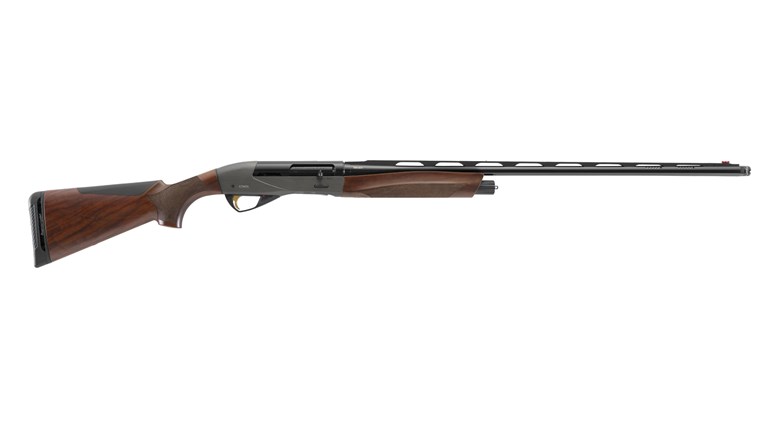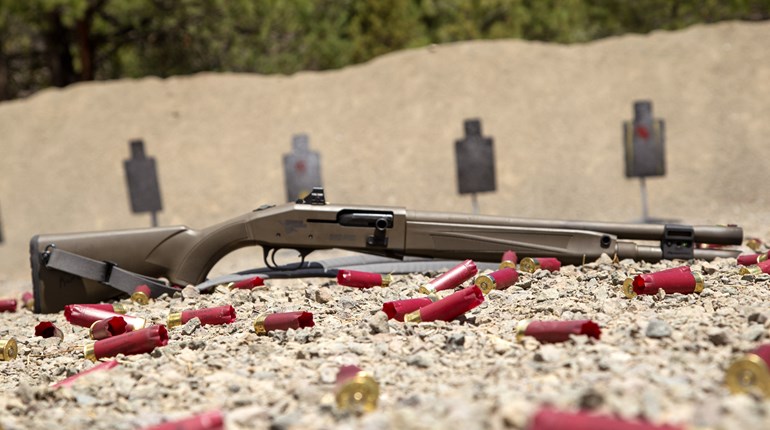
The 3½-inch, 12-gauge semi-auto has become the flagship shotgun among major manufacturers. They lavish R&D dollars on their latest-generation models. They pack the guns with cutting-edge features and give them price tags to match. The so-called “B” guns—Browning, Beretta and Benelli—as well as Winchester’s SX3 and now Remington’s Versa Max, are excellent, no question, but it has become hard to find a 3½-inch semi-auto for less than $1,500. Sure, you get a lot of features in the top-of-the-line guns, but what if all you want is a simple hunting gun that shoots small (2¾-inch), medium (3-inch) or large (3½-inch) shells every time you pull the trigger?
If a versatile, affordable hunting gun is what you’re looking for, the Stoeger 3500 is designed for you. It offers 3½-inch capabilities for less than half the price of a “B” gun. Essentially, the 3500 is a 3½-inch big brother to the Stoeger 2000, a low-cost, lightweight gun beloved by many budget-conscious waterfowl and turkey hunters.
Made in Turkey, the 3500 has a version of the inertia action similar to that made famous in the semi-autos of parent company Benelli. Inertia guns, of course, function without bleeding gas out of the gun’s barrel, making them very clean shooting and reliable, and therefore a favorite of waterfowlers and high-volume dove hunters.
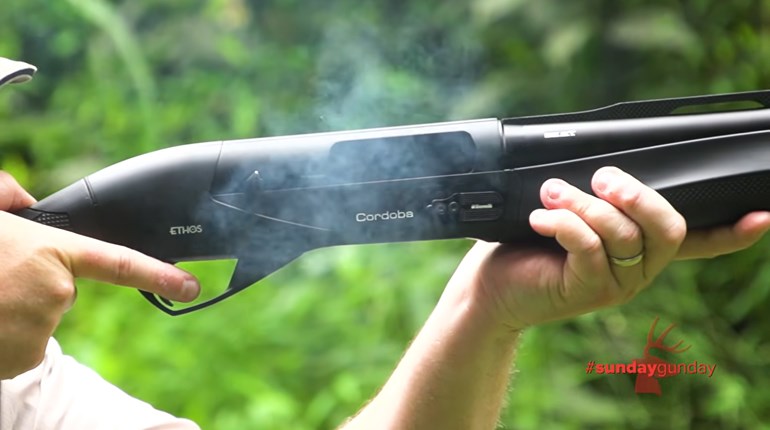
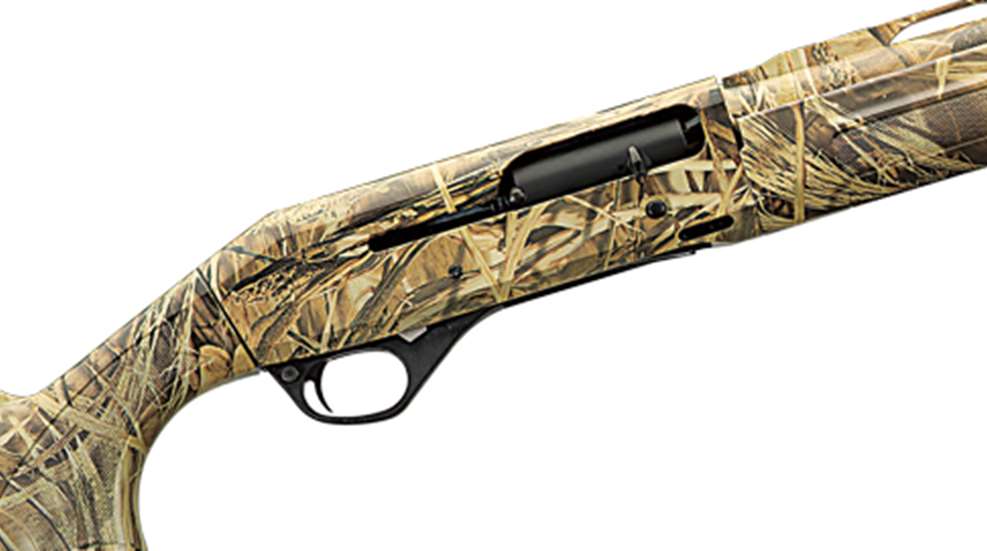
The 3500 looks like a more robust 2000. It has just the hint of a humpbacked receiver, like the 2000, and otherwise it is clearly Benelli-inspired, although with the futuristic styling slightly toned down. It has a Benelli-style rotary bolt and a flat bolt lock button alongside the trigger guard as well as a ventilated, stepped rib similar to the ones found atop the M2 and Super Black Eagle. The gun comes in basic black, Realtree APG or Max 4 with a conventional checkering pattern molded into the stock and forearm. It has a soft, vented rubber pad and an integral swivel stud in the buttstock. At the other end of the gun, there’s a large orange fiber-optic bead resembling a brighter version of the old Ithaca RayBar sight. In all, it is neither good nor bad looking, which is kind of the point of the 3500. This is a no-frills working gun.
And it does work. As I mentioned, it shares the proven inertia action of Benelli semi-autos. In fact, the bolt and trigger group parts were nearly identical to those in my Montefeltro. The one major difference is the location of the action spring that slows the bolt’s travel rearward and returns it to battery. In a Benelli, as in most semi-autos, the action spring is tucked away in the stock, and it connects to the rear of the bolt via a link arm. In the 3500, as in the 2000, the action spring surrounds the magazine tube. It’s held in place by a ring connected to the bolt by twin action bars. The design does make the 3500, by necessity, slightly bulkier in the forearm than a Benelli, but it also puts the spring in a place where it is easy to get to for cleaning, inspection and, if needed after several thousand rounds, replacement.
I cycled a wide range of shells through the gun, from target loads up to 3½-inch magnums and Remington’s Hypersonics. Out of the box, the gun worked fine with 1 1/8-ounce target loads and it might eventually break in to the point where it functions with lighter loads. On the heavy end of the scale, it cycled everything, as I expected it would. What surprised me was not the lack of recoil, exactly, but the lack of painful recoil. The 2000, with its light weight and inertia action, is known to be a kicker. The 3500, which weighs about a pound more (around 7.5 pounds with a 24-inch barrel), seems to have enough mass to offset some of the recoil of high-velocity waterfowl loads. Also, while inertia guns don’t soften recoil as much as gas guns, they are softer-shooting than fixed-breech guns.
I shot the 3500 at low gun skeet and five-stand sporting clays and had no trouble handling it or moving it to the target, nor recovering for followups even with heavy loads (with the range’s permission, I shot some targets with 3½-inch magnums). Even with a shorter 24-inch barrel the gun was easy to shoot.
I’m not sure I have ever seen a lower price-point gun come with as many extras as the 3500. You get five chokes, including a turkey choke; a 10-ounce recoil-reducing weight for the buttstock; a Weaver-style scope base that fits the tapped receiver; and a set of shims to alter drop and cast. Since the gun arrived in April I installed the turkey choke and scope base, mounted a Nikon turkey scope and a Vero Vellini sling and took the gun hunting. Unfortunately, no turkey was rash enough to approach within range. Perhaps they were intimidated by the 3500; as soon as I put it down in favor of my 870 again, my luck changed.
My only complaint about the 3500 is its gritty, 7-pound trigger. In all other ways it’s a solid, likable gun. At $679 in camo, it costs $1,000 less than some 3½-inch high-tech wonder-guns on the market. You can buy a lot of ammunition to run through your 3500 for that much money, and from what I have seen so far, the 3500 will handle it all. Stoeger’s new gun is an excellent value for someone who wants a semi-auto ready to go from the dove field to the goose pit, with a detour to the turkey woods along the way.
Type: inertia-operated semi-automatic shotgun
Gauge/Chamber: 12-ga.; 3½"
Barrel: 24" (tested), 26", 28"
Magazine Capacity: 4+1
Sights: orange front bead
Safety: cross-bolt on trigger guard
Stock: synthetic; length of pull—14 3/8"; drop at heel—2½"; drop at comb—1½"
Overall Length: 46" w/24" barrel
Weight: 7.5 lbs.
Metal Finish: camo dip
Accessories: 5 choke tubes, recoil-reducer, scope base, shim kit
Price: $629 (black); $679 (camo)