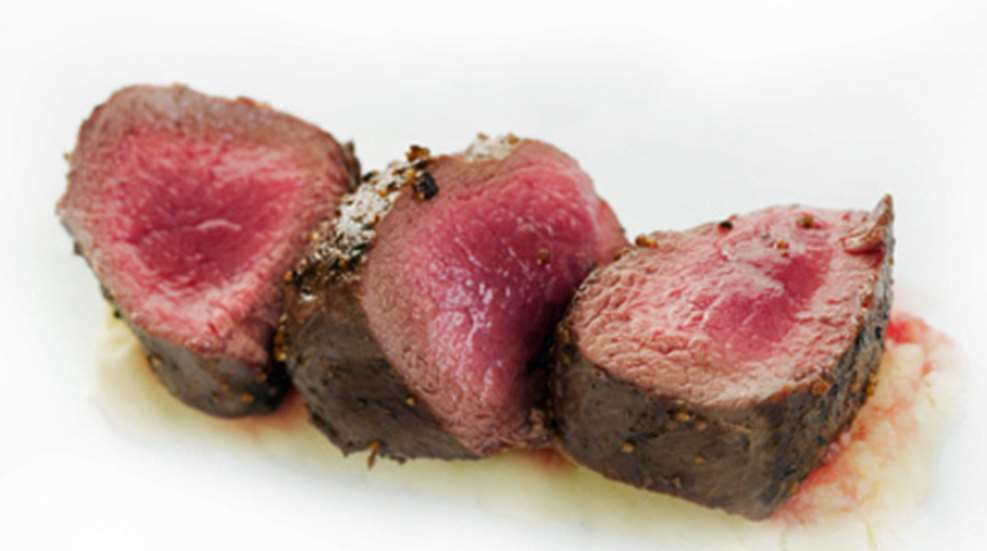
Venison is much more than food for the deer hunter's soul. It also contributes to a very healthy lifestyle, and serves as a cheap alternative to other meats. Not to mention this mouthwatering meat is typically lower in saturated fat and calories than domestic choices.
Deer feed on naturally occurring forbs and browse that don’t contain antibiotics or growth hormones. Also, helping to keep our burgeoning deer herds in check through hunting and eating what your game is good for the environment. A survey of the energy used to produce and distribute various foods has found that wild-game meat is among the most energy-efficient and least polluting foods in our diet. The analysis includes the manufacture and application of fertilizers and other chemicals, harvesting, processing, packaging, transport and waste disposal.
Nutritionally, the following tables clearly show that, compared to beef, venison is high in protein, low in calories and saturated fat.
|
Species |
% Protein |
% Fat |
(mg/100g*) Cholesterol |
(Kcal/100g*) Calories |
|
Beef (USDA Standard) |
22.7 |
2.0 |
69 |
152 |
|
Beef (USDA Choice) |
22.0 |
6.5 |
72 |
180 |
|
Deer (Mule) |
23.7 |
1.3 |
107 |
145 |
|
Deer (Whitetail) |
23.6 |
1.4 |
116 |
149 |
Some game meat is higher in dietary cholesterol than domestic meats, but the combination of more lean body tissue, less saturated fat and significantly higher percentage of cholesterol-reducing polyunsaturated fatty acids makes wild game a heart-healthy choice.
|
Species |
Saturated (bad fat) |
% Fatty Acids (monosaturated) |
Polyunsaturated ("good" fat) |
|
Beef |
46.3 |
45.5 |
8.2 |
|
Deer (Mule) |
48.0 |
31.8 |
20.2 |
|
Deer (Whitetail) |
45.6 |
30.5 |
23.9 |
*100 grams= 3 1/2 ounces
With ample proof that venison is the way to go, here are my secret venison recipes developed over decades of chasing whitetails.
The Best Venison Burgers Ever!
Please don’t hold it against me, but I love to cook. During the summer I am barbecuing at least every other night. Of course, mostly I am cooking wild game or fish.
My wife Cheryl and I love a good hamburger, and venison burgers are our favorites. For us, the key is at the time of harvest. I make sure I meticulously clean the meat, cool it immediately and let it age a bit before processing. We grind our own burger, adding a 5 to 7 percent combination of beef and pork fat—just enough to hold the meat together when we make burgers and give it a tad of flavor, but no more than that.
When I make summer burgers, I often combine two 1/4-pound patties with a surprise in the middle. Here’s what you do. Pat out four 1/4-lb. patties. On top of one patty place a couple of long mild green chile slices (remove the seeds first!), and a piece of your favorite cheese (we like Pepperjack.) Now place the other patty on top, and be sure to close the sides of the double patty up.
Grill over a medium flame, the key being to cook the burgers slowly so they are cooked through and the cheese inside melts. I season mine with a little garlic salt, coarse black pepper, and celery salt. In the house, Cheryl has cooked a few strips of bacon and toasted onion buns. We serve the burgers on the buns and add the bacon, dill pickle slices, red onion slices and some fresh avocado. To top it all off, a fresh garden salad, some Boston baked beans and salty Kettle chips will be washed down with a fine microbrew pale ale outside on the deck.
Grilled Venison Backstrap Supreme
I covet venison backstrap as much as Ebenezer Scrooge coveted money. There is so much meat from a big deer and so little of those tender, tasty backstraps that one hates to cook them poorly.
In summer, we barbecue a lot, and backstraps on the grill are the centerpiece of one of our favorite meals. Here’s how we do it.
First, I soak the backstraps in salt water to get every iota of blood out of the meat. Once that’s done, I rinse them in cold fresh water and pat them dry. Then I trim all the viscera and fat away, leaving nothing but pure meat.
For this simple recipe you’ll need about 2 pounds of backstraps cut into thick little 2-inch chunks. You’ll also need a quart of sweet apple cider, 2 pounds of bacon, one large red onion and 24 ounces of your favorite barbecue sauce.
To start, place the venison chunks in a shallow baking dish wide enough to keep from having to pile them on top of each other. Pour the apple cider over them, cover and refrigerate overnight. In the morning, remove the chunks from the cider, pat them dry, and set them aside while you wash and dry the dish. Return the chunks to the dish and cover them with the barbecue sauce, then refrigerate until its time to cook them—at least 3 hours.
Before cooking, take the meat out of the refrigerator and let it warm up to room temperature. While you preheat the grill to high heat, wrap each meat chunk with a slice of bacon and a thin slice of onion, holding it all together with a wooden toothpick. Coat the grill with cooking spray or brush it with olive oil to keep the meat from sticking. Now place the meat onto the grill, making sure there is some air between each chunk. I keep a small squirt bottle of water handy and when the bacon drippings start kicking up flames, squirt them down without putting out my fire. Turn them occasionally until the bacon becomes a little burnt—usually about 20 minutes.
Remove and serve with a fresh salad, garlic toast, fresh asparagus and a chilled Merlot. Bon appetit!
Best Venison Stir Fry Ever!
If you take your deer to a professional butcher, chances are, along with those steaks, backstraps, roasts and hamburger he gives you back some chops. Most people broil or grill their chops, and that’s a great way to do them up. But for a tasty oriental twist, try stir frying them.
How much meat you need is dependent upon how many people you’ll be feeding. I figure about a half pound of meat per person, with my chops about a 1/2- to 3/4-inch thick; the amount of vegetables you use is dependent upon how much your crew likes them. Then I get a whole bunch of fresh carrots, fresh bean sprouts, celery, broccoli, a red bell pepper, a handful of mushrooms, some unsalted peanuts, 1 medium yellow onion and 2 cloves of garlic. You’ll also need 1 tbsp. of crushed red pepper, 1 tsp. of ground cumin, a cup of soy sauce and a bit of canola oil.
The first step is to marinate the chops in soy sauce overnight in the refrigerator. Then comes the work—prepping the vegetables. That means peeling, then chunking, carrots, slicing celery, cutting broccoli and dicing the garlic and onion. I like to keep everything in separate small cups so it is all handy and easy to grab.
It is best to do the cooking in a large wok, but since I like to keep the bone in my chops I find a very large skillet works best for me. Get the skillet very, very hot, then coat it with just enough canola oil to keep everything from sticking. Cook the meat about 30 seconds per side, then add everything else, including the seasoning. Stir constantly, making sure everything hits the hot skillet and is coated with all the spices and oil. Do not overcook!
Serve with a side of fried rice and, if I am feeling like it, I’ll top the stir fry with some of those crunchy cooked noodles you can find in the oriental food section at the store. Wash it down with some icy Tsing Tao beer. This is a low-calorie, low-fat meal that doesn’t taste like it.