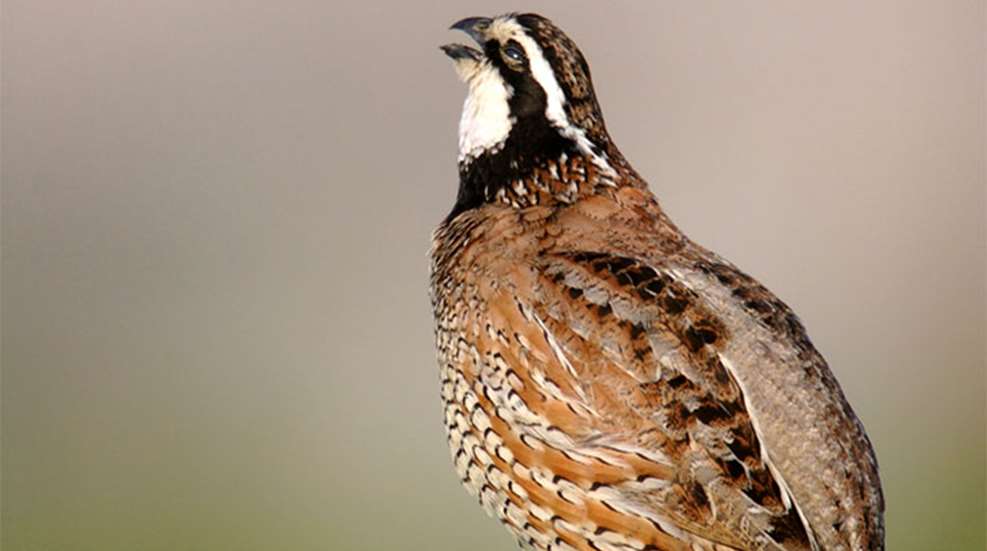
Haunting sounds they are, those spring whistles and fall covey calls of the bobwhite. Lonesome, yet thrilling. Contemplative. Heard on a misty spring morning, the whistle is a thing of renewal, a thing of wild beauty. And on a similar day in autumn, with perhaps a touch of frost clinging to grasses in a shaded nook, the covey call is one filled with mystique. It is an invitation of sorts for he who hears it to gravitate toward that sound in anticipation of an ecstatic eruption of wing beat, a cloud of rocketing bundles skimming the tops of broom sedge. Quite marvelous, these sounds are. But sadly, they, in large measure, are gone.
Even as recently as the 1960s, which in the overall scheme of time is certainly recent, those various calls and covey rises were common throughout the Southeast. History will show, however, that those years were not the beginning of a significant decline; a downward spiral had been occurring from perhaps as early as the late 1800s. But the 1960s seem the approximate time of a pronounced alarm.
I hunted during those latter years of quail abundance. I was often in grass fields and pea patches behind our country home, double 20 in hand, ragtag pointer winding birds. But the first half of the 1970s captured me as a college student and released me only after graduate school. I went back to those country roots mid-’70s and made a spirit-crushing discovery: no quail. All was lost.
But, maybe not. Not long back, I found myself in the company of a young quail hunter. We hunted quail and admired dogs and talked shotguns and enjoyed spectacular bird shooting. This young man is Mark McConnell, Ph.D. and assistant professor of upland birds at Mississippi State University (MSU) in Starkville, Miss. He related his first encounter with quail, a single bird on his uncle’s property in Louisiana. Mark was simply out for a stroll. He admits to being captivated, and this led to his life’s work. He, along with others of similar dedication, is seeing success from Texas to Georgia with wild quail management.
“We call it the rule of thirds,” McConnell says regarding management. “Bobwhite need about one-third native grasses, one-third annual forbs and one-third shrub cover. But the arrangement of these components is what’s really important. The more interspersed they are the better.”
This is a simple, basic regimen, but implementing such practices in the world of modern farming and property ownership is not often simple or basic. Demands on a given property may preclude or at least diminish what can be done for the express purpose of enhancing quail populations. Still, many property owners can take steps toward assisting quail in their often perilous existence.
The two of us were that day fortunate to be on a sizable property with quail management holding the No. 1 slot in importance. The property is Prairie Wildlife, a 6,500-acre working farm and commercial hunting operation near West Point, Miss., this not far from MSU. McConnell drives the quail management here, with the encouragement and support of owner Jimmy Bryan, himself a lifelong quail hunter. The property is home to a great many studies by MSU graduate students and hosts seminars on quail management for biologists and students throughout the Southeast. As a result, it is the perfect locale for the type management McConnell and others seek. It is much apart from the customary properties of the region, but the tactics employed here can work on other holdings as well.
While McConnell admits predation is a factor, he concludes it is not as significant as some may think.
“Everything eats quail, but that’s always been the case,” he says. “When quail have enough habitat, they can handle predation.”
And that is where proper management comes into play. Adequate habitat reduces loss and bolsters covey numbers.
Native grasses and forbs were once common across the Southeast, but exotic grasses such as Bermuda and tall fescue seem now to dominate, McConnell notes. These, he points out, are detrimental to quail. They are too thick for quail to negotiate. Bunch grasses, those that grow in clumps at the bases and leave open ground between those clumps, are more conducive, providing not only food sources but travel routes with overhead protection for quail. Broom sedge is an example of this type grass. He considers those spaces between bunch grasses to be the places where quail habitat is made. This is particularly important during breeding, nesting and brood-raising.
While McConnell admits predation is a factor, he concludes it is not as significant as some may think.
During fall and winter, quail need a different structure. Food, such as those from grasses and forbs like partridge peas and beggar’s lice, are essential. Waste grains from farming operations are also important, but these should be in proximity to cover. A strip of native grasses, preferably disked the previous fall, separating agricultural crops from pine plantations or shrub cover is needed so that quail are never far from that cover. Shrub cover, such as plum thickets with closed canopies and open ground beneath, provides protection from winter weather and avian predators.
And what if a given property has these essentials and is still minus a viable quail population? McConnell suggests a quick study of surrounding properties. If those basic requirements are not available on adjoining lands, one isolated locale where they are available may not be adequate. If possible, a joint and cooperative effort among property owners would be in order.
McConnell and I stopped to watch the dogs work and I asked that potent and perplexing question: Can we legitimately expect quail to return in viable numbers?
“Yes!” His answer came without hesitation. But it did come with qualifications. Those included proper management on a scale large enough to produce the desired results. And he noted that numbers may never return to those of 100 years back. Things are simply too different now. But hope remains. There is a positive possibility that the hills and hollows will again ring with those lonesome whistles and fall covey calls.