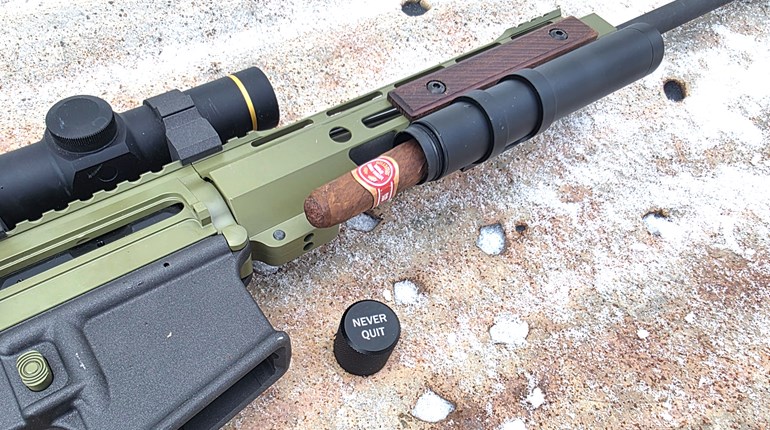
There are many ways to start an argument in polite company, but three of the best are to kick a man’s dog, kiss his wife or insult his elk gun. Even at that, most folks will forgive a virgin offense of the first two, but when you disrespect any hunter’s elk gun, you insult his honor.
That is not my intent here.
The last time I wrote about elk cartridges for American Hunter, the mailbags were full and it’s an understatement to say that not all of it agreed with me. But it’s been a few years and in spite of the death threats I decided to have another go at the subject. I am not asking you to agree with me, just to hear out my opinions and think about what I am saying.
First off, I know all too well that elk can and have been killed with little cartridges. I also know there are stories of at least one elephant being killed with a .22 Long Rifle, but no sane person will argue that the .22 LR is an adequate elephant cartridge. Yes, smaller cartridges work, but nobody can argue successfully that they work better, or even as well as, a bigger cartridge.
That’s like saying your Dodge Neon is fine for NASCAR. Sure it can run around the track and even go fast, but is it a winning plan to drive it in a race? I am not exploring cartridges that will simply kill elk here, nor is this an article about “adequate” elk cartridges. This article explores those cartridges that are going to give you an edge in elk hunting, not by being “adequate” but by being down and dirty, serious, no-holds-barred, remove-the-doubt, kill-them-dead elk cartridges. I think these cartridges should be no smaller than .30 caliber and deliver a bullet weighing at least 180 grains to the elk with a minimum of 2,000 ft.-lbs. of energy. For most of us that means the elk should be 300 yards or closer. Beyond that distance, shooting becomes tricky with any cartridge.
I don’t know about you, but in the 25 years I have been hunting them, no elk has ever given me a break. I do not intend to make this a fair fight and I want every advantage. Keep in mind, too, that a big bull elk can be five or six times the size of the average whitetail deer. Thinking that your deer cartridge is big enough might be a mistake.
Elk are tough, and nobody with any real experience with them will ever argue that point. If you wound a deer he will lie down. If you wound a moose he will run in circles, acting stupid. But wound a bull elk and he will head for the next ZIP code with nothing but dust behind him. Shots that would cause deer or moose to give up and die just aggravate elk. They can soak up a lot of misplaced lead and still leave a lot of tracks. The physics are simple: the bigger the bullet, the bigger the hole. Physiology is also simple: the bigger the hole, the faster the elk dies. For most of us, elk hunting is expensive and can be emotionally draining. Why risk the outcome of your hunt with a small, possibly inadequate, rifle cartridge?
All too often the letters I get preaching about using smaller cartridges for elk or any other big game are thinly disguised bragging sessions about the writer’s shooting ability. I prefer to prove my shooting abilities at the range and in competition, not when I am hunting. I like easy shots at elk. Proving I am a good shot does not seem like a viable reason to use a marginal cartridge.
Of course shot placement is important. It always is. But a larger cartridge gives you more options about shot placement and will allow you to take shots that you should pass on with a lesser cartridge. Also, in the real world, shot placement is not always a guarantee. Things happen and bullets sometimes hit where you do not intend, or the bullet’s terminal performance may not be what you expected. A larger cartridge is an insurance policy.
Tell me with a straight face that you would pass the following shot:
You just saved every dime for five years to pay for your elk hunt. You skipped movies, brought your lunch from home, worked overtime, whatever it took. This was your dream, the thing that kept you up nights for years and now, finally, you are in elk country with a tag and a rifle.
But it hasn’t exactly gone as planned. It’s the last day and you have yet to see an elk. You have been running on the ragged edge for 10 days with hardly any sleep, climbing those steep mountains every day, giving everything you have and all you can see is your dream slipping away.
Then just before darkness ends it forever, your guide spots a 6x6 bull 200 yards away with a bunch of cows. By the time the bull is clear of the cows, they are in the timber and he is following. All you have is a sharp quartering-away shot and about two seconds before he disappears.
Will you shoot?
Remember, lying is a sin.
I doubt one hunter in a thousand would pass on this shot. But you need to drive a bullet through his stomach, which is full of wet, soggy, green, energy-sucking material. And that bullet needs to continue on through his lungs, possibly only hitting one, and out his chest, perhaps hitting the shoulder, so that there is a blood trail to follow in the fading light. Which cartridge would you prefer to shoot? A .270 Winchester with a 130-grain bullet and 1,800 ft.-lbs. of energy remaining at 200 yards? Or would you like a .338 Ultra Mag. with a 225-grain bullet and 3,585 ft.-lbs. of energy smacking that elk?
Yup, the .270 will kill elk, every Jack O’Connor fan (including me) knows that to be true. But will it kill this elk? Will it kill it and allow you to find it in the little time you have available?
An ethical hunter with a .270 should pass on the shot. Those who don’t are very likely in for even more heartbreak as the wounded bull escapes to a painful, lingering death. With a .338 Ultra Mag. firing a 225-grain Barnes MRX, you can penetrate all that elk, leave a big exit hole for a blood trail (if you need it) and probably have enough power left to plow a furrow in the dirt deep enough to plant a row of peas.
One thing about that last point. I don’t buy the “leave the bullet in the critter and expend all the energy” school of thought. I want my bullets to exit if possible, and I want them exiting with lots of remaining horsepower. Energy doesn’t kill elk, death happens because of damaged body parts. A well-designed bullet that is still traveling at high velocity on exit does a lot more tissue damage than one that stops inside the elk. That’s because the wound channel remains large all the way to the exit. It also will usually result in a larger exit hole, for a better blood trail if needed. With elk, it often is.
One more thing: The bullet does all the work and it is the most important decision you can make. Always pick a good bullet. I would prefer a marginal cartridge with a superior bullet to a fire-breathing, dragon-slaying magnum cartridge with a poor bullet. But if I have a choice, I am bringing the dragon killer with the best bullet I can find.
Fear of recoil is not an acceptable excuse today to use an inadequate cartridge. A cartridge like the .30-06 is hardly a shoulder dislocater. Besides, while a muzzle brake will not endear you to your guide, it will cut the recoil of an elk rifle by a large margin. If you are tough enough to hunt elk you are tough enough to handle a compensated elk rifle. I know a couple of little bitty women who hunt with non-ported .338 magnums. If a 100-pound, 5-foot-tall woman can shoot a full-grown elk gun, you ought to be able to handle a lesser cartridge with a muzzle brake.
Sure, it takes practice. But are you telling me you will invest all that money, all that time and all those dreams in an elk hunt and then not practice with your rifle? Think for a minute about how foolish that sounds.
I am not talking about using a cartridge designed for elephant hunting here, simply that you follow Robert Ruark’s posthumous advice and “use enough gun.” He was referring to African dangerous game, but that simple advice applies to elk just as much as buffalo.
Short-Action Cartridges
This is one that’s going to get me into trouble, but I really am not a big fan of traditional .308 Winchester-based, short-action cartridges for elk. Yes, a .308 Winchester can work, but refer back to the previous 1,300 words for my thoughts.
The newer .338 Federal is actually a decent enough elk cartridge for timber hunting, as is the old-but-hanging-in-there .358 Winchester. They are two of my all-time favorite cartridges. But I need to be honest here. If you have to take a 300-yard shot they are starting to show their limitations. With a 200-grain bullet the .338 Federal is down to about 1,800 ft.-lbs. of energy, similar to the .30-06 at the same distance. The .358 Winchester is way out of the running due to the round-nose bullets in factory loads with only about 1,100 ft.-lbs. left.
The .30-06 “Family”
The .30-06 is the “mother of all cartridges,” or at least the mother of a big brood, as it has been necked up and down to create cartridges from the .25-06 through the .35 Whelen. In my never-humble opinion, elk cartridges start at .30 caliber and this is particularly true with this cartridge case size. I know some of you kill elk with a .25-06 or a .270 every year and most of you will write a letter after reading this. But does that mean it is the cartridge an elk hunter should carry if he wants the best chance of a favorable outcome? Hardly.
I own and hunt with rifles in these cartridges as well as my favorite, the .280 Remington. Would I use them if it meant staying home if I didn’t? To mock my least-favorite president, let me be clear: I would hunt elk with a hatchet if the alternative were not hunting elk. But they are not the rifles I would grab from the safe when packing for an elk hunt with options.
I have always maintained that serious elk cartridges start with the .30-06 Springfield using high-quality 180-grain bullets at 2700 fps. Even at that, it drops below the ton-of-energy threshold at something short of 300 yards. The .338-06 and the .35 Whelen both will push a 225-grain bullet to 2500-plus fps, and are both excellent elk cartridges for timber hunting. They both also fall just short of 2,000 ft.-lbs. of energy at 300 yards. While it’s a bit off-category I would include the .350 Remington Magnum here as well. But only with handloads. There are no factory loads that I know of with a decent elk bullet.
What About the Short Magnums?
Short-magnum cartridges are nothing more than “long” magnum cartridges in a different dress. Again, at the risk of more hate mail, I think only those with a bullet diameter of .308 or larger qualify for serious elk cartridge status. All the .30-caliber short-magnums—WSM, RSAUM, RCM—more or less mimic the old stable of .300 magnums. With a 180-grain bullet at 2900 fps, give or take, the .30-caliber short magnums are decent enough elk cartridges, and can easily cross the 300-yard line with more than a ton of remaining energy.
My view, though, is that bullet diameter is a big factor in cartridge performance, and so it’s the larger short magnums that set my heart aflutter. The .325 WSM or the .338 RCM are darn fine elk cartridges, if loaded with properly constructed bullets weighing at least 200 grains. You must keep that sectional density up there if you want to penetrate elk, and bullet weight is how you do that.
I have a custom rifle built on a Winchester Model 70 by Mark Bansner that is chambered for the wildcat .358 Winchester Short Magnum. It is simply the .300 WSM necked up to take a .358-diameter bullet. It pushes a 225-grain Trophy Bonded bullet out the muzzle at 2950 fps, the same speed as the .300 Winchester Magnum with a 180-grain bullet. If I were to develop the perfect elk cartridge from scratch, it might well look like this when it was finished.
Traditional Belted Magnums
The .30-06 is the “American” mother of all cartridges. But the European-born .375 H&H is the mother of a huge family of big cartridges, too. The über-popular belted magnums can all trace their ancestry to this wonderful hunting cartridge.
The .300 belted magnums—.300 H&H, .300 Winchester and .300 Weatherby—are all decent enough elk cartridges. Again, I think heavy bullets of at least 180 grains are best. But the more I use them, the better I like 200-grain bullets, particularly in the .300 Wby. with its bigger powder capacity.
The .338 Win. Mag. uses a 225-grain bullet with a muzzle velocity of 2800 fps. It is a good balance of power vs. recoil and might well be the perfect elk cartridge. The .340 Weatherby Mag. does it a bit faster, adding a couple of hundred fps to the catalog velocity with a corresponding increase in recoil.
While it’s a bit hard to find a rifle chambered in it, the .358 Norma has become one of my favorite cartridges. I’ll confess to a soft spot for .35-caliber rifle cartridges, and this one is a thumper. The 250-grain bullet has a muzzle velocity that is very close to the 225-grain from the .338 Win. Mag. My rifle is in an E.R. Shaw MK VII, which will shoot sub-MOA groups with Norma factory loads. If you want to be a little different than the other lemmings in hunting camp, you might consider this cartridge for your next elk rifle. Or if you want even more whack, consider my .358 UMT wildcat. This is the .300 Ultra Mag. necked up. It pushes a 250-grain bullet to 3100 fps. It shoots flatter than a .300 Win. Mag. and hits harder than a .416 Remington. Mark Bansner can build you one.
If you do like being off the beaten track when it comes to cartridges, also consider a 9.3 mm cartridge. This bullet diameter is very popular in Europe for moose and red deer, a kissing cousin of our elk. The most common is the 9.3x62. It’s a bit pokey, with the factory loads pushing a 286-grain bullet at 2360 fps. Surprisingly, it’s still got that magic ton of energy left at 300 yards, proving again that bullet weight is king. If you want a bit more speed, consider the new Federal-loaded .370 Sako, which drives the same bullet 200 fps faster.
Finally, we have the momma of all the belted magnums, the .375 H&H. One of the legends of gun guy history, Elmer Keith, lived in elk country, he hunted elk all his life and guided professionally for years. He liked the .375 H&H, so what more is there to be said? With a 300-grain bullet at 2530 fps or the even more elk-appropriate 270-grain at 2700 fps, it’s a bit on the big side. But there is only one degree of dead. There are many degrees of wounded.
A new option is the .375 Ruger. It’s a non-belted magnum that will fit in a .30-06-size action. The cartridge uses Hornady’s new propellant technology to produce better ballistics than a .375 H&H, but from a much shorter barrel. In fact, I just had Bansner re-barrel a Model 70 Winchester in .375 Ruger. I am fitting one of his High Tech stocks to the gun and hope to have it finished soon. It should be one heck of a big-bore elk gun, and if Africa or Alaska comes knocking with opportunity, I’ll be ready to answer.
The Big Guys
Anything the “other” .300 magnums can do, the .300 Remington Ultra Mag. or .30-378 Weatherby can do better. I really like how a 200-grain bullet performs with the Ultra Mag. I think it balances the cartridge and it launches at 3070 fps, which is about 100 fps faster than a .300 Win. Mag. pushes a 180-grain bullet. If you prefer, the .30-378 Wby. will push the same bullet another 100 fps faster than that.
The .338 Remington Ultra Mag. is the unsung hero of the Remington Ultra Mag family. Ignored and disdained, like ol’ Rodney it “gets no respect.” (Younger guys can Google that reference.) But I have had three and they have all been wonderfully accurate. I am talking varmint-rifle accurate. Sure they kick a bit. But I’ll live with the recoil as a trade for the performance. The .338 RUM launches a 225-grain bullet with 3060 fps of muzzle velocity and well over 2 tons of energy.
I once shot an elk 50 yards from the Yellowstone park border. The deal was if the elk fell 1 foot across the line you had to let it lie there and rot. So to anchor him fast I depended on a .338 RUM.
Another hunter in camp hit his elk with a 7mm magnum when it was standing a good bit farther from the boundary than mine. His bull would have made it across, except a third guy in the party stopped it. He also was shooting a .338 RUM. There is a reason he picked that cartridge. The smack-down of the big 6X6 before he could make good on his escape proved that he (and I) are right. There is simply no profit in messing with diminutive cartridges while hunting elk.