In an age when turkey hunters place so much emphasis on new loads, choke tubes, camouflage patterns and decoys, we don’t hear much about the basics. One of these overlooked fundamentals is the seemingly simple decision of where and how to sit when calling to a gobbler. If you’re sitting in the wrong place and in the wrong position, all the gear in the world will not make you successful on turkeys.
THINK LOCATION, LOCATION, LOCATION. Pick a seat in a place where the turkey will feel comfortable approaching. A little cover is fine, but thick brush that obscures the bird’s view will keep him from visiting your calls. Other potential hang-ups include fences, brush rows and bodies of water. A hot bird may fly over or pick a path through these obstacles, but your best bet is to sneak around them before sitting down.
Often the best situation is finding a place that hides you and the gobbler from one another until the final moments of his approach. When the gobbler pops into view, he’ll already be in range. Take advantage of terrain features like ridgelines and points, or bends in logging roads and paths, when choosing a spot to sit.
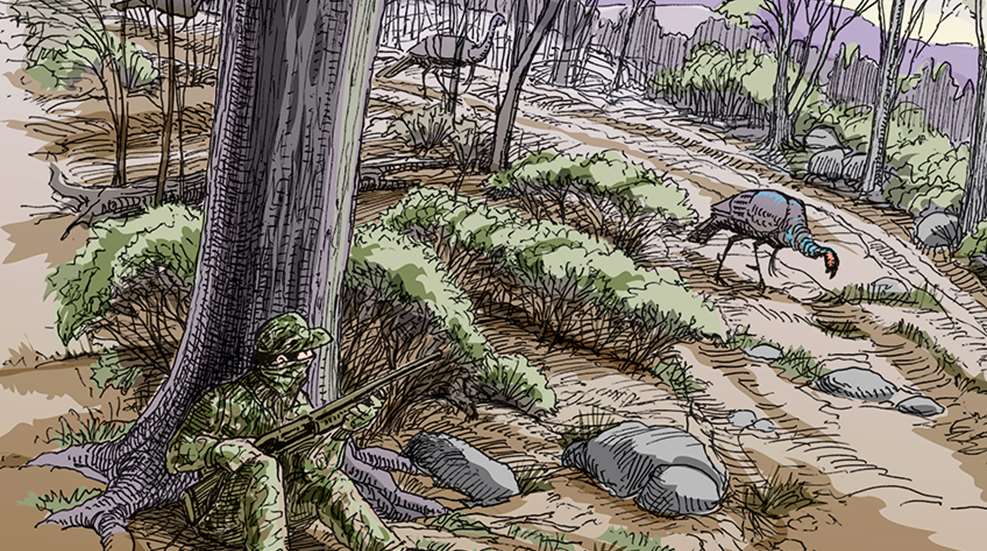
FIND A GOOD TREE. The rule is to sit at the base of a tree wide enough to cover you from behind for safety, break up your outline and give you support to lean against. When you find a likely tree, sit down and determine how well you can see in front of you. Sitting on the ground decreases your field of view by yards.
POINT THE GUN. Your natural inclination may be to face the area where you think the turkey will appear—but this is a mistake. If you are a right-handed shooter, it’s better to point your left shoulder in the direction of the bird’s anticipated appearance (opposite for lefties). This gives you the best range of motion to cover the gobbler’s approach.
Sit with your legs bent and knees up to help hold and steady the shotgun. Rest the forearm of the gun on the knee that’s opposite your shooting shoulder, with the barrel pointed toward the bird’s advance. As the gobbler closes the distance, shoulder the gun and place your support-side elbow against your thigh. You should be able to hold this position for several minutes, so don’t wait until the gobbler is in range to mount the gun.
If the turkey is in sight, make these movements carefully when the gobbler walks behind a tree or other cover that blocks his view. The turkey must be within a few feet of the tree or cover for you to remain unseen; if he is farther, he’ll see around it and bust you. Remember the old adage: A turkey can see through a thin rock. Pick your seat and time your movements with care.