When one of the best spotting scopes in the world is advertised as “new and improved”—and you saw no room for improvement in the old model—is it a scam?
Hunters should worry about “optic scams” for at least three reasons. First, we can’t see inside the instruments to judge their quality; most look and feel pretty similar yet ... . Second, there is huge price disparity with similar-looking scopes and binoculars selling from $100 to $3,000 without revealing anywhere close to a 30-times difference in image quality. Third, manufacturers often conceal critical information on parts, materials, coatings and construction behind vague adjectives, and buzz words like bright, crisp, ultra-sharp, uncompromising and ergonomic. It all sounds like a politician trying to obfuscate his latest illegal campaign contribution.
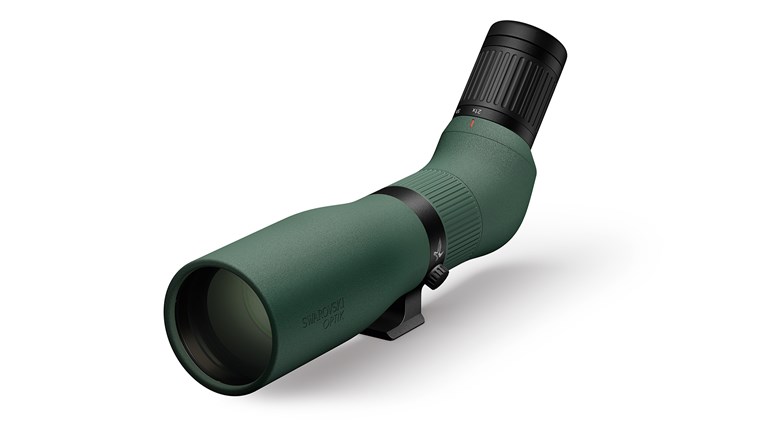
I believe that when considering the purchase of tools costing upwards of $4,000—tools that most consider more luxury than necessity—clarity and understanding are essential. Just what does this new Swarovski ATX Modular spotting scope do to justify its high price tag? More than you might imagine.
It zooms from 25X to as high as 70X. Because it’s a modular system, its objective lenses are 65 mm, 85 mm and 95 mm, a first. It's available with an angled eyepiece (ATX) or a straight eyepiece (STX). Buy whichever you prefer and change later if you want. It’s a telephoto lens for an iPhone camera and a super-telephoto 15X-36X lens for compact digital and DSLR cameras. It breaks down for travel from a maximum of 17 inches (95 mm objective) to a minimum of 11.5 inches (65 mm objective). It’s bright, crisp, ultra-sharp, uncompromising and ergonomic. And it transmits arguably the highest-quality telescopic views I’ve ever seen.
Let’s review this scope’s performance by category, starting with optical quality, which is primarily a product of lenses, prisms, coatings, precision engineering and construction.
On most of this we have to take the manufacturer’s word, and Swarovski’s words are all the right ones. Every lens is multi-coated with proprietary Swarotop anti-reflection materials to minimize flare, maximize contrast and deliver 86 percent light transmission. In the ATX (angled eyepiece), the roof prism is BAK-4 glass, the best for this application, and phase-coated to minimize distortion. The mirror is Swarobright, Swarovski’s proprietary dielectric process for maximum transmission (brightness.) In the STX (straight eyepiece) the prism is a Porro, which needs no phase-coating or mirror.
An HD flourite objective lens effectively eliminates color fringing. I could detect none even around backlit objects against a clear sky, conditions that reveal any color fringing in a scope. A field-flattener lens creates nearly perfect sharpness across the field of view, literally to the extreme edges, even at top magnification of 70X on the 95 mm objective. I viewed a brick chimney, putting the vertical edge of bricks on the extreme edge of field of view. Then I focused on the bricks in the center. Those at the edge were just as sharp. For optical quality, I give this scope an A+.
Our next category is mechanical, and the mechanics of this scope are most unusual. Instead of a small zoom eyepiece screwing into the end of the scope, as is traditional, the ATX/STX eyepieces include the prisms. Roughly half the scope is represented in the eyepiece, which joins the objective end of the scope on the straight, main body tube. Engineers then put the zoom ring at this junction, which means it’s just a quarter-inch behind the focusing ring. No more reaching up under your cap brim to change the zoom. Keep your stabilizing hand on the focus collar and the zoom collar simultaneously. Turn either without lifting more than a finger. I found it easiest to use index finger and thumb to turn the zoom. Any other finger could easily adjust the focus.
The magnesium alloy body keeps weight to a minimum. Rubber armor coating protects against dings and scratches. Fit and finish are excellent, and all moving parts are smooth and firm with no slop. The integral lens hood pulls out and doesn’t exactly lock, but seems to snap into place where it stays quite firmly. An unobtrusive notch in the hood serves as an aiming sight that is surprisingly effective. The set screw for unlocking the tripod collar is rather small with ineffective gripping grooves, but remains easy to turn regardless. Once loosened, the scope body glides smoothly 360 degrees with audible and tactile detent stops every 45 degrees.
Ergonomics: This five-dollar word simply means “well-designed to be user-friendly,” and the location of the zoom ring by the focusing ring achieves this in spades. The 20 mm of eye relief is another welcome touch. Too many spotting scopes have such short eye relief that you end up smearing the glass with your eyelashes. This one provides enough relief for a full field of view even for eyeglass users.
Hunters understand a spotting scope’s value for scouting, finding game in big country, assessing trophy potential (you can see even the smallest sticker points) and seeing bullet holes on the range. The ATX/STX modular unit does all this and more. It functions as a superb super-telephoto wildlife lens.
The optical path, eyepiece and ergonomics were engineered from the ground up for optimum photographic performance. A specially designed TLS APO lens mounts to DSLR cameras and then slides over the scope’s eyepiece, locking into place with a large set screw. Bulky though it is, on a good tripod the rig is surprisingly usable. I was able to follow moving deer, ducks and even a worm-hunting robin and get sharp images. Focusing is manual only, but at 30X the lens is about an f/9.5, bright enough for accurate focusing. At full zoom you lose 22/3 stops of light. A new SSR II spotting scope rail is designed to support the scope front and rear, making it more stable on a tripod. This should minimize vibrations and contribute to sharper images.
The DCB II adapter affixes a variety of point-and-shoot digital cameras to the scope. With the addition of the MeoPix iScoping mount, I was able to slide an iPhone 5 over the eyepiece and capture amazing images. The small size of the iPhone and its video capability make this an easy way to film far distant game, before and during the shot.
To my surprise, Swarovski claims this scope is waterproof to 13 feet. With interchangeable lenses, how can that be? There is an O-ring seal around the joint. I’d be careful about this seal tearing or wearing over time, but I’m sure you could buy replacements as necessary. Rubberized O-ring seals are used in most waterproof optical instruments, and they all age, oxidize and eventually fail. At least you can see this one and spot trouble coming. Given the price of this instrument, I did not subject it to my usual dunk-tank test. I intend to protect it afield, too. Even if it’s as waterproof as warranted, I’m not taking any chances.
Stunning optical quality, mechanical excellence, modular versatility and some of the most convenient digi-scoping attachments in the industry make the Swarovski ATX/STX modular spotting scope system the top dog—and help justify the high cost.
Swarovski ATX/STX
Type: ariable-power, modular eyepiece spotting scope
Magnification: 5X-60X w/65 mm, 85 mm objective; 30X-70X w/95 mm objective
Objective Lens: 5 mm, 85 mm, 95 mm
Focusing Range: lose focus 6.9' (65 mm), 11.8' (85 mm), 15.7' (95 mm)
Eye Relief: 0 mm
Exit Pupil: .08 mm-4.2 mm
Field of View @ 1,000 yds: 24'-68' (104'-57' w/95 mm)
Dimensions: ength 13.3" (65 mm), 14.6" (85 mm), 16.8" (95 mm) angled eyepiece; weight 55.9 ozs. (65 mm), 67.4 ozs. (85 mm), 77.8 ozs. (95 mm)
MSRP: cope $977 (65 mm), $1,721 (85 mm), $2,110 (95 mm); ATX eyepiece $2,421; total $3,398-$4,531
Most Popular