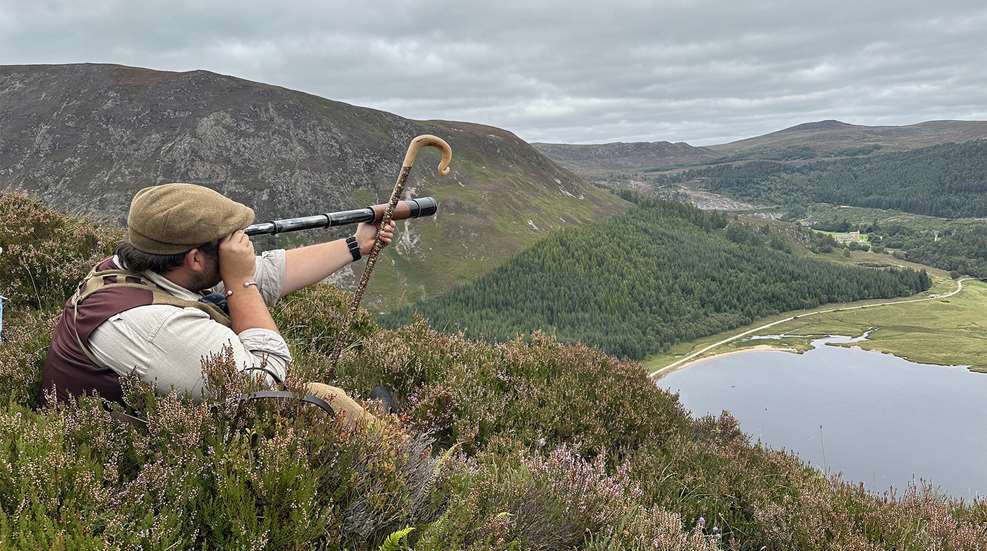
I almost didn’t believe him when under stalker Mole returned from his short trek over the peak with a grin on his face. He was nearly prancing as the word “stag” emanated from his lips. Yes, we were in prime stag country, but we’d seen very few throughout the week and none on this particular stalk. Our prospects had just received a welcomed upward turn.
What we had encountered over the week were midge flies, and plenty of them. With the weather unseasonably warm for mid-September, these little biting insects were out in full force, and they were out for blood. Mesh face masks kept them from nesting in our noses and kept us from breathing them in with every gulp of air—that and the wind, what we could find of the wind, anyway. But as much as the midges plagued our existence, they were just as much of a nuisance to the red deer. Unfortunately for our determined crew, the only way the deer could escape the blood-sucking swarm was to climb to the highest peaks available, where the wind’s consistent blow was strong enough to keep the flies from lingering. That meant we’d have to walk far and climb high to locate any red deer. Truth be told, neighboring estates claimed higher peaks than those of the Kildermorie estate we were hunting, and the stags didn’t have a permanent address. This was proving to be a tough week of deer stalking.
We’d already put miles underfoot, utilizing one of many steep burns (“burn” is Scottish for small brook or stream) that morning to hide our entry into the highlands. Gaining elevation with every step, that initial push up the winding burn nearly wore me out before the real adventure had even begun. Luckily, I was able to drain my water bottle twice on the hike up and simply step down to the crystal flowing babbling brook for a refill without fear of inducing some waterborne illness. I don’t know that I’ve tasted better water. Still, I was physically drained—and sick of swallowing midges—by the time we reached the top. But alas, when we finally did reach the plateau, I could feel my legs and lungs becoming acclimated, and the rolling hills ahead offered some reprieve from the climb we’d just endured. I hoped they offered a bit of wind, too. Another quick rest and we pushed on.
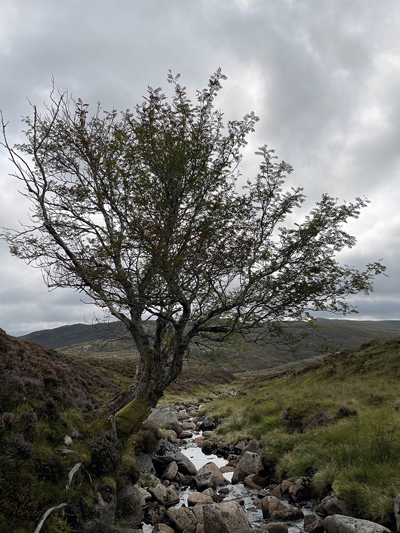
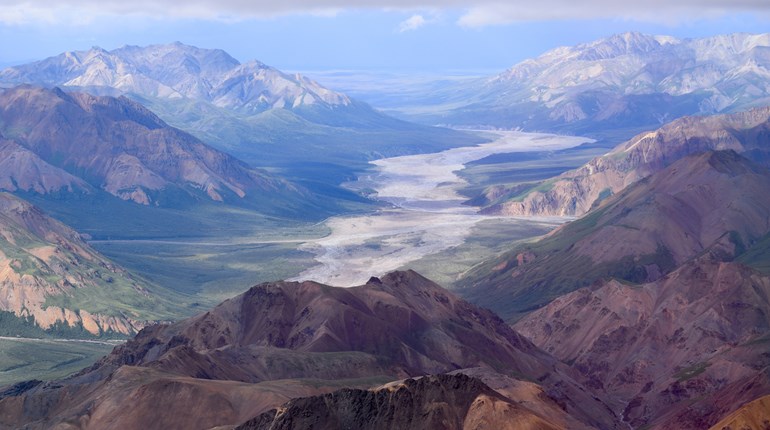
The Scottish Highlands are a uniquely beautiful place to hunt, but the terrain will play tricks on your eyes as well as your will. Without any trees to speak of, once you gain elevation hunters, or “stalkers” in this part of the world, are forced to use the cover of the burns— the trails of running water that have carved their way deep into the soil over centuries—to hide any pursuit. These small yet steep-walled canyons offered a maze of concealment, allowing us to wind our way forward with the occasional peak over top to scan all the usual hideouts. Hidden grass-covered hillsides and small bowls revealed themselves with every turn, and each was as likely to hold a group of stag as the next, so it was slow moving, eyes constantly scanning and, of course, more walking.
We’d been walking for what seemed like hours through absolute postcard-worthy countryside, and had finally made it to the ridge at the edge of the estate. While the expansive view was indeed beautiful (in certain directions we could see for miles, all the way to the coast) the emptiness of the land at this elevation was impossible to ignore. No trees, no bushes and no stag were in sight, which is why I was partial to calling Mole’s bluff when he claimed he’d spotted a large group of stag feeding on a far hillside just around the peak.
We followed him in schoolyard fashion, a single-file line of hunters staying below the skyline until the far ridge appeared around the curve of the mountain, and put our bums to grass to rest and glass with binoculars. Unmistakable, though farther away than I anticipated, sat a large group of red deer scattered across a near 500-yard stretch of distant hillside, from the base up to the peak. Standing, sleeping, noses to both grass and ass, the group consisted of a large number of stags (males) and more than a few hinds (females). A keen eye, Mole was able to tell from behind his antique telescoping glass that there were a few mature stags in the mix that were worth going after.
To even begin thinking about a stalk, though, we’d have to cut the distance considerably, so Mole picked a path that had us backtracking a few hundred yards before cutting down into the shallow valley to then push forward again until we reached a rise opposite our current position, and much closer to our quarry. It took us nearly another hour to close that distance, but once we did we were looking at a real possibility. A 1,000-yard bowl separated us from the herd at this point, but with the wind steadily blowing from left to right and absolutely no trees below to hide our progress, options to get within shooting range were few and far between. The way I looked at it, with my stateside elk-hunting eyes, we had but two options: cut around the mountain to the right and push beyond their current position then come overtop behind them, or cut around a near mile to the left and come upon them side-hilling, hoping to get a clear shot from the very hillside they were on before the wind blew our cover. Either option meant more walking than I wanted to do at this point, but alas, walking was all we’d done on this trip. It was the Scottish way, so who was I to balk at a few more miles this close to success? That’s when Mole came up with a third option that I hadn’t even considered: we could go right to them, a straight shot, using the maze of peat bogs that filled the bottom of the bowl like swamp spaghetti to hide our pursuit. We’d be forced to crawl, he explained, and it could get considerably mucky, but with the late afternoon soon upon us and a favorable wind for such a stalk, it would be the shorter route and should allow us to cut the distance for a likely 300-yard shot.
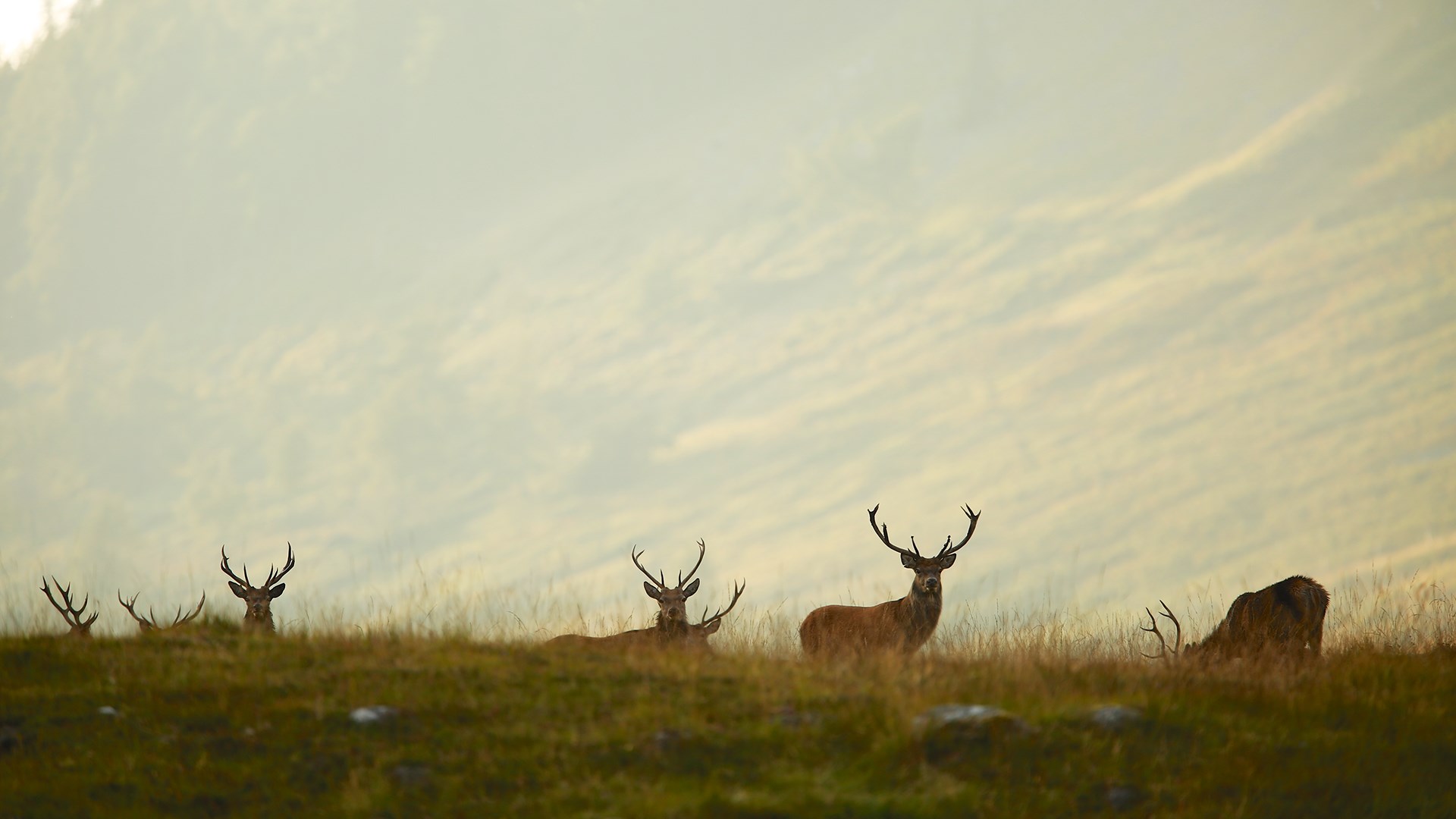 Photo by Dušan Smetana
If the difference between Western elk hunting back home and stalking the Scottish Highlands hadn’t yet become clear to me, it was this maneuver that painted the starkest picture. If you’ve never stepped foot in a peat bog, then it’s nearly impossible to imagine the daunting task that lay ahead. It’s safe to say that even the most daring Western hunter wouldn’t even have considered it a possibility, let alone chosen it as the best one. I was about to learn firsthand that despite their posh attire, Highland deer stalkers are a breed apart, perhaps the most hard-core hunters that walk the face of the earth.
Count that among my many revelations from my week in the Scottish Highlands.
We’d arrived a week earlier to the Kildermorie estate, located in Ross-shire, about an hour’s long winding drive northwest of Inverness, where we landed after a change of planes at London’s Heathrow airport. Currently owned by the Duncan family, Kildermorie is an estate with a rich history, with documented reference of the land reaching as far back as the 18th century. Current scientific dating of the still-existing ruins of an ancient granite chapel on the property show the stone to be from the year 1510, constructed prior to the Reformation. Today, Kildermorie estate encompasses approximately 1,900 acres of land, complete with seven lochs (lakes), countless high hills (the tallest of which, Carn Chuinneagh, rises about 2,749 feet in elevation) and a beautiful stone lodge that the owner had meticulously rebuilt in traditional Scottish fashion. The lodge boasts upwards of 20 estate rooms, a large industrial kitchen, a beautiful dining room, a modern game room, countless tapestries of the medieval style and, of course, a lounge area complete with a stone fireplace and stocked with a collection of fine Scotch whisky and hearty local beers. Outside, a quaint stone courtyard invites guests to the natural wonders of Kildermorie that lie beyond.
Greeted upon our arrival by head stalker Sam Thompson and his second in command, under stalker Sam “Mole” Whiting, it was blatantly obvious that this would be a hunt like none I’d ever experienced. Proud of Kildermorie’s lineage, Sam and Mole both, along with apprentice stalkers Joseph Owen and Andrew Warner, wore the traditional highland stalking garb, consisting of a fine three-piece tweed suit topped with a matching flat cap. Upon first inclination, those fine clothes assured me that this would be what I’d consider a leisurely hunt. In my mind, there was just no possible way such attire would be put through any amount of mud-and-muck rigor. I didn’t know it at the time, but that assumption was the furthest thing from accurate.
To say that Sam and Mole were pleasant fellows is an understatement. Warm, immensely comical, and bearing the historical knowledge that provided context to a land with such a long and rich history, the pair became instant companions to each member of our group, and offered not only the last ounces of their physical efforts over the course of the week but answers to countless questions regarding the history of the land and this strange thing called deer stalking.
It seems lost to most American hunters today, but the idea of going after big game on foot and taking them by surprise rather than baying them on horseback or by following the pursuit of hounds did indeed have its beginnings somewhere. And, as I am continuing to learn even as I write this, that somewhere is arguably the Scottish Highlands. Sam turned me on to a fascinating book, The Art of Deer-Stalking, written by a man named William Scrope and first published in 1838. I located a reprint copy on Amazon upon my return from Scotland last year, and I’ve been glued to its pages ever since, learning as much as I can about the origins of the spot-and-stalk hunting style that would eventually find its way across the Atlantic to the shores of the New World.
A description of Scrope’s personal accounts and observations collected during his 10 years spent hunting the deer forests of Atholl in the heart of the Scottish Highlands, The Art of Deer-Stalking provides details on spot-and-stalk methods, red deer characteristics, habitat and behavior, forestry, game management, riflecraft and so much more. It even delves into folklore and superstition, along with Scrope’s interactions and relationships with locals and other deer stalkers that helped him learn and hone his craft along the way. Though steeped in the best scientific observation Scrope could muster at the time, The Art of Deer-Stalking is full of humor and sarcasm, complete with local stories of 100-plus-year-old stag—unkillable legends that have roamed the deer woods for generation after generation—offering a unique insight into life, lore and the pursuits of this game as it existed in that time. It’s truly a fascinating book that I would highly recommend every hunter add to his or her bookshelf.
The traditional “stalker” is an honored position on any Scottish estate, and though existing hunting estates have decreased in both size and number in the country since Scrope’s time, the honor and respect the position garners is still as prevalent today as it was 200 years ago. Responsible for the hunting of game on the property, from red deer, fallow deer, roe deer and sika, to grouse and other upland birds, it’s the stalker’s job to not only guide shooters on a hunt but to discern the health of the herd and the land and manage it accordingly. Only mature stags are killed for sport, and the ability to locate and judge the age of these animals is a skill and a duty not taken lightly. Of course, there is culling to be done for management purposes, mainly hinds during the offseason, but true and proper stalking is done in search of what Scrope labels a “Hart,” a mature stag greater than 6 years of age. From what I can gather thus far in my reading, according to Scrope, stags can be broken down into seven age classes, best determined by their antler size and shape, and labeled thusly: “Calves” are animals less than a year old, followed by the 1-year-old “Brocket” males, which turn into a “Spire” at age 3, a “Staggart” at age 4, a “Stag” at age 5, a “warrantable Stag” at age 6 and a “Hart” when they surpass 6 years of age. Proven ability to judge and guide for mature stags, along with knowledge of forestry and game management, can earn the right person a job as an estate’s head deer stalker. Typically, as was the case on Kildermorie, the stalking crew consists of three to five individuals: a head stalker, an under stalker and a few apprentices learning the trade. Apprentices, such as young Andy and Joe who worked on Kildemorie, are of high school age and are training to perhaps one day earn an official position. It’s a trade that fewer and fewer are taking up these days, but one that is backed by tradition and honor the likes of which are dwindling in the modern world.
Along with the title and responsibility of becoming an official estate stalker comes the official estate tweeds, the uniform of the trade. I would eventually learn that, like a sports team, each estate has their own colors, determined by the very land they sit on. There is custom in their colors, weave pattern, silk backing and even thread stitching; these tweed suits are handcrafted for each estate stalker by a professional tweed maker who first journeys to the estate to match the specific colors to the land, essentially crafting a unique tweed camouflage that matches the estate flora perfectly, from the distinct colors of the flowering heather to the shades of green grass on the hillside. Stalkers wear their estate tweeds like a badge of honor. The suits are meticulously cared for and polished; they represent their estate, craft and position with an earned pride not found beneath the patterns of Mossy Oak, Sitka and Kuiu that adorn stateside hunters and guides. Until they’ve earned that right, apprentice stalkers wear off-the-shelf tweeds or the hand-me-down tweeds of their hunting relatives. But even in their unofficial tweeds, these trainees still look the part, and the pride brimming beneath even those garments is unmistakable.
Wanting badly to immerse ourselves in as much of this storied culture as possible, our group took a break from the hunt for a day trip to the small town of Beauly, home of the famous tweed shop Campbell’s of Beauly. The shop, which first opened its doors in 1858, is not only the very shop that crafts the official stalking tweeds of Kildermorie but is also proud to boast multiple Royal Warrants, granted first by the Duke of Windsor in 1960, followed by the Queen Mother in 1975, the Queen in 2017 and the Prince of Wales in 2022, which, following his ascension to the throne, was reaffirmed by King Charles III in 2025. Plaques located on the front of the building read “By Appointment To HRH The Prince Of Wales” and “By Appointment To Her Majesty the Queen.” Yes, this is the very shop that outfits the royals for their own hunting excursions, including the late Queen Elizabeth II, who was well known to cherish her time spent stalking at the famous Balmoral estate.
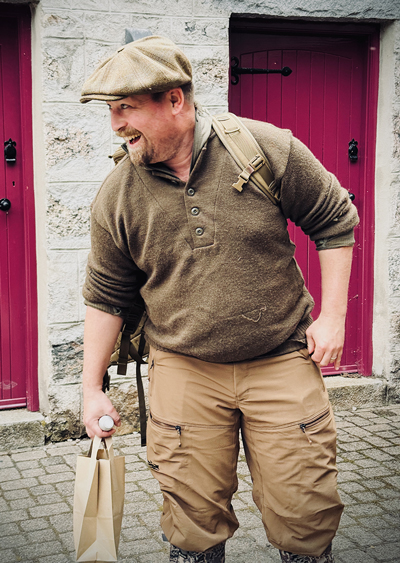
Though I didn’t have the coin to drop on a full tweed suit, I was able to leave Beauly with a sharp-looking flat cap, which I showed off with a touch of my own pride to Mole later that day. Upon comparison, however, I quickly noticed that though similar, it wasn’t exactly the same style as the flat caps he and Sam wore, and I was soon informed that there are in fact many different styles of these caps, each with a slightly different trim, brim and shape, and each signifying a different trade in the traditional sense. Realizing I hadn’t purchased a traditional stalking cap, I looked to Mole to divulge the background of my headpiece. His response brought forth a bit of embarrassment from me, followed quickly by a whole lot of laughs from the both of us. “It’s called a ‘Baker’s Boy,’” he said, as my face turned a bright shade of red. Just my luck. Here I was, trying my best to look the traditional stalking part, and I came home with a “Baker’s Boy.” Our laughter echoed across the estate. Keen to offer some form of sympathy, Mole explained that in addition to owning one himself, the “Baker’s Boy” is actually quite a popular style, officially known as an eight-panel cap, recently renewed in its popularity by being the very hat worn by the Shelby gang in the hit Netflix series “Peaky Blinders.” Okay, so I had purchased a working-man’s hat—that, I could live with. I decided the “Baker’s Boy” cap was my new good luck charm and I’d wear it with pride from then on out. A few days later, when Mole made the final call to stalk through the peat bogs and go after those distant hillside stag, I simply tipped the brim of my sweat-soaked Baker’s Boy and smiled. It was game on.
That smile didn’t appear again until we’d safely stepped foot back at the small shack next to the two-track road hours later, when Mole filled my tin cup with a bit of Scotch he’d pulled from under a nearby rock that he’d stashed for just such an occasion. Trust me when I say though we came back empty-handed, we’d more than earned the drink.
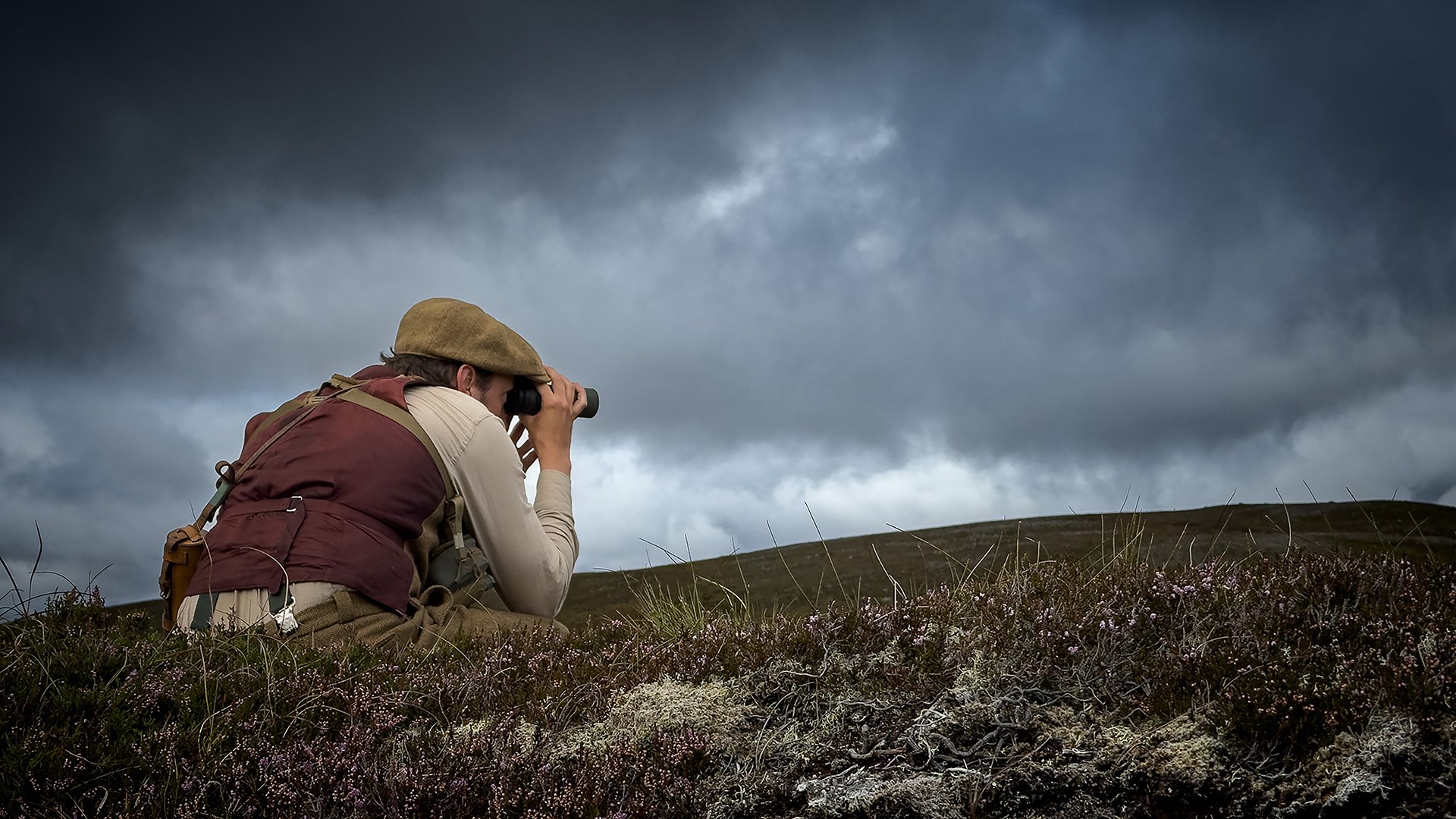
It took us all of two and a half hours to close that 1,000-yard distance, crawling like a trail of worms through the peat bog the entire time. We crawled on hands and knees when the berm was tall enough, on flat bellies, faces pressed into the water-logged peat when it wasn’t. Though Mole tried to guide us around the worst of it, we never knew if the ground was solid only a few inches underneath the mucky surface as to only allow our hands to sink into the mud, or if it was a false bottom, where our legs, arms and at one point Joe’s entire upper half would disappear and sink into the cavernous depths below. It was a maze of natural booby traps, each waiting to gobble you whole. With each plow forward, we’d pack wet peat in our cheeks and down our shirts as we followed the winding rivers of interweaving bogs.
Like soldiers pushing the trenches of the World War I, minus the barbed wire and machine gun fire overhead, we kept our faces pressed to the swampy earth as to not be seen by the herd as we cut the distance, one peaty foot at a time. At times we’d be forced to switch bogs, side-crawling inch by inch over the berm a short distance to drop down into the swamp again. At times we’d be frozen, stuck to the ground like earthen mounds until an errant hind’s eyes broke their lock on our movement. These words don’t do it an ounce of justice. Suffice to say that it was the most grueling stalk I’d ever attempted. At times I couldn’t help but pause and wonder how Mole and Joe would get all that mud out of those beautiful tweeds.
Though I thought it might never end, hours after we first sank into the bog we finally found ourselves roughly 350 yards from the sleeping stags. Breathing heavily, soaking wet, cold and tired, I crawled through the last few feet of peat to place my shoulder behind the rifle positioned on a rise ahead. When the targeted stag stood, I pulled the trigger and sent my hard-earned opportunity just over his back. The resulting thud of my copper-plated projectile cratering into the soft, peaty earth echoed across the Highlands, sending the uninjured stag, along with the rest of the herd, on a run up and over the hillside, leaving only silence and four dumbfounded and peat-soaked stalkers in their wake.
Though I carried the heavy load of defeat back down the burn with me, Mole’s acknowledgment that we’d just been part of the toughest stalk he’d ever attempted provided me with enough pride to lighten the load considerably.
“That, my boys, was a proper stalk,” he said, his white, toothy smile shining bright through his black, peat-covered face.
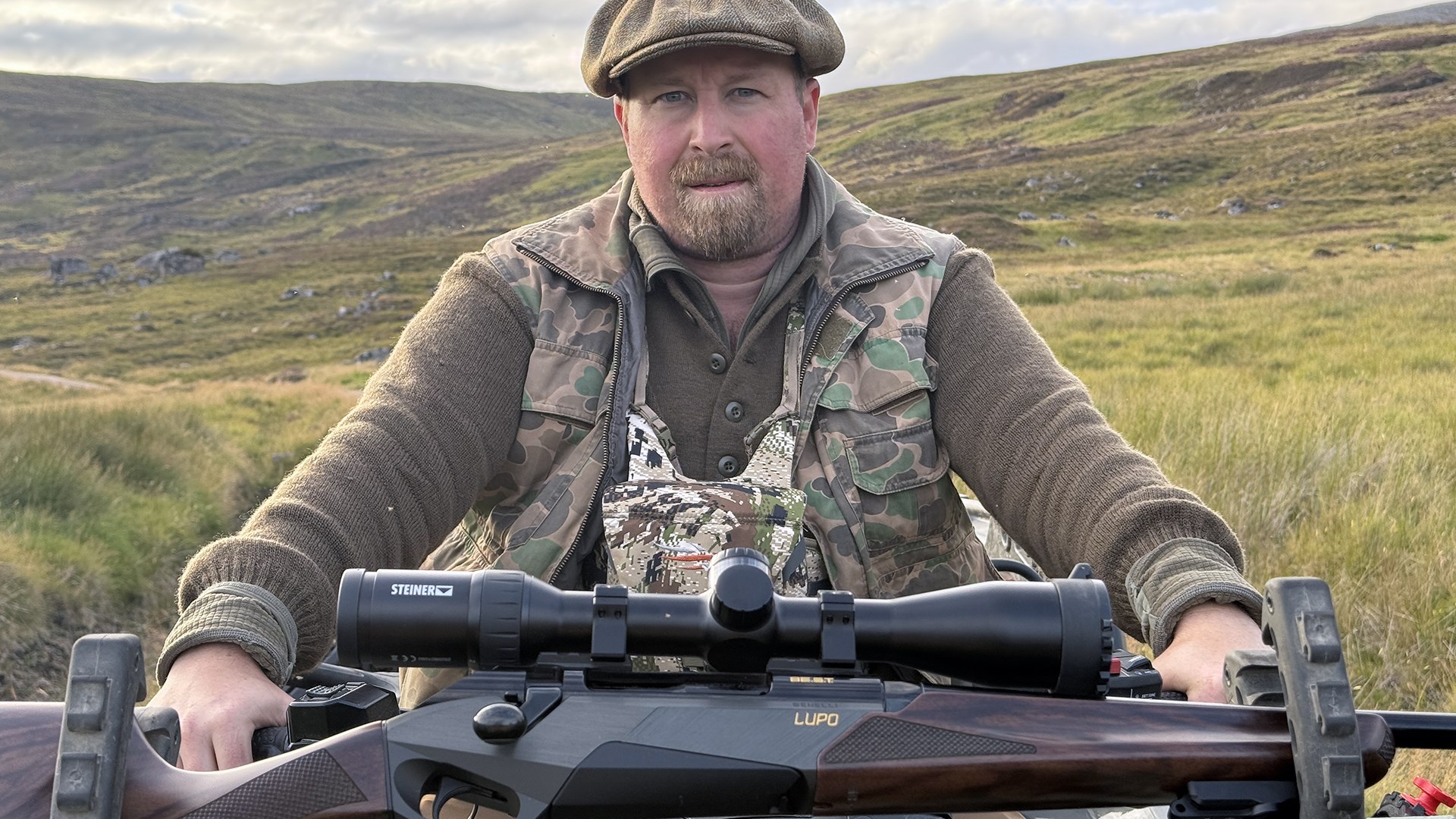
My Scotland Setup
Officially known as the BE.S.T. Lupo Walnut, this Benelli bolt action has Italian lines and American dependability. Classic and traditional with a AA-grade satin walnut stock and devoid of the molded plastic that so often adorns rifles in the field today, the Lupo Walnut sports all the modern design, ergonomics, fine craftsmanship, machining and tolerances capable this day and age.
Built on a chassis-type barreled action, the .300 Win. Mag. rifle I carried sports a 24-inch barrel, to which we threaded a monstrosity of a suppressor. I’ve proven its accuracy on the range as well as on stag in Argentina, and happily report it produces sub-1-inch groups at 100 yards. With the slightly raised comb and Benelli’s Progressive Comfort recoil system, it’s also soft on the shoulder and cheek. benelliusa.com
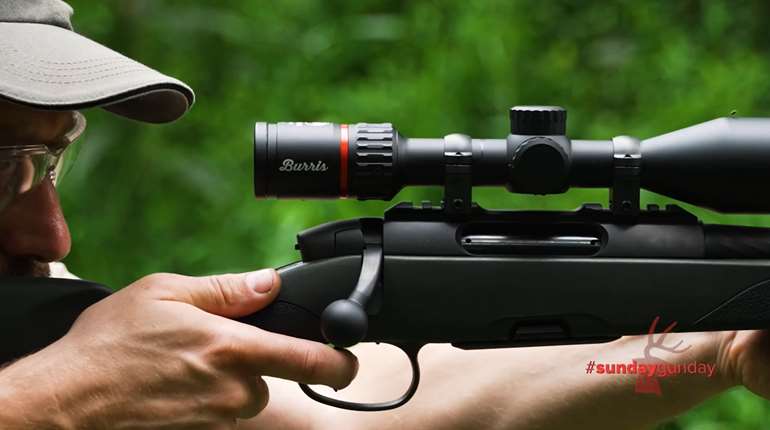
Guiding my errant round was Steiner’s Predator 8 2-16x42 riflescope, and to reiterate, my miss can’t be blamed on this optic, either. It’s got exceptional glass, a crisp illuminated reticle and a return-to-zero customizable ballistic turret. Unique in its design, the turret consists of three numbered and moveable rings the user can set to his exact ballistic range, allowing for a quick twist to dial for distance. It’s easy to set up, and even easier to use in the field. steiner-optics.com
A great addition to my rifle, the Classic Guide Adapter from Spartan Precision allowed me to instantly add or remove one of the many compatible bipods and tripods we had on hand. The three we had available were the Javelin Pro Hunt Tac bipod, the super-stable Hoplite Mini Tripod and the new and incredibly versatile SpringBok tripod. Regardless of the device you choose to run, you can be sure the Spartan Precision system will be fast to set up and provide near magic-like stability that will extend your effective range and help you deliver accurate shots on target. javelinbipod.com