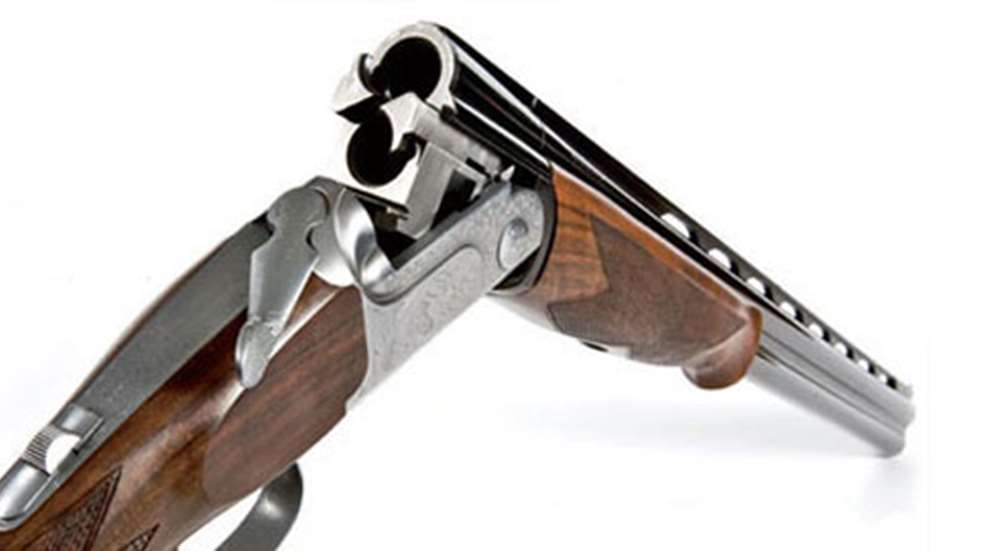
In the past few years Remington has begun naming its top-of-the-line products "Premier," and the company's new Italian-made over/under shotgun lives up to the name. Remington has developed and marketed several over/unders, including the Model 32 at the beginning of World War II and the excellent-but-heavy 3200 Field in 1977, but all of them have been discontinued for one reason or another. The Premier over/under may be the end of the rainbow the company has been seeking.
American shotgunners have enthusiastically embraced Italian over/unders for their sleek lines, low-profile actions, durability, quality of workmanship and good shooting characteristics.And, the 28-gauge has caught fire with knowledgeable upland hunters. The 28 has virtually no recoil, and the 3/4-ounce shot charge is plenty for all but wild pheasants, making it a primary gauge of choice for game-farm birds, and excellent for young shooters and ladies.
Getting the criticism out of the way first, the Premier 28-gauge weighs 6 pounds, 12 ounces, a bit on the hefty side. This is partially due to it being built on a 20-gauge action. Compare this with my AyA No. 2, built on a true 28-gauge action with 28-inch barrels that weighs a mere 5 pounds, 10 ounces and points and shoots with the best of 'em. (Of course the AyA is much more expensive than the Premier.)
Weight aside, the Premier has everything a shotgunner wants. The buttstock is of plain-but-attractive walnut with a low-luster finish that resembles traditional hand-rubbed oil. The butt carries a 3/4-inch rubber pad that, with the 28's low recoil, isn't really necessary. The grip is a well-shaped, semi-pistol style that but for a rounded bottom is a classic Prince of Wales. Applied to the grip and fore-end is excellent laser-cut checkering with a classy, checkered-diamond inset between the points. The wood-to-metal fit is quite good, with the wood standing a little above the metal.
The stock dimensions are more Italian than American, and in my view that's good. (Italian shotguns are known for owning straighter stocks, slightly higher drops at comb and about a quarter-inch of cast off.) For years I and other writers have been nagging Remington to update their 1950s-era (shorter) stock dimensions. The Premier I used had a length of pull of 14 5/16 inches; drop at comb was 19/16 inches; drop at heel measured 21 1/16; and the stock had a slight quarter-inch of cast off at the heel.
The boxlock action is finished in a silver-colored nickel enhanced with laser-engraved quail on the left side and a single woodcock on the right. The balance features rose and scroll, and the bottom of the action carries a large, gold-colored "R." The fore-end has a Schnabel tip, the purpose of which is to reinforce the thin wood at the forward end of the fore-end. I don't like Schnabels because to my eye they break a gun's sleek lines, and, because I'm tall, I like to extend my index finger out on the fore-end and the lip on the Schnabel prevents it. But other people like Schnabel fore-ends, so this is a matter of opinion.
The deeply blued, 28-inch barrels have a high ventilated rib that terminates in a Bradley-style white bead. Like most Italian shotguns, the barrels pivot on trunnions, but the lockup is allowed via a single Purdey-style under-bolt, as opposed to the more familiar Italian-style pins that lock into slots at the sides of the barrels. The ejectors, a la Boss, are integral with the barrels, with no springs and hammers in the fore-end. This style of ejector is very positive and trouble free.
The barrels are very uniform. Nine inches from the breech the bottom barrel measured .5525 inch, and the top .5530-slightly on the wide side-and when measured from the muzzle they were the same. Remington's Pro-Bore chokes are included; in all, five tubes allow the user to adapt to any situation.
The tang-mounted, automatic safety incorporates the barrel selector. From the "fire" position, push the large slide to the right to fire the lower (under) barrel first, or move the selector to the left to make the top (over) barrel fire first. I have to say I hate automatic safeties, those that when the top lever is pushed to open the action, the safety is "automatically" pushed to the safe position. This feature would drive anyone insane in an Argentine dove field or a clays course.
The trigger has a lot of preliminary take-up, which is not especially damning in a shotgun. The trigger pulls run a uniform 7 pounds for each barrel, and that is too heavy-although 7 pounds is common today, 3-4 pounds would be better. To its great credit, the Premier has a mechanical trigger that is not dependent on the firing of the first shot to set the sear for the second.
Never discount the effectiveness of the 28-gauge. I've used it on ducks and geese with bismuth shot in Canada that were within 25 yards, all with excellent results. Rolled into this new Remington package, the Premier is as pleasing to the eye as it is to shoot.