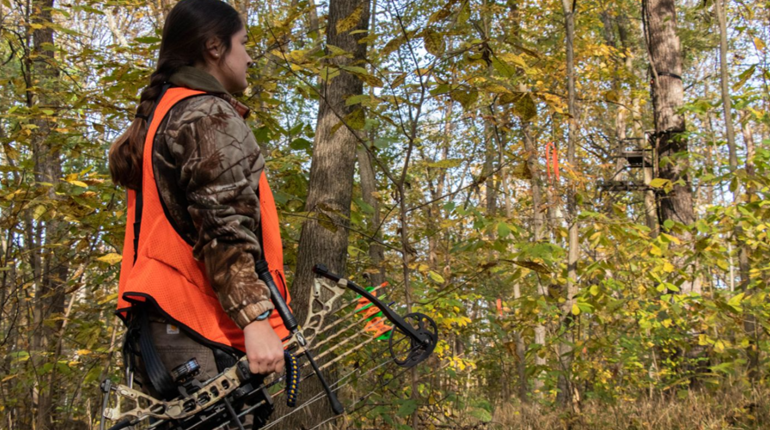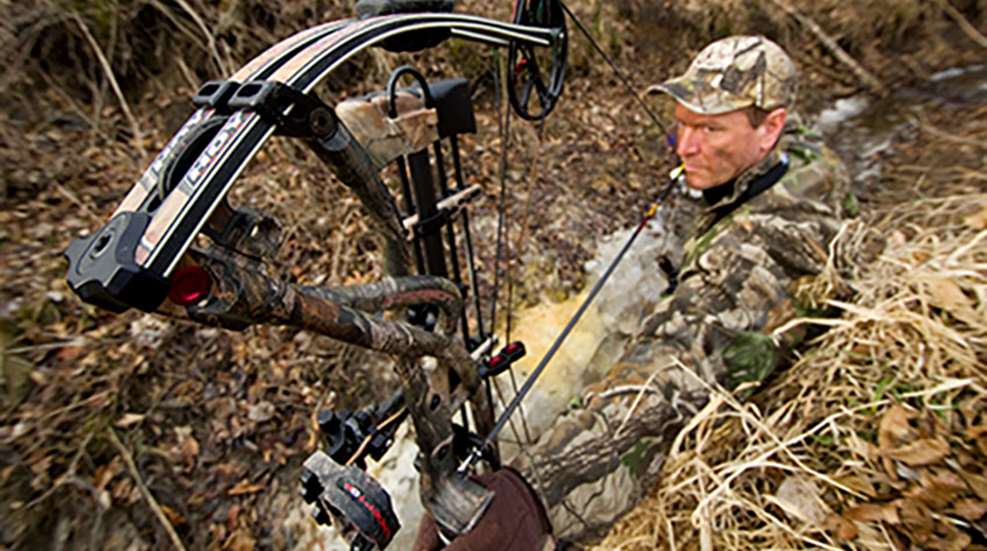
How you set up your bow and what accessories you put on it will ultimately determine how reliable it is at the moment of truth. Remember, if it can go wrong, it will. Here’s how to set up your bow so it won’t.
String
The most overlooked accessories on any bow are the string and harnesses. If they stretch, your accuracy will suffer badly. I always use the best bowstrings, like those from Fuse and Winner’s Choice.
The idea is to eliminate stretch and twist even in rain and heat. The string and harnesses are critical to an idiot-proof bow, so don’t skimp. If you find your bowstring is not of a custom caliber, take it to the shop and have them install one. As a side benefit, a no-stretch string allows you to forgo rubber tubing to align your peep sight. That’s good, because tubing often breaks.
Peep Sight
I like my quarter-inch-diameter G5 Meta Peep because the large aperture permits maximum visibility in low light and a wide field of view when timing my shots. Second, I can center my entire round pin guard within the large opening and still enjoy very precise aiming.
Sight
I use a five-pin Fuse Carbon Blade sight. You want fiber-optic pins because being able to shoot at dawn and dusk is huge. Make sure the pins are protected. Further idiot-proof your sight by reducing the number of pins. If I never shot past 40 yards, I’d have just two pins: one set for 25 yards and one set for 35 yards. Less pins means less chance for confusion during the moment of truth.
Rest
My rest is a Fuse Ultra. I love this rest because I can lock it in the upright position so my knocked arrow can’t fall off the string. I like drop-away rests because they work well with small-diameter carbon arrows and the helical offset I apply to the fletching. The drop-away rest eliminates fletching contact, allowing for easy tuning.
No Wrist Sling
I don’t use a wrist strap. It takes too long to get my hand into it when I am trying to make a quick shot. Modern bows don’t have very much forward jump during the shot.
Rest Silencers
The rest I use comes with adhesive-backed strips to silence the sound of the arrow sliding across the launchers during the draw (it is amazing how loud this can be on a crisp still morning). However, you can use moleskin from the local drug store.
Bow Silencers
You may never be able to make the bow quiet enough that a deer won’t hear it and duck the string on calm days, but with the addition of limb and string silencers you can reduce the noise so they may not hear it on windy days.
Direct Knock Point
I want to be able to hook my release to the string very quickly without looking down and I can only do that by attaching a caliper release directly to the string below the arrow (and not via a string loop). So I use two brass nocks set above the arrow and one rubber “eliminator” button below. I overwrap the portion of the serving my release head contacts to reduce wear.
Stabilizer
I don’t believe my short stabilizer makes me more accurate, but because of the rubber mounting system it eats up some vibration to make the bow slightly quieter. I will never use a stabilizer long enough to truly affect the inertia of the bow, at least not while hunting.
Release Aid
I hunt with a caliper design, like that from Scott Archery. Nothing has gone wrong with this release for 22 seasons. I set the trigger to medium tension so I can get a feel for it before it goes off when shooting with gloves.
Quiver
I use a detachable quiver so I can (and do) remove it when hunting from a treestand. I believe it’s an advantage to remove your quiver from your bow when possible because it adds wind resistance to your bow, making it harder to hold steady while aiming on a windy day.
Add some small-diameter carbon arrows and mechanical broadheads and I feel I have the ultimate setup for reliable, accurate whitetail hunting.