Tradition is a fine thing in firearm design and engineering, but so is innovation. If every gunmaker sat on its laurels, we’d still be shooting maple-and-iron flintlocks.
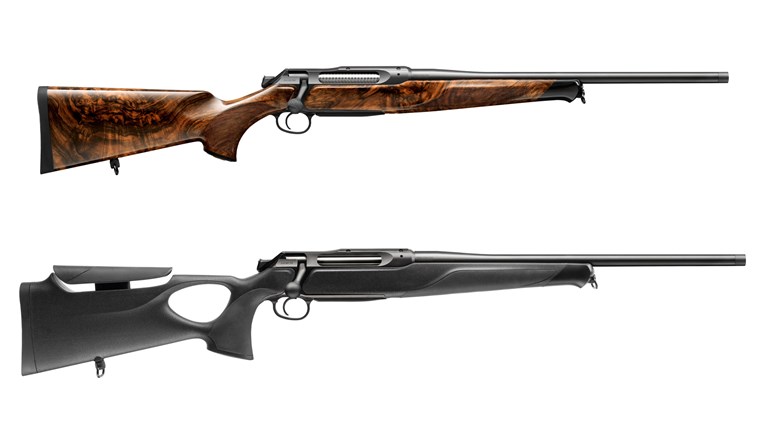
J.P. Sauer & Sohn doesn’t make flintlocks, but it does a great job of mixing the best firearm traditions with the latest, sensible technology. Founded in 1751, this German gunmaker is as relevant today as it was then. The new Sauer 100 Classic XT bolt-action is an example of the company keeping up with the times, specifically in regard to the budget-priced, general-purpose, big-game rifle.
Despite the howlings of walnut-and-blued traditionalists, synthetic-stocked rifles are swamping the marketplace. So are simple, easy-to-manufacture bolt actions that dispense with traditional designs requiring elaborate machining and multiple parts. KISS has become the motto driving today’s most popular, low-priced hunting rifles, and the Sauer 100 lands near the top of that pile. The 100 is more than an old bolt-action in a plastic stock. It has been engineered as the complete package, manufactured to combine incredible accuracy with inexpensive durability at Sauer’s lowest price point, $699 MSRP.
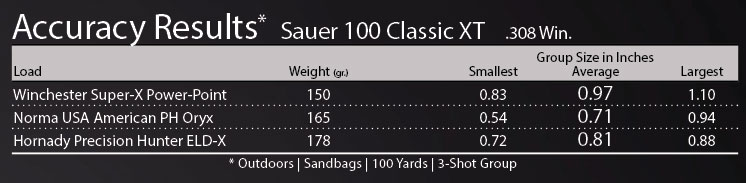
I recently tested a 100 chambered for the ubiquitous .308 Win. and found it everything Sauer promised. It shot three of Norma’s American PH 165-grain Oryx loads into .54 inch and nearly everything else sub-MOA. This, from a “price-point” rifle, required some investigation.
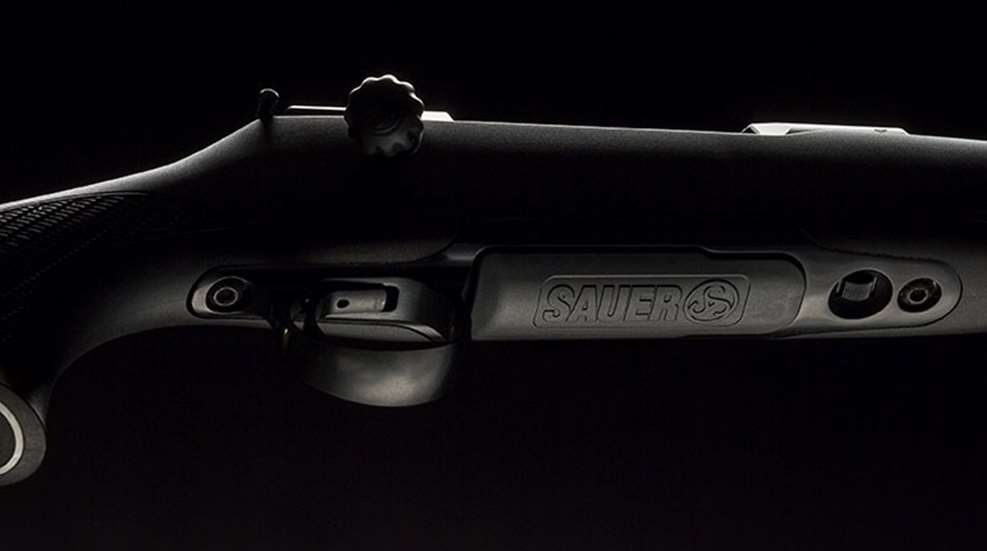
The 100’s bolt is the increasingly familiar full-diameter body fronted by three locking lugs, which gives it a quick, 60-degree lift. The bolt face is recessed with an extractor hook set in one of the lugs and twin ejector plungers in the bottom of the face. A deep, straight-line groove in the bolt body lets it ride on the bolt stop, which is pin-hinged into the left rear receiver ring for a slick, smooth, non-binding cycle. A spring-loaded release button on the exterior of the receiver ring enables quick and easy bolt removal.
Unusual in “starter” rifles is the 100’s three-position safety, located at the rear of the receiver on the right. The toggle moves straight forward like most two-position safeties. Fully back, it locks the bolt handle and blocks the mechanism from firing. Nudging it forward to the first click-stop frees the bolt but still prevents firing. Fully forward, it readies the rifle to fire. When the action is cocked, a bright red cocking indicator juts from the rear of the bolt shroud as a visual reminder.
Unlike most bolt actions, this one does not lock cartridges into battery by securing the lugs inside receiver recesses. Instead, the lug recesses are milled into the breech of the barrel, which is heat-shrunk to the receiver rather than threaded on. This will undoubtedly turn off pragmatic, do-it-yourselfers who dote on replacing worn-out barrels, but how many big-game hunters seeking budget-priced hunting rifles ever do that? Most never put more than a few hundred rounds through their deer rifles before passing them down to the next generation. The stocks usually break or wear out before the barrels.
I suspect this system of shrink-fitting the free-floating, 22-inch, cold-hammer-
forged barrel—plus locking those triple lugs into its breech—contributes to accuracy. I had no way of measuring interior bore dimensions, but I imagine them to be pretty consistent to achieve the degree of accuracy the rifle demonstrated during testing.
Then there is the 100’s unusual bedding system, which Sauer calls Ever Rest. Instead of hanging a recoil lug from the receiver or barrel, Sauer machines a lateral groove into the bottom of the front receiver ring and mates this to an aluminum block that’s bedded to the stock via epoxy. A threaded bolt protruding from the front receiver ring runs through the bedding block, and a large hex nut fastens the two. What looks like a traditional action screw through the front of the steel magazine frame merely tightens into the tension-bearing hex nut. The rear action screw secures the bottom metal/trigger guard and stock wrist to the action tang in the usual fashion. If changing its pressure alters impact or accuracy, I didn’t detect it.
As is common to all modern, budget bolt rifles, the 100 employs a polymer, detachable box magazine. This one is staggered, meaning you can top it off through the action port, and holds five rounds. The magazine slides straight in from the bottom, no rocking required, and a simple upward push of the release button frees it.
The black Ergo Max plastic stock is nicely rigid. Its molded-in “checkering” pattern has sharp edges for a good grip. Two panels on the slim fore-end and two on the grip could be a bit more extensive for my tastes. Ergonomically, stock lines are impressively effective. The semi-open pistol grip has a palmswell on both sides, and the comb nose is fluted on both sides to fit thumb pads whether you shoot right- or left-handed. The comb rises noticeably toward the rear, directing recoil into the shoulder, not the face. Felt recoil was surprisingly mild despite the hard, black rubber recoil pad. The fore-end finishes with a schnabel nose you can actually use as intended if you don’t mind gripping around the sling-swivel stud.
In the field the 100 was light, responsive and easy to handle. Function was nearly flawless except for the hard bolt lift common to three-lug designs. From the bench I found this rifle impressively accurate. One glitch was intermittent misfires with two brands of ammunition that showed light primer strikes. No other brands caused this. It suggests either a combination of minimally sized cartridges and maximum headspace, a slightly short firing pin, or perhaps a light mainspring. Sauer offered to fix this under warranty, but since it was a review rifle I was shipping back, I didn’t bother. Instead, I test-fired a few dozen rounds through a friend’s new 100 in .308 Win. It, too, shot sub-MOA but functioned perfectly with no misfires.
Overall, in fit and finish I find the Sauer 100 Classic XT at or near the top of the budget bolt-rifle class. It’s atop the price ladder, too, but if you want Sauer precision, you won’t find it for any less.
Technical Specifications:
• Type: bolt-action centerfire rifle
• Caliber: .222 Rem., .223 Rem., .243 Win., 6.5 Creedmoor, 6.5x55mm, .270 Win., .308 Win. (tested), .30-06, 8x57mm IS, 9.3x62mm, 7mm Rem. Mag., .300 Win. Mag.
• Barrel: 22"; cold-hammer-forged chrome-moly steel; 6 grooves, 1:11" RH twist
• Trigger: single-stage, user-adjustable; 2.75-lb. pull weight
• Magazine: polymer detachable box; 5-rnd. capacity
• Sights: none; receiver drilled and tapped for Remington Model 700-style bases
• Safety: three-position toggle
• Stock: black polymer Ergo Max w/Ever Rest bedding system; LOP 14.5"
• Metal Finish: blued
• Overall Length: 42"
• Weight: 6.7 lbs.
• MSRP: $699