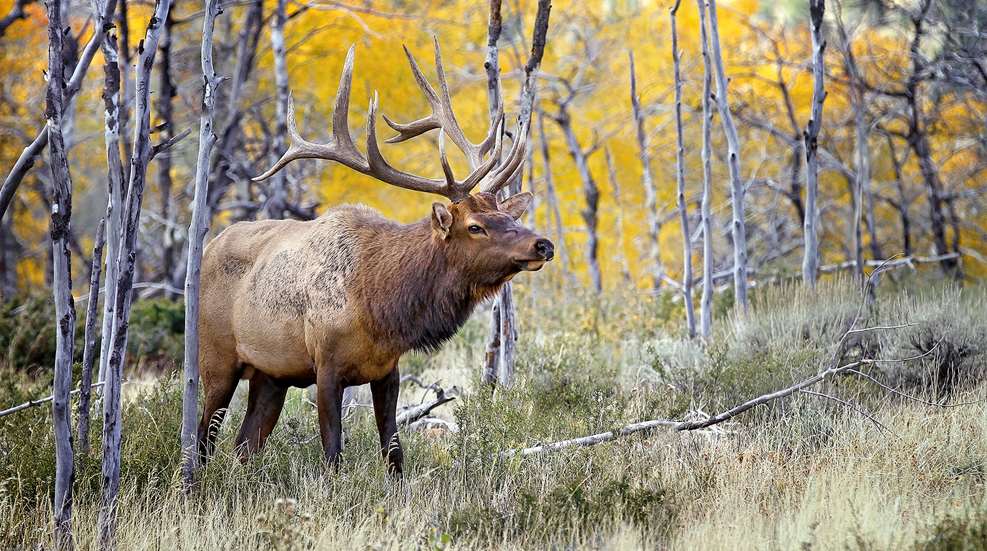
We parked the truck in the dark and guide Don “Amo” Amos led us down a narrow track into a lower valley. We heard the first bugle almost immediately, then a constant serenade of that magic mountain music as we made our way slowly in predawn blackness.
“Slowly” is the operative word. At 71, Amo is a year younger than me, tough as nails, could probably walk me to death. Oh, boy, could I feel the altitude! I could hold his gentle pace and was grateful. We’d chatted in the lodge the night before and I knew Amo had decades of experience hunting elk on this ranch. It’s a bad idea to “guide the guide,” so I kept my mouth shut. Even so, I couldn’t keep from wondering why we were bypassing all these bulls in the dark.
Amo had said: “In this area bulls tend to move downhill in the morning. Keep your mouth shut and suck in more air.” We hit bottom at the first hint of gray, set up in aspens overlooking a wallow. Bulls were still bugling all around us. To the left, to the right, straight ahead and behind us. I’m not an every-year elk hunter, but I’ve hunted elk off-and-on for 50 years, caught the bugling season several times. I’ve never sat in one spot and heard so many bugles.
Some were close. As the light grew, a bull stood on an open slope on the far side of the wallow. Nice 6-by-6. Amo dismissed him instantly; too young. Despite plaintive cow-talk, none of the bugling bulls seemed inclined to come to this wallow. Ater daylight we shifted position, up the ridge on the far side. From there we had an amazing procession of elk, bulls and cows, on a big, open ridge to our left. Most were too far; didn’t matter because Amo wasn’t interested.
By 10 o’clock activity tapered off, but there was still bugling in a brushy pocket below us. We headed that way, saw a couple more small bulls then started back toward the trail. Maybe too fast. We bumped a big cow herd, scattering them into aspens on the next ridge. In a few more steps we could see down into the valley, and Amo spotted a bull bedded by a pond.
This time he got excited. Amo was clear that he hates shooting on the first day. If a first-morning bull existed, this could be it. Massive bull, heavy with good tops. By the time I got clear and steady he was up and moving, following the cows we’d spooked. I stayed with him, 360 yards, but we couldn’t will him to stop.
Special Time in a Special Place
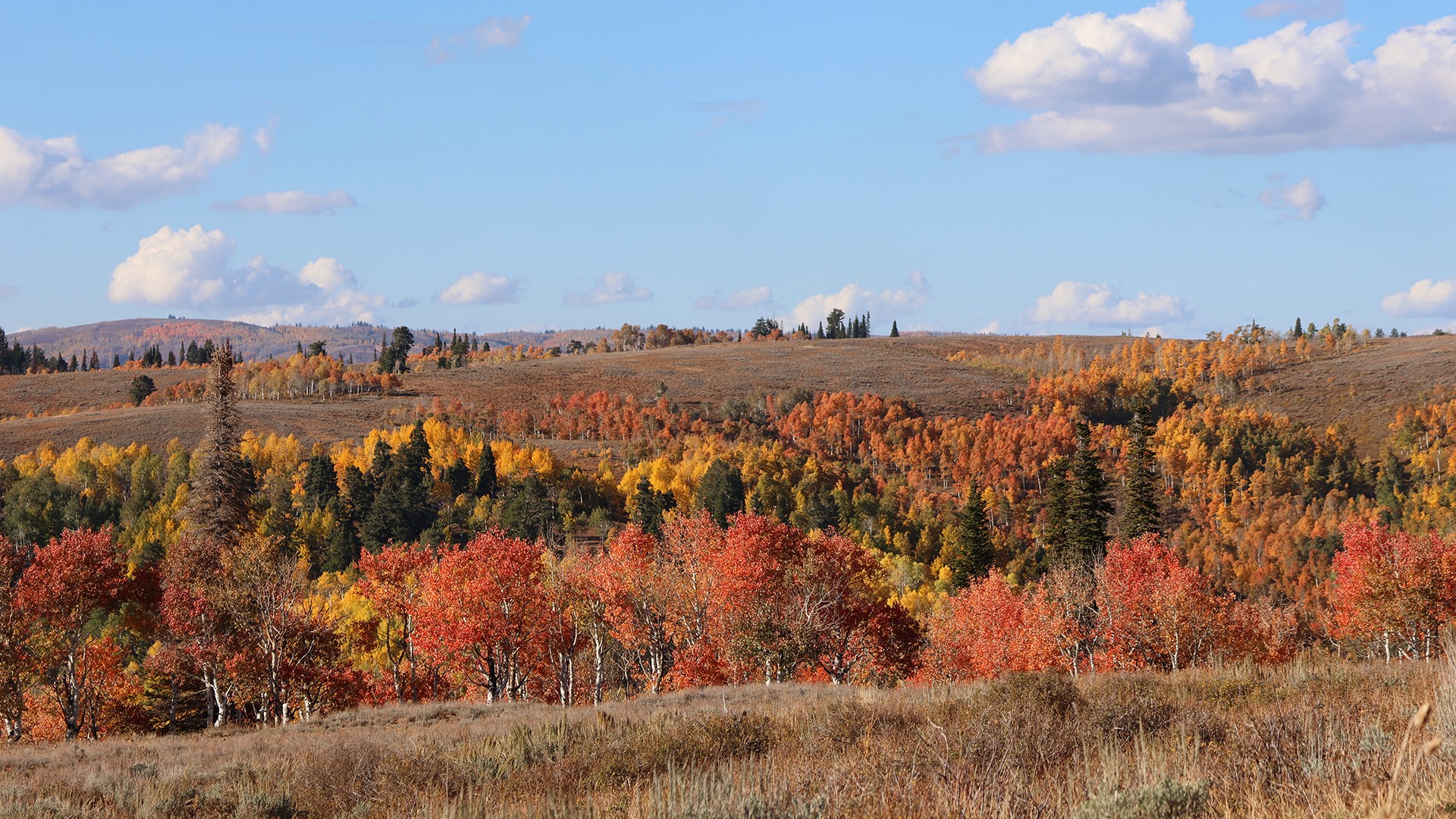
I can’t estimate how many bulls I heard that first morning, probably saw a dozen branch-antlered bulls. I hadn’t heard or seen anything like it. I was part of a large annual Hornady group, hunting with Wild Country Outfitters on a big ranch in northern Utah. Part of the group was there for elk, part for mule deer, some just to be there. It was Sept. 29 and we hit the rut near-perfect. Also, an ideal time to be in high country, aspens nearing the height of fall colors, hillsides bright with crimson and gold.
I’d never been in this area. Many in the group had hunted this ranch before, Jason Hornady since he was in college. Although I’d heard stories about this outfit, I was unprepared. I’ve hunted a lot in the West, not much in Utah, always thought of Utah as primarily a mule deer destination. There’s some truth to this. By 1900 elk were nearly gone, deer scarce, and hunting was closed between 1908 and 1913. Between 1912 and 1925 Yellowstone elk were introduced. They prospered and regained ground quickly; elk seasons held since 1935.
Mule deer numbers climb in good years, fluctuate with bad winters and drought. Right now, Utah’s mule deer herd is estimated at about 300,000, a big number, but well below management goals. Utah’s elk are estimated at 83,000. Also a big number, but behind Colorado, Montana, New Mexico, Oregon and Wyoming in total herd. However, most of Utah’s elk are in the north, much of southern Utah too arid. Utah’s elk are thus concentrated in a smaller area than the states with larger herds.
To some extent, this accounts for all the elk I saw (and heard) that first morning. It’s not that simple. The ranch we were hunting, more than 200,000 acres, offers ideal habitat, rolling ridges with well-watered valleys. Tough winters and periodic drought have impact, but this ranch has managed their elk—and their harvest—for 40 years. The bull/cow ratio is estimated at an amazing 90 bulls per 100 cows, accomplished through landowner and draw tags, with an aggressive cow quota.
A Tall Order
Like I said, this was a longstanding annual Hornady group: distributors, Hornady folks, family friends. Wild Country’s lodge was huge and sprawling, new and comfortable, plenty of room and great food. Having not been there before, the size of the group surprised me. As a small-time outfitter for my Kansas whitetails, the logistical challenges shocked me. On this hunt, there were 11 elk hunters, 10 mule deer hunters … and another dozen folks not hunting. Plenty of country, plenty of game, lots of beds and grub. Still, that’s a lot of guides and hunters, and serious coordination to ensure groups didn’t bump into each other.
Amazingly, the hunt was seamless. I don’t think I’ve seen such a big group in a hunting camp since the 1980s, when larger firearm manufacturers still held big annual seminars. I’m not a pessimist, but the night before the hunt, as we gathered around long tables, I was thinking: This is a tall order! Of course, I hadn’t seen the ranch. Most of the group had, whether for pronghorn, deer or elk. Nobody was concerned; nothing but excitement and anticipation.
Wild Country’s Tyson Land gave us a briefing: safety, rules of the road, a bit about the country … and what we were looking for. The watchword was “mature” bucks and bulls. Naturally, there were huge elk and massive mule deer mounts displayed in the lodge. Through decades of hunting, giants have been taken here.
Despite the size of the bull herd, northern Utah isn’t famous for monster, record-class bulls. Instead, we were looking for bulls in the 6-year class or older. At our guides’ direction, we would pass younger bulls and keep looking. Our editor and my friend Scott Olmsted took a 360-inch bull on this ranch a few seasons back. That’s a giant elk, just 4 percent off the Boone & Crockett all-time typical minimum. Maybe a good year, maybe good fortune, likely both. Tyson’s briefing, and Wild Country’s website were clear and accurate. Both suggested we could expect mature bulls from about 310 to 340, year-to-year average about 315.
I hate today’s increased emphasis on inches of antler or horn. Just seeing that country in autumn splendor and hearing all those bulls should be exciting enough. However, it’s good to know what you’re looking for: what you should pass … and what you’re unlikely to see. We were looking for good, solid bulls. And we found them. Most were 6-by-6’s. A couple had kickers and, inevitably during the rut, there were broken points. All had heavy beams, and good body condition.
The ranch has produced many monster mule deer. However, mule deer are more fragile, and this mule deer herd competes with a large elk herd. Bumming around the ranch after I took my bull, we saw a lot of mule deer out in sagebrush pockets with pronghorns, also a lot of mule deer up high. However, I saw more elk than deer, in part because I was looking for elk, also because mule deer are more solitary in the early fall. A recent bad winter hurt the mule deer, especially older age classes.
Even so, the rules are the same: Only older, grown-up bucks are targeted. The mule deer taken were all mature, heavy-antlered bucks. One awesome over-the-hill 3-by-3 buck, mostly nice 4-by-4’s. The largest typical looked like 190 to me—which is a giant—but in general 2025 wasn’t the year for monster mule deer in this area.
At the Range
Wild Country had a sight-in range set up near the lodge, paper and steel to 300 yards. So, on arrival, in groups and pairs, we headed out to check our rifles. A good thing, never to be taken for granted. In my case, a very good thing. For the first time since I’ve owned it, my 7 PRC was out of zero, 4 inches low and a bit left. Inexplainable, but we can’t know what the airlines do with our gun cases. Easily corrected. Glad I checked!
It was a younger group. In fact, at 72, I was the oldest person in camp. I was young when I got into this business. For years I was often the youngest guy in camp; feels odd to have this reversed. I gathered that many of these hunters participate in Precision Rifle competition. In fact, Hornady’s Neil Davies, Jens Tigges from Germany, and others, were going straight from the hunt to a PRS match. I was curious to see the rifles this group brought.
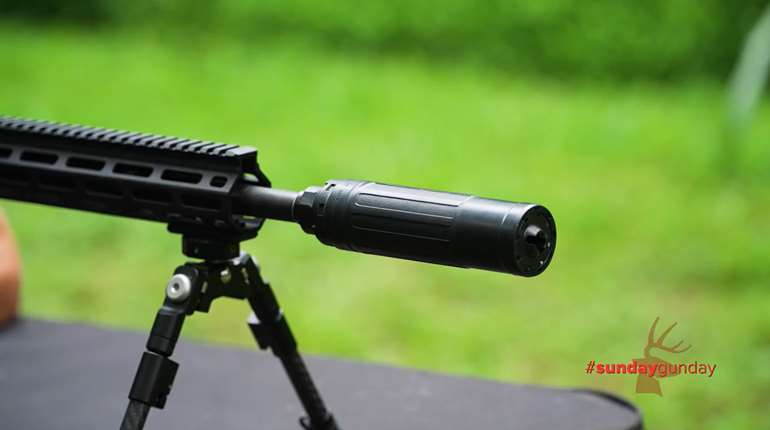
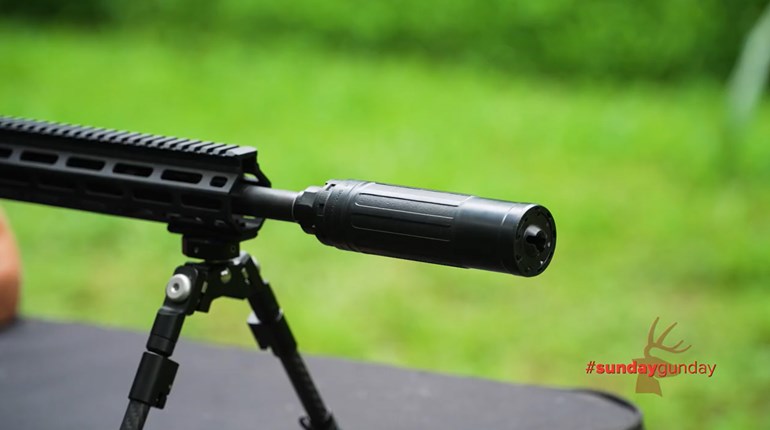
On the range, I was struck by how many of our group were using suppressors, easily the majority. Long a California resident, where we can’t have them, this is a mindset change for me. When Charlie Barnes at Flat Creek Precision built my 7 PRC, I didn’t have him thread the barrel. That was a mistake. Now a Kansas resident, I’m using suppressors more. And loving them for hunting because of reduced disturbance to game.
Since it was a Hornady group, it was no surprise that everyone was shooting Hornady bullets, mostly ELD-X, some CX (hornady.com). Cartridges, well, Hornady loads a bunch of them in Grand Island and everyone had their choice. Preferences were probably skewed because this was a PRS-heavy crowd. Among the 11 elk hunters, one hunter brought a pet .280 Remington; one .300 PRC, couple of .300 Win Mags … and an amazing seven 7mm PRCs. This group took elk seriously and planned to use enough gun! In my 7 PRC, I was using a 175-grain ELD-X handloaded with 66 grains RL26, chronographed at 3000 fps in my barrel. I didn’t pay close attention to the deer hunters, but they used a wider array of cartridges. Multiple 6.5 PRCs and Creedmoors, at least one .308, all good deer cartridges.
My Bull Broke the Rule
At the pre-hunt briefing, Tyson Land had told us that, on this early bugling hunt, they liked to hike down the ridges and hunt wallows in the bottoms, as we did that first morning. Jason Hornady offered a caution: “Before you drop down into a hole, remember you’ll have to climb back out of it.”
I was remembering that as Amo led us steadily up a long, tall ridge, me gasping for thin air. We got halfway up before full dark, the rest of the way with headlamps. Seemed farther than it was because I’d shot, felt sure of the shot, but we hadn’t found my bull. We’d have to come back in the morning. Made it in an extra-long walk, and I knew I had a long, sleepless night ahead.
Early that afternoon, Amo had led me down that ridge, Neil Davies and Dallas Miller along for moral support. Or, just maybe, to help me get out of that hole. Elk bugled the whole way, and we saw several small bulls in the aspens. We set up in another of Amo’s favorite spots, two-thirds to the bottom, overlooking a small pond 250 yards below us, deep wallow beyond.
It was still early when a nice 6-by-6 came to the pond. Amo’s judgment: “Needs another year.” I put the long lens on, grabbed some pictures while the bull bugled several times then moved on. It was soon replaced by a similar bull on the far ridge. Some experienced elk hunters maintain they can tell an older bull by the deeper tone of his bugle. Mostly tone-deaf, I make no such claim. A half-hour later, farther down that same ridge, a deep-throated bull started screaming up in the aspens, coming our way.
A half-dozen cows trickled out of golden aspens, spread out above the wallow, followed by the bull. Big fronts, good mass, decent points. Amo said, “That’s a mature bull. You can take him if you like.” Looked like a no-brainer to me.
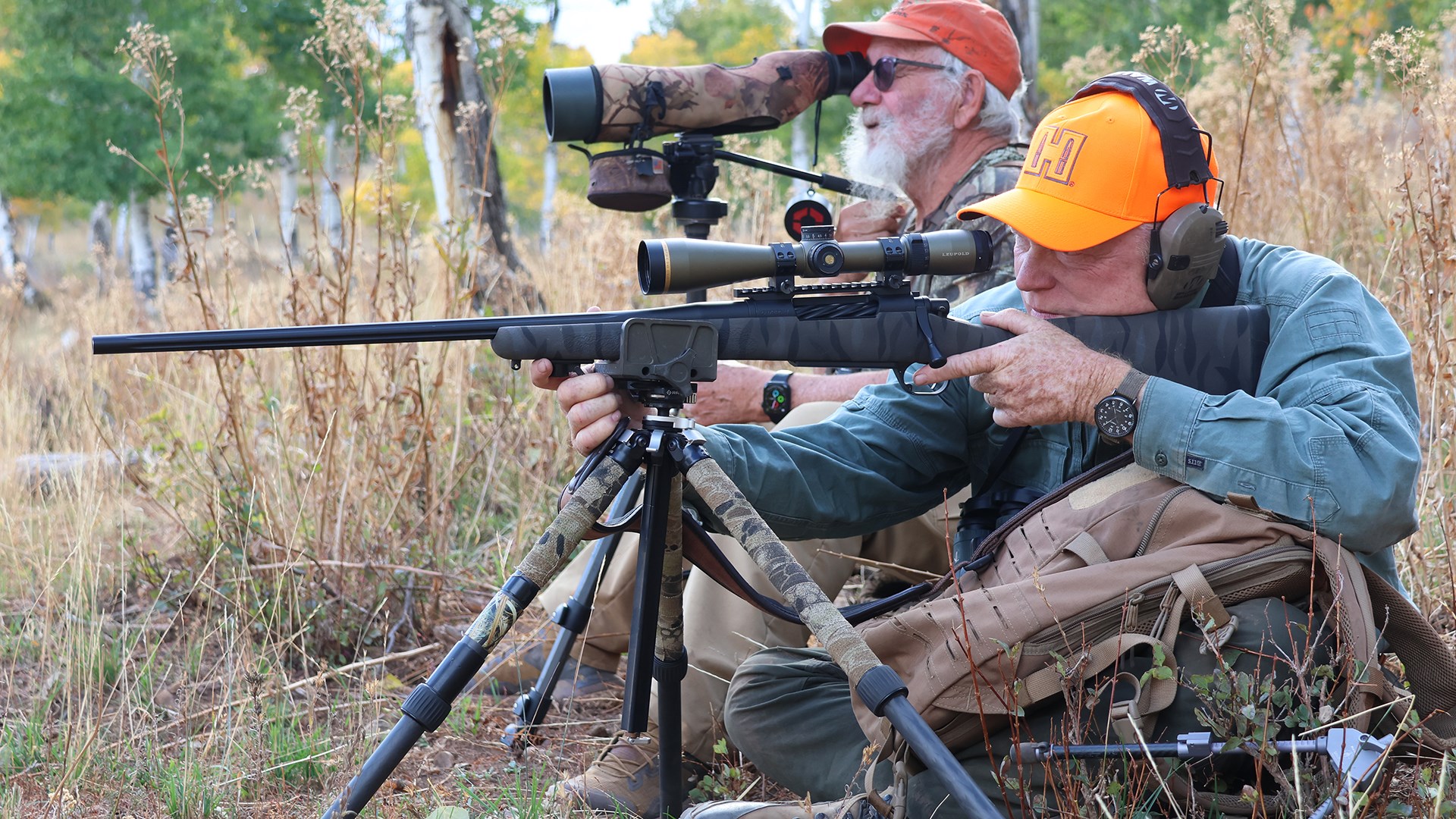
The bull passed his cows and stepped into the wallow, hidden by the near bank. Just over 300 yards. With the bull out of sight, I had time to get this right. Neil handed me his tripod. I sat behind it, adjusted the height, snuggled my backpack into my lap to steady my shooting elbow.
Mud gleaming on his flanks, the bull stepped across the wallow and stood against the far bank. He faced away for long seconds, then turned and offered a quartering shot. I waited, hoping he’d turn broadside, realized it might get worse: Cows close by but clear, big conifers just above the wallow. I held a few inches high for distance, was certain I had the off-shoulder centered when the trigger broke.
We heard the bullet hit. The bull wheeled into high gear, across the wallow and down into the V of the cut. I got the bolt worked but he was gone before I could catch up.
Neil had videoed the shot. Definite hit, well back but looked like the angle was correct. We figured we’d find him piled up just out of sight. Still early, we gave it a half-hour before we went down. Big trail in the bottom, too many tracks … and not a drop of blood. Everyone knows that hit animals go downhill, so he must have gone down the cut. We followed it down until it joined a larger stream in the bottom. Nothing. So we went back and started over, now checking uphill trails left and right of the wallow.
Still nothing. Light fading fast, no choice but to make that long uphill hike. It could have been a much longer night. Thanks to modern magic, we blew up Neil’s video and could see my bullet exiting, seemingly from the off-shoulder, plunking into the mud. Hit like that, he had to be there; we must have walked past him.
At daybreak we started again with the obvious. Downhill. He must have gone downhill. Still nothing so we expanded the search. Then back to the beginning, intending to comb thick stuff on the far side just down from the wallow. Dallas took bottom, I took center. Amo went higher and he called out a minute later.
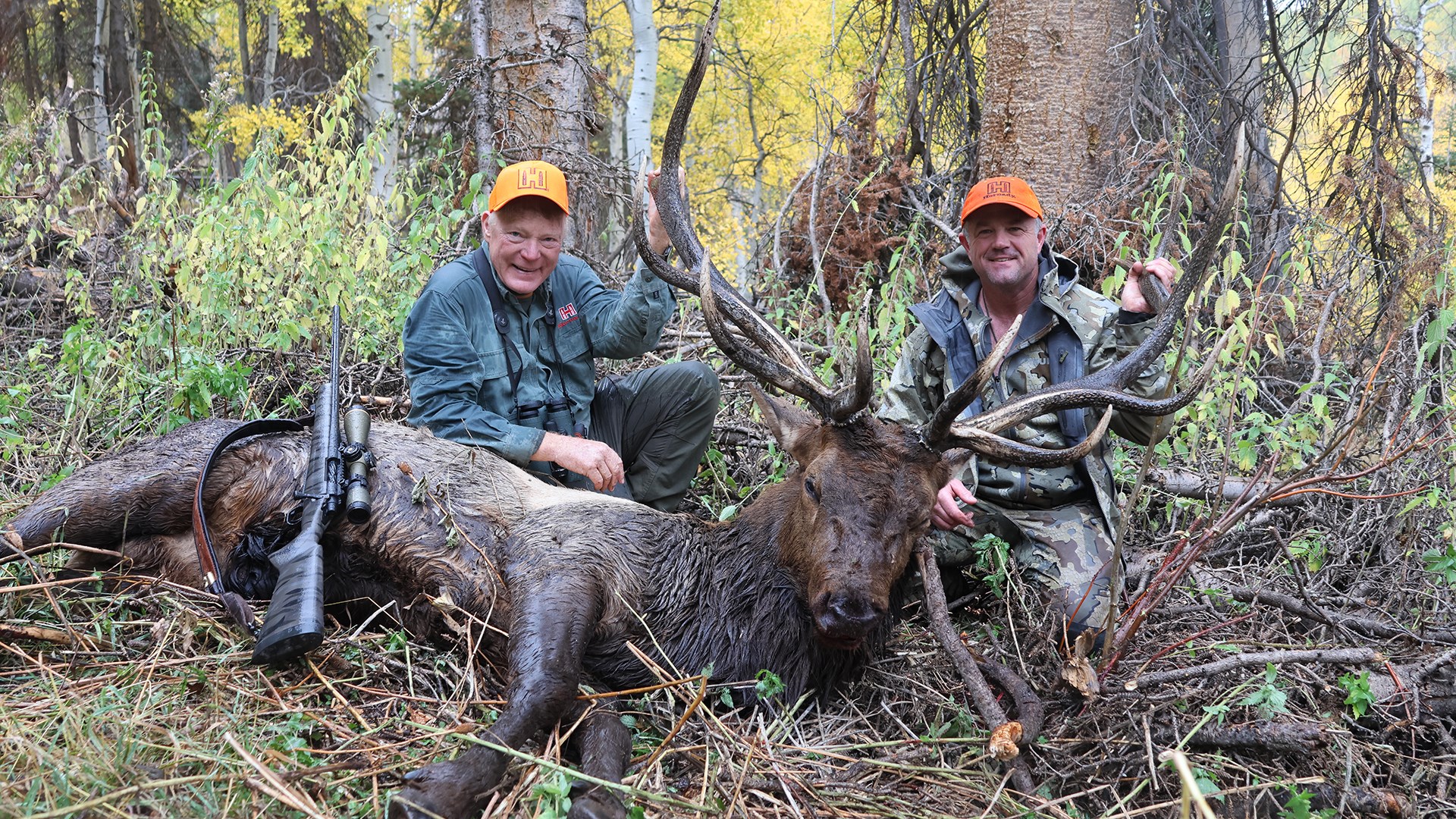
The bull had gone about 40 yards downhill under a full head of steam, somehow turned uphill, then nose-dived into the first deadfall, down before he started to bleed. Barely 60 yards from the wallow, tough to see unless right on top of him. We’d been within 20 yards of him the night before, again an hour earlier.
Full Camp
Elk hunting is tough. So is modern mule deer hunting. Both are weather-dependent and, since both species change habitat with the seasons, conditions miles away matter. I took my first elk, a young 5-point, in southwest Montana in 1972. From then on, I hunted them a lot in the ’80s and ’90s. Public land and private, guided, unguided. I’ve taken nice bulls and not so nice, never a giant. I’ve also been beaten many times. Getting beat is part and parcel to Western hunting.
During the pandemic, I realized it had been too long since I’d hunted elk, better do it while I still can. In ’23, I hunted Colorado’s last season. Unseasonably warm, no snow up high. Six of us in camp, some with both elk and deer tags. Good place, good people. No shots fired, nobody’s fault. I’ve been in other camps where all hunters filled. One such was the bugle-season elk hunt on Philmont Scout Ranch in ’24. Nine hunters took nine nice bulls. This is so rare. Even in a great place at the right time, at least one hunter in any group usually gets the neck of the chicken.
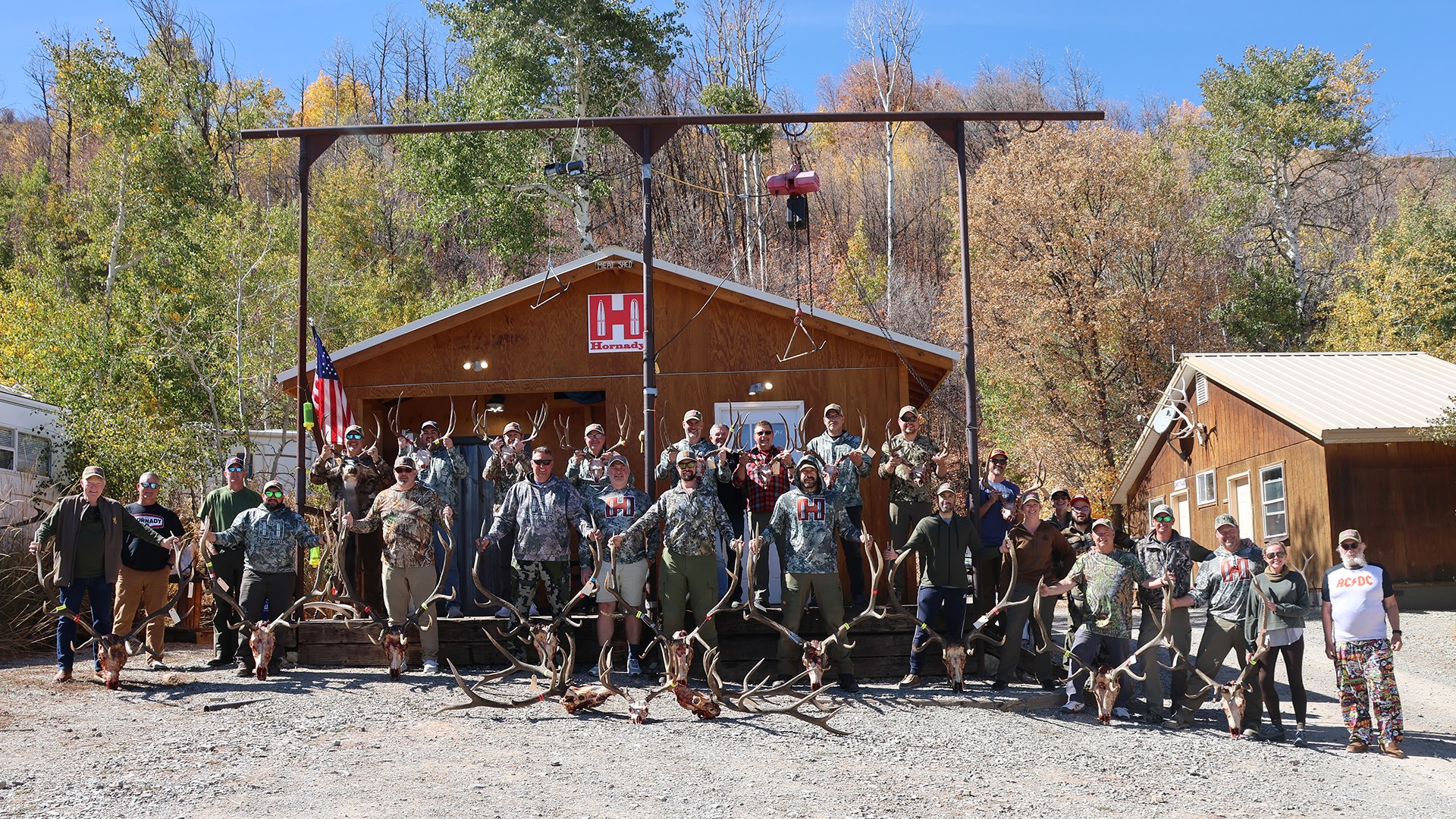
I’ve chewed my share of chicken necks, which is why, as I looked around the dining room that first night in Utah, I figured this was a tall order. First day was slow. Hunters who had been there before knew there was no rush. I didn’t know that, but I’d done enough elk hunting to know I wasn’t going to pass that bull if Amo gave the go-ahead. Things picked up the second day, and by the end of the third day we had 11 good bulls in the skinning shed. Mine wasn’t the biggest, short of the smallest. Most in the same class; if several of them stood side-by-side, which one to pick would be tough.
Except for the last bull, suggesting holding out can pay. It was taken by my friend David Miles of Baron Engraving, his first elk and with extra-long points, a cut above, into the low 350s.
In this year, and with weather still mild, the mule deer hunters had it tougher. Numerous bucks passed, lots of looking for a year older, a little more mass or another point. On the last evening, we still needed three mule deer … and the Wild Country team came through, last buck at sunset. No giants, but three more good, mature bucks. Whole camp filled out. I doubt I’ll ever be in another Western hunting camp like that.
The author is about to drop the hammer on his bull at 305 yards. Sitting over a tripod or bipod, with a pack pulled in tight to your support side to steady your “chicken wing”—this is a great position to wring the most accuracy from your rifle.
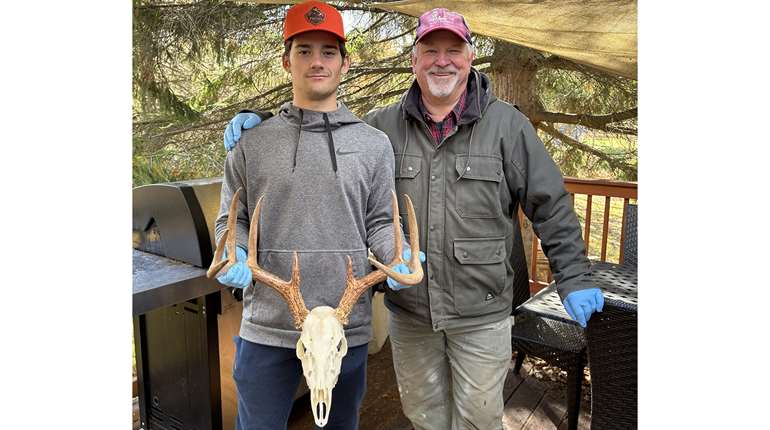
The author and Hornady’s Neil Davies are all smiles after finding Boddington’s bull the morning after he shot it with a175-grain ELD-X from his Flat Creek Precision 7 PRC. After 21 hunters tagged out on elk and mule deer, the entire camp smiled.